Звёздный кокон для красной точки экспресс
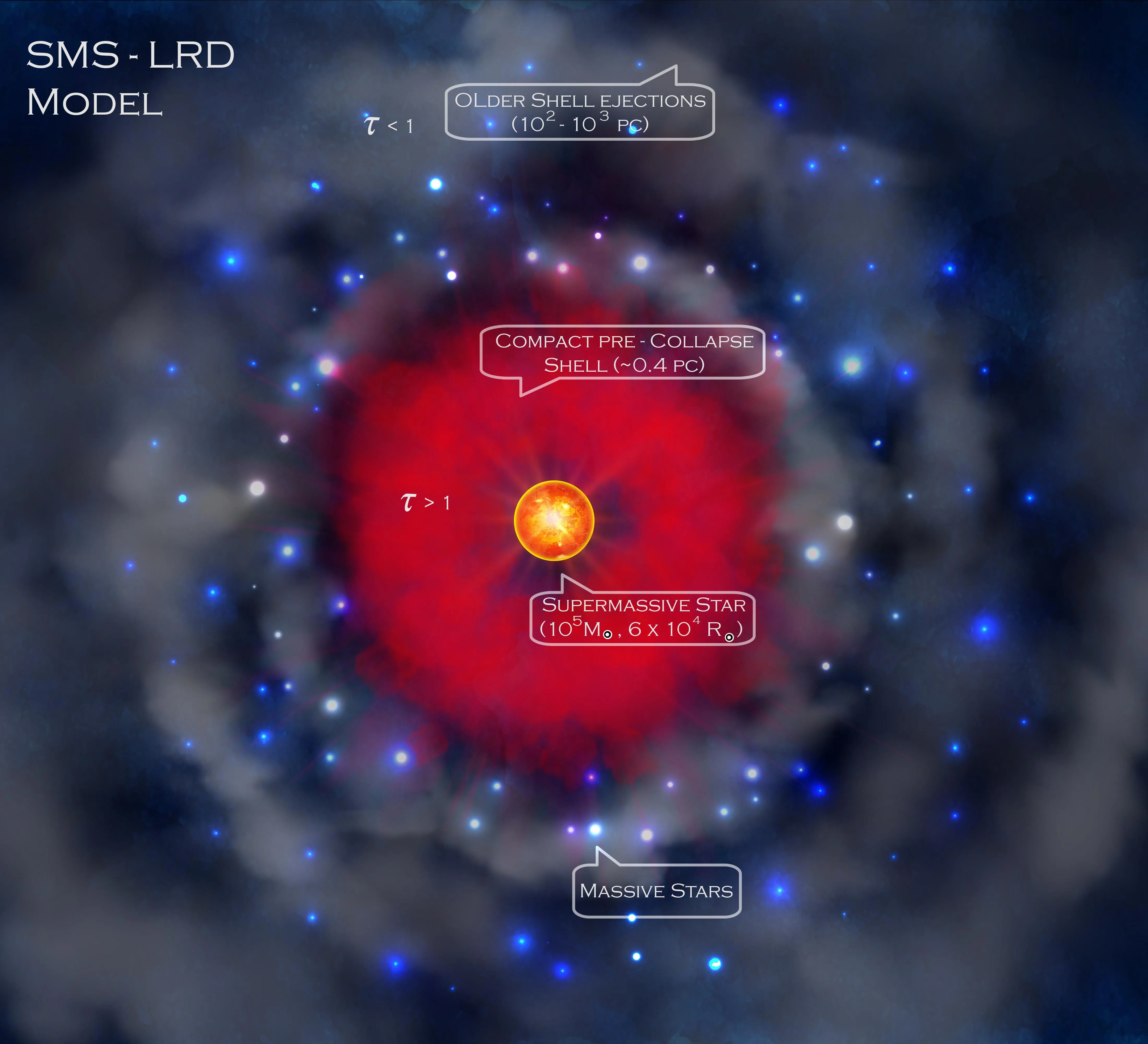
Звезда весом в сто тысяч солнц живёт ярко и недолго. Финал её — стремительное сжатие в чёрную дыру. Но перед самым концом она успевает окутаться плотным газовым коконом. Именно такие коконы телескоп Джеймса Уэбба различает вокруг загадочных объектов — «маленьких красных точек».
Астрономы взяли пять моделей сверхмассивных звёзд разного состава и шаг за шагом проследили их жизнь. Выяснилось, что звезда теряет массу не ровным потоком, а резкими толчками — словно паровой котёл, который время от времени выпускает струи пара. В одной из моделей, наиболее близкой к условиям ранней Вселенной, случилось четыре таких эпизода. Каждый длился от сорока до трёхсот лет и выбрасывал от десяти до трёхсот пятидесяти солнечных масс газа.
Этот газовый кокон сложен в основном из водорода и гелия, но с химической особенностью: азота в нём необычно много по сравнению с кислородом. Такая метка поможет отличить этот механизм от других. Сама звезда после сброса оболочки живёт ещё около миллиона лет, а потом за считанные часы схлопывается в чёрную дыру — готовое «семя» для будущих гигантов в центрах галактик.
Оригинальная аннотация
как её написали авторы, на английском arXiv:2604.19988
Little Red Dots (LRDs) have emerged as one of the central puzzles of the JWST era. Their spectra increasingly require dense gas close to the source, yet the physical origin of that cocoon-like structure remains unclear. We examine whether late pulsational mass loss from supermassive stars (SMS)leads to dense gas cocoons. We analyze five accreting GENEC models at different metallicities with characteristic masses of order $$10^5\,M_\odot$$, following them through post-accretion evolution with radial pulsation calculations and general relativistic (GR) stability diagnostics. Mass loss during the final stages of evolution occurs not as a steady wind, but through discrete strange-mode ejection episodes. In the $$Z=10^{-2}\,Z_\odot$$ model, which provides the clearest LRD analogue, four late episodes last $$41$$--$$282$$ yr and eject $$10$$--$$348\,M_\odot$$ each, for a total loss of $$(4.8-10)\times10^2\,M_\odot$$; the final episode alone contributes $$\simeq 73\%$$ of that budget. Since the last episode dominates the mass-loss, it is the only event sufficiently massive enough to leave behind a compact, optically thick shell extending out to 0.4 pc that reproduces the LRD dense gas cocoon. The final ejecta are H/He dominated but chemically distinctive, with a robust nitrogen-rich composition, $$\log(\mathrm{N/O})\simeq0.13$$ and $$\log(\mathrm{C/O})\simeq-0.23$$. The SMS reaches GR instability at an age of $$\sim 1$$ Myr and collapses in $$\sim10^4$$ s, retaining $$\sim 99\%$$ all of its mass. Across the full metallicity range from Pop III to $$10^{-2}\,Z_\odot$$, this shell-ejection channel persists. Pulsational mass-loss from SMSs therefore provides a physically motivated origin for the compact cocoon-like structure implied by LRDs, while remaining the natural progenitors of the massive black hole seeds invoked in direct collapse scenario.
Последний выброс газа у сверхмассивной звезды длится меньше трёхсот лет — по космическим меркам это короче, чем одно мгновение.
В романе Артура Кларка «Свидание с Рамой» человечество встречает гигантский инопланетный корабль, похожий на плотный кокон, — чем не красная точка, прошедшая через горнило звёздной эволюции?