Abraham Loeb

11 articles · 25 co-authors · latest: 2026-07-27
23 citations · h-index 2 · 11 papersData: Semantic Scholar

We have retold 11 papers by this author. 3 of them with a full read. most often about: primordial black hole, Hawking radiation, black hole merger. 25 co-authors across our retellings.

Links in the knowledge graph
General Relativity2025-11-071 minarXiv:2511.04895express
Primordial Black Holes as Dark Matter Candidates: Detection Methods
The Universe is filled with invisible mass, dark matter, which reveals itself only through gravity. One hypothesis suggests that dark matter consists of primordial black holes — objects formed in the extreme conditions just after the Big Bang.
Stellar2026-01-091 minarXiv:2601.05774express
The Quiet Death of a Star
In 2014, astronomers spotted a massive yellow star in the Andromeda galaxy. By 2022, it had vanished without a trace — without the usual blinding explosion of a supernova. It was as if someone simply switched off the light.
Exoplanets2026-01-151 minarXiv:2601.10860express
Tumbling Comet: How an Icy Visitor Spins After Its Solar Encounter
An icy chunk the size of a small town hurtles through space. As it approaches the Sun, the ice starts to vaporize, and jets of gas and dust burst from the comet. These jets act like tiny rocket engines: they push the comet and make it spin. That's exactly what astronomers observed with comet 3I/ATLAS after it rounded the Sun.
Stellar2026-02-142 minarXiv:2602.13875express
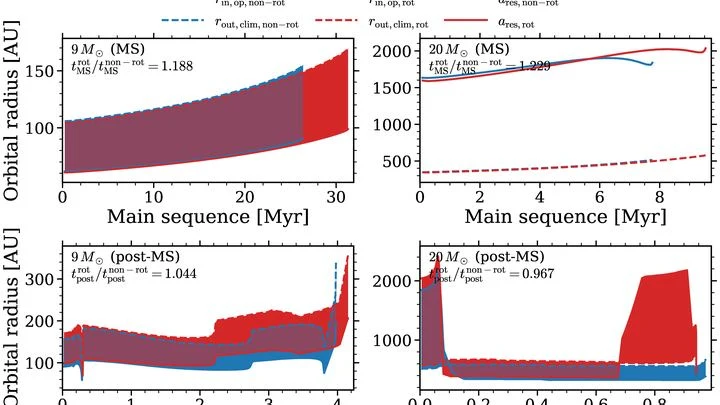
Planets Around Giant Stars: Life on a Short Leash
A star nine times heavier than the Sun ignites a zone around it where liquid water could slosh on a planet's surface. But this zone is like a narrow strip of beach at low tide: it will vanish in 30 million years. Such stars live bright and die young, leaving life no time for the long journey from microbes to complex beings.
High Energy2026-04-211 minarXiv:2604.19988express
A Stellar Cocoon for the Little Red Dots
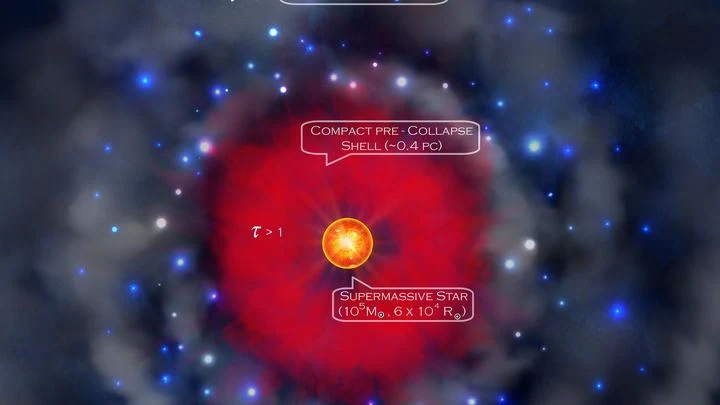
A star weighing a hundred thousand Suns lives bright and brief. Its finale is a rapid collapse into a black hole. But just before the end, it manages to wrap itself in a dense gas cocoon.
Popular Physics2026-04-211 minarXiv:2604.20896express
The Loeb Scale: When a Strange Rock Isn’t Just a Rock
Astronomers occasionally spot interstellar objects — rocky chunks or comets from other star systems. Most look ordinary, but some puzzle us with their shape, speed, or shine. To stop guessing, scientists applied the Loeb scale: from 0 (plain rock) to 5 (technosignature — an artificial signal from space).
The Funeral March of Negative Mass: Why LIGO Doesn't Hear Anti-Chirps
Imagine an orchestra tuning up: the violins rise in pitch: that's the familiar 'chirp' of black hole mergers in LIGO detectors. Now picture a funeral march: a sound that descends, like a fading siren. That's exactly the gravitational-wave signature a system with one negative mass should leave.
Exoplanets2026-05-312 minarXiv:2606.01288express
Spacecraft disguised as a dark comet
In July 1988, the automatic station Phobos 1 lifted off from Earth. Its target was Mars and its mysterious moon, Phobos. Two months after launch, an incorrect command was sent, communication was lost, and the probe fell silent forever. Since then, it was considered lost. Decades later, astronomers spotted a strange object—1998 KY26.
Interstellar Wanderer with a Polar Orbit
On April 1, 2026, satellites recorded a bright fireball blazing in the sky over the South Atlantic. Photometric tracking satellites detected the entry and demise of the object at an altitude of 90.5 km. An ordinary asteroid? No. Astronomers recalculated the velocity vector into the heliocentric system — and gasped: 51.73 km/s.
Exoplanets2026-06-301 minarXiv:2607.00202express
Can life travel between stars on icy comets?
Tiny seeds of life can cross the black void on icy wanderers like comet 3I/ATLAS. The James Webb Space Telescope found water and methane on it for the first time, and light analysis revealed an unusual gas composition.
Galaxies without dark matter: a sieve for the invisible
In the galaxy NGC 1052 DF2, stars move at only 8 kilometers per second, as if there were no invisible mass around. For comparison: in our Milky Way, outlying stars accelerate to 200 kilometers per second, held by a massive dark matter halo.