A massive galaxy cluster acts as a giant lens. Its gravity warps the fabric of space, and the light of distant objects, bending around this curvature, is amplified and split into multiple images.
Thanks to gravitational lens — an effect predicted by Fritz Zwicky, where a galaxy cluster acts like a magnifying glass — the James Webb Space Telescope spotted two red dots in a galaxy 800 million years after the Big Bang.
A quasar is a supermassive black hole at the center of a galaxy that devours matter and shines brighter than all the stars around it. Some of that energy goes into radio emission, which, it was thought, could heat or expel cold gas — the raw material for new stars.
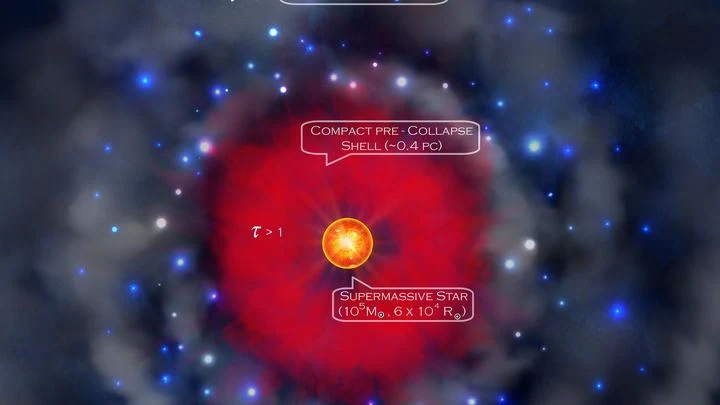
A star weighing a hundred thousand Suns lives bright and brief. Its finale is a rapid collapse into a black hole. But just before the end, it manages to wrap itself in a dense gas cocoon.