الثقب الأسود قد يتحول إلى ثقب دودي سريع
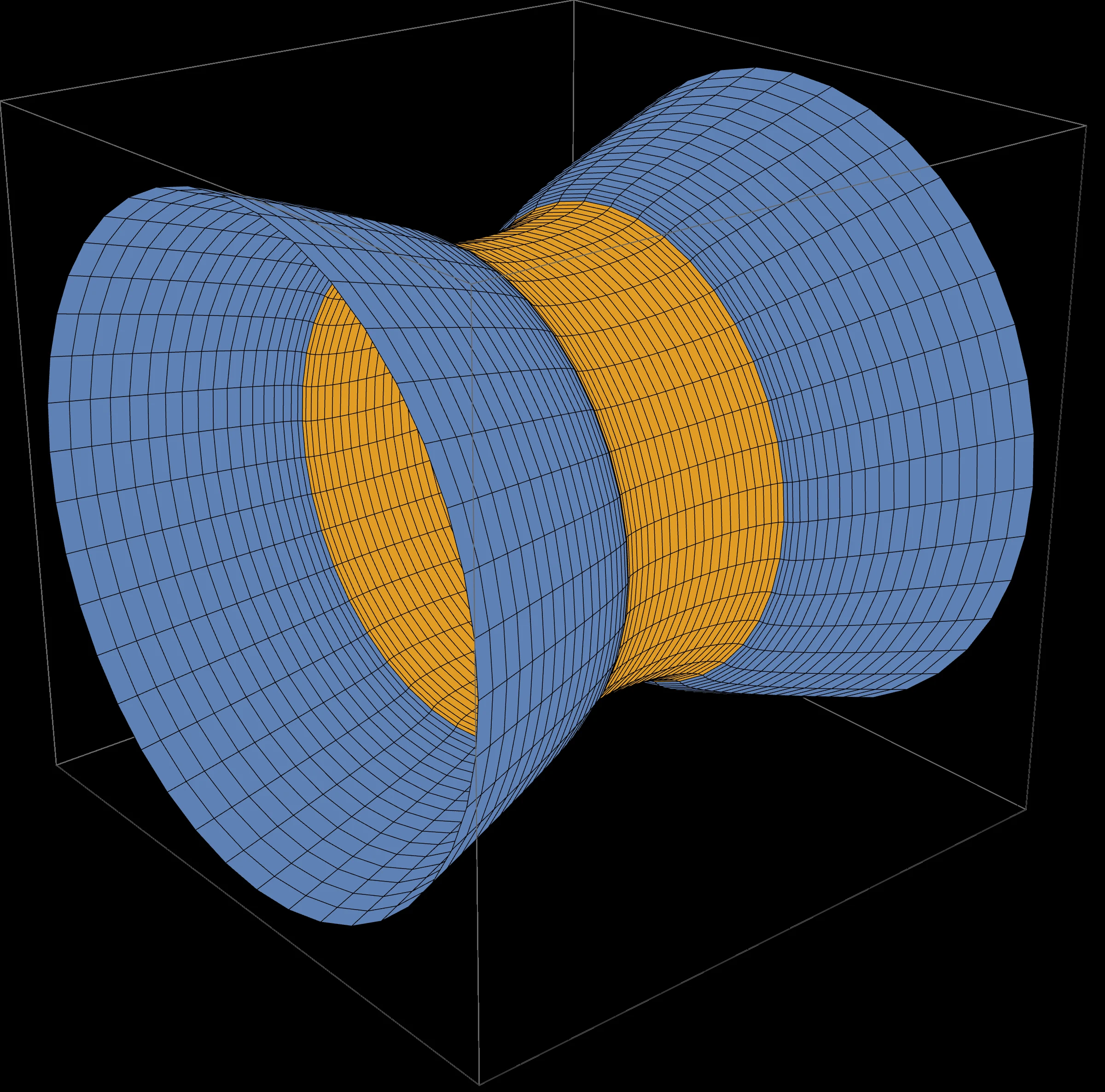
الثقب الأسود الاعتيادي هو حفرة لا قرار لها، لا يفلت منها حتى الضوء. لكن الفيزيائيين وجدوا طريقة لتحويل هذه الحفرة إلى نفق نافذ — ثقب دودي. انطلاقًا من نموذج الثقب الأسود الذي استنتجه كارل شفارتسشيلد عام 1916 من معادلات أينشتاين، أضاف العلماء مكوّنًا غير معتاد — الطاقة السالبة. هذه المادة لها خاصية مضادة للجاذبية: فهي لا تجذب، بل تدفع الفضاء بعيدًا.
بتصادم تيّارين من هذه الطاقة، يتحركان بسرعة سرعة الضوء، يمكن جعل الثقب الأسود يتحول إلى ممر منحنٍ يربط مناطق بعيدة من الكون. المفاجأة الكبرى: كي لا ينهار النفق، يجب أن يكون عنقه واسعًا بما يكفي — فالذراع الضيّق سينطوي تحت ثقله، بينما سيبقى الفسيح مفتوحًا كأنه سلسلة جبالية مخترقة.
تُظهر هذه الديناميكية لأول مرة نشأة ثقب دودي قابل للعبور من ثقب أسود. والطاقة السالبة ليست ضربًا من الخيال: لقد أُنتجت فعلاً في المختبرات باستخدام تأثير كازيمير. سيسمح لنا هذا يومًا ما بالوصول إلى نجوم أخرى لا في آلاف السنين، بل في لحظات.
الملخص الأصلي
كما كتبه المؤلفون، بالإنجليزية arXiv:2602.13609
We study spherically symmetric, self-similar wormhole solutions supported by colliding streams of negative-energy null dust, and their dynamical formation. Under the assumption of self-similarity, the Einstein equations reduce to a system of ordinary differential equations, which we solve numerically under boundary conditions enforcing the existence of a minimal areal radius (the throat) on constant-time hypersurfaces. For a sufficiently large throat radius, the resulting geometries remain regular at both spatial and future null infinity, while a singularity is retained in the past direction. We then construct a dynamical formation scenario by patching together three regions: a Schwarzschild black hole, negative-energy Vaidya spacetimes, and the self-similar wormhole geometry. These regions are joined across null shells using the Barrabes--Israel formalism, which provides explicit relations among the throat radius, the black hole's mass and the energy injection by the shell, demonstrating that an initial black hole can evolve into a wormhole. Our analysis generalizes the formation model for static wormhole solutions proposed by Hayward and Koyama in 2004 to non-static wormhole solutions, offering a novel perspective on the formation of regular traversable wormholes.
يمكن توليد الطاقة السالبة في المختبر باستخدام تأثير كازيمير: صفيحتان معدنيتان في الفراغ تتجاذبان لأن عدد الجسيمات الافتراضية المتولدة بينهما أقل من الخارج.
في فيلم «بين النجوم»، يُستخدم الثقب الدودي للسفر بين النجوم — تمامًا ما يحلم به العلماء.