كيف نميّز النجوم الثنائية عن النجوم المفردة سريع
كشّافان ضوئيان متلاصقان: من بعيد يندمج ضوءهما في بقعة واحدة، فيبدو المصدر واحدًا. وهكذا في الفضاء: حوالي 10–20% من النجوم الخافتة هي في الواقع أزواج متلاصقة من نجمين متطابقين. لا يمكن تمييزهما منفردين، لكنهما معًا يضيئان بشكل أكثر سطوعًا من نجم مفرد له نفس الخصائص.
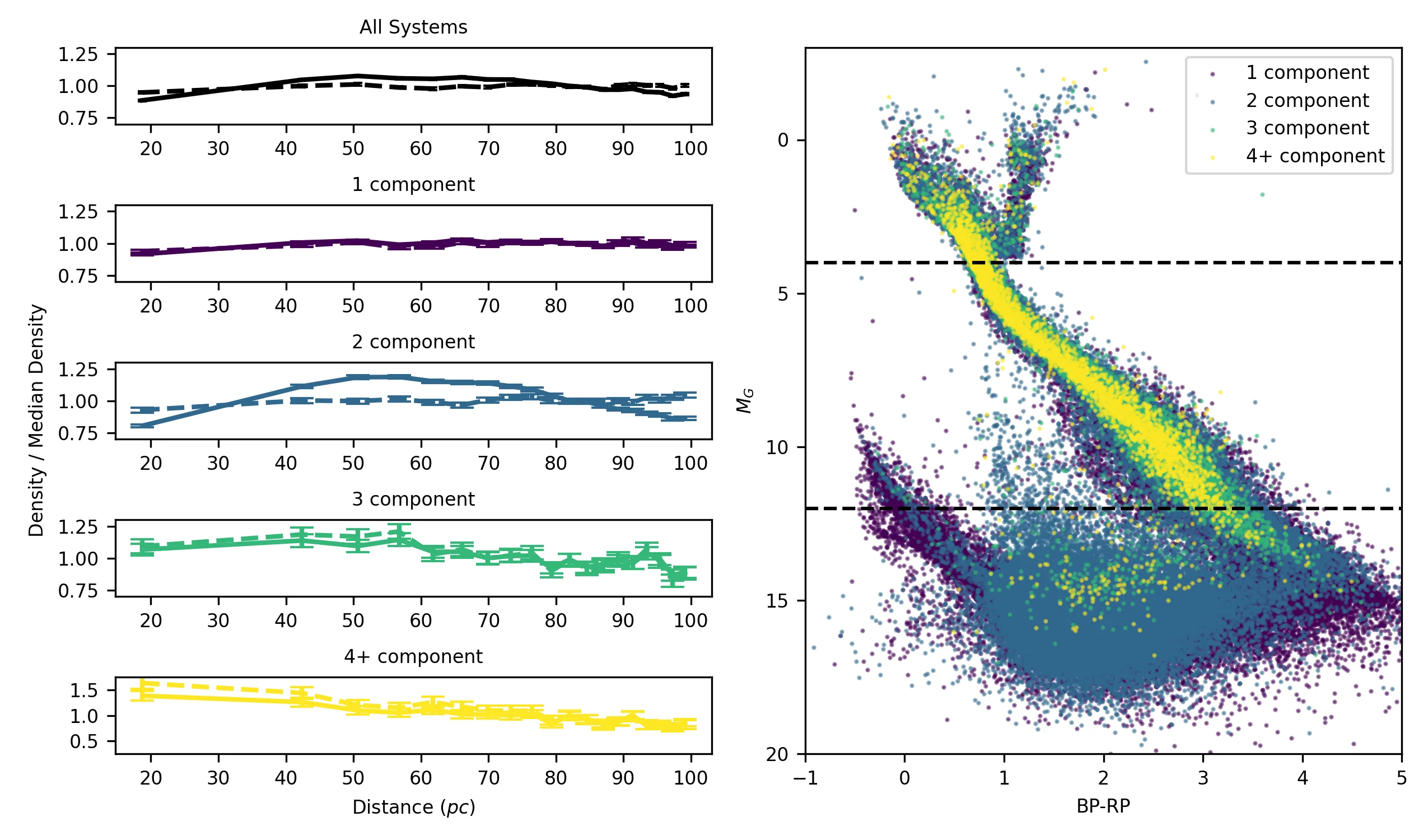
أخذ علماء الفلك بيانات من تلسكوب الفضاء "غايا" (Gaia) عن النجوم ضمن نطاق مئة فرسخ فلكي من الشمس (أي حوالي 326 سنة ضوئية). اختاروا تلك التي تتحرك بحركة منتظمة ولا تظهر عليها علامات زوج غير متساوٍ — فبقي معظمها نجومًا مفردة وأزواجًا توأمية. ثم درّبوا النموذج مرارًا على التنبؤ بسطوع النجم ولونه من طيفه — الشريط الملون الذي يتركه الضوء بعد تحلله. وبعد كل جولة تدريب، كانوا يستبعدون من العينة النجوم التي تلمع أكثر من المتوقع: وهكذا تخلص النموذج تدريجيًا من الأزواج الخفية.
في النهاية، وجد النموذج، الذي دُرّب فقط على النجوم المفردة، حوالي 13% من الأجسام "المفرطة السطوع" — وهي الأنظمة الثنائية غير المحلولة. أُضيفت إلى بيانات من مسوحات أخرى لتجميع كتالوج شامل للأنظمة في الجوار القريب للشمس. ومن خلاله تمكنوا من تقدير الحد الأدنى لنسبة الثنائيات بين النجوم منخفضة الكتلة — من 0,1 إلى 0,7 كتلة شمسية.
هذا الكتالوج مهم ليس فقط لحصر "التوائم": فهو يساعد في تحديد المعلمات الأساسية للنجوم بدقة أكبر — الكتلة والعمر ونصف القطر. فإذا اعتُبر الزوج نجمًا مفردًا، فإن كل الاستنتاجات عنه ستكون خاطئة.
الملخص الأصلي
كما كتبه المؤلفون، بالإنجليزية arXiv:2602.20096
The fundamental parameters of a low-mass star can potentially be determined from its photometry and astrometry. This is complicated by the fact that 10-20 percent of low-mass stars are predicted to be equal-mass binaries. These unresolved systems appear more luminous compared to single stars with the same fundamental parameters. We present a method to differentiate binary stars from single-star main sequence K and M dwarfs using their \textit{Gaia} DR3 XP spectra. We assemble a training set of stars which have pristine astrometry and photometry, are located within 100pc of the Sun, and exclude stars with \textit{Gaia} DR3 flags suggesting they may be unequal mass systems, thereby leaving stars that are predominantly either single- or equal-mass binaries. We then iteratively train Random Forest Regression (RFR) models to predict absolute magnitude and color given the RP spectral coefficients of a star. After each model, we remove the stars that have absolute magnitudes significantly brighter than their predicted values. This method converges on a model trained only on single stars. We then use this model to identify the ``overluminous'' K and M stars in \textit{Gaia} DR3 within 100 parsecs, with some quality cuts. We find that $$\sim13\%$$ of the sample is significantly overluminous and assume these to be unresolved binaries. We aggregate several multiplicity surveys across different projected separations and incorporate our overluminous binaries to create a general \textit{Catalog of Systems} within 100 pc. We use this \textit{Catalog} to provide lower limits on the multiplicity fraction for stars between $$0.1$$ and $$0.7~M_{\odot}$$.
حوالي ثلث جميع النجوم في مجرتنا تعيش في أزواج أو أنظمة متعددة، لكن بين النجوم الأخف وزنًا تكون نسبة النجوم المفردة أعلى.
في رواية ليو تسي شين "مشكلة الأجسام الثلاثة"، تعيش حضارة في نظام من ثلاثة نجوم حيث المدارات غير متوقعة — أما هنا فالحديث عن أزواج توأمية أكثر هدوءًا بكثير.