أين تنتهي النجوم ويبدأ غير المرئي سريع
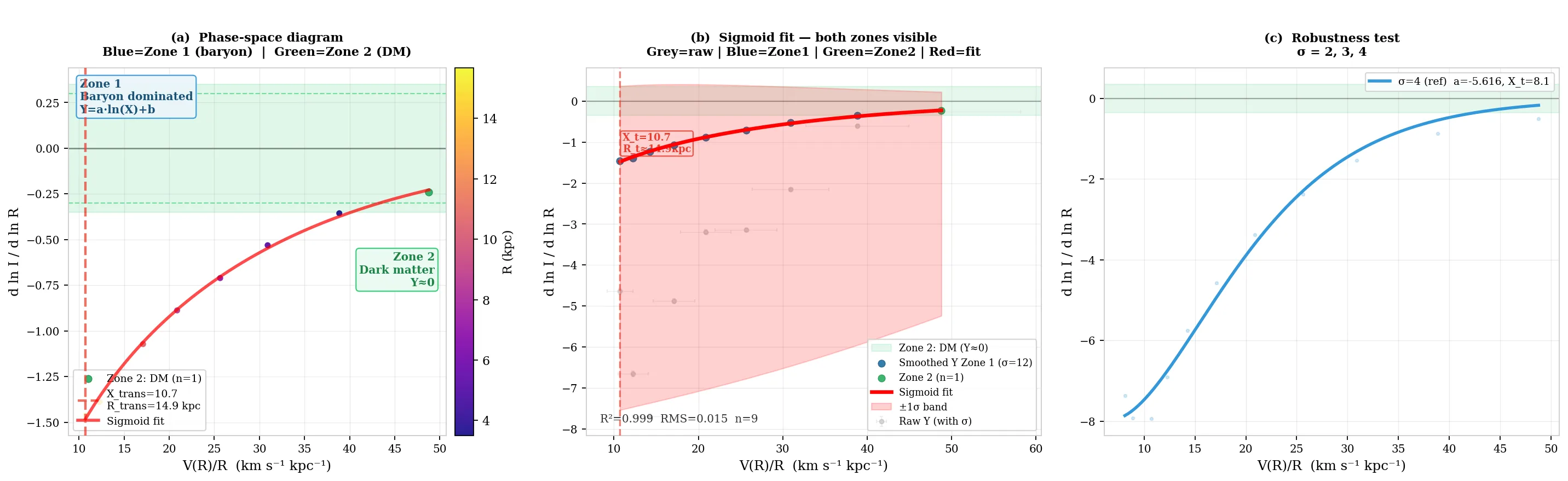
المجرة تشبه المدينة: في المركز أضواء ساطعة ومبانٍ كثيفة، وفي الأطراف أضواء متناثرة وفراغ. لكن إذا نظرت إلى كيفية دوران الغاز في قرص المجرة، سترى أن سرعته في الأطراف لا تنخفض تقريبًا. وكأن أحياء غير مرئية تستمر في إبقاء الحركة. وجد علماء الفلك طريقة لرسم خريطة لهذه المدينة غير المرئية.
قارنوا بين كميتين لكل مسافة من المركز: مدى سرعة دوران المادة (وهذا يدل على كمية الكتلة داخل المدار) ومدى حدة انخفاض سطوع النجوم. في الداخل، حيث النجوم كثيرة، ينخفض السطوع بشكل حاد. في الخارج، حيث النجوم قليلة تقريبًا، لا يتغير السطوع كثيرًا. وتبين أن الانتقال بين هذين النظامين سلس، مثل النزول من تل، ويوصف بنفس المنحنى الرياضي لجميع المجرات.
بعد فحص 136 مجرة على مسافات مختلفة منا، رأى العلماء أن الحدود في المتوسط تقع على بعد 5.4 ألف سنة ضوئية من المركز. قبل هذه الحدود، تسيطر النجوم، وبعدها تسيطر الكتلة غير المرئية، والتي تسمى المادة المظلمة. لا يمكن رؤيتها بالتلسكوبات، لكن جاذبيتها تسرع الغاز والنجوم في الأطراف.
هذه العلامة البسيطة تساعد في التقدير السريع لمكان انتهاء المادة المرئية في المجرة. إنها مثل تحديد مكان انتهاء الحي السكني وبدء الحقل من خلال لون السور — دون النظر خلف السور.
الملخص الأصلي
كما كتبه المؤلفون، بالإنجليزية arXiv:2608.11264v1
The interplay between luminous matter distribution and the local gravitational field within disc galaxies encodes physical information beyond that captured by global scaling relations. We introduce a \emph{dynamical--photometric phase space} defined by the kinematic variable $$X(R)=V(R)/R$$ and the photometric variable $$Y(R)=\mathrm{d}\ln I/\mathrm{d}\ln R$$, placing the local gravitational scale and the logarithmic surface brightness gradient into direct pointwise correspondence at each galactocentric radius $$R$$. The quantity $$X=V/R=\omega$$ represents the angular frequency of circular motion and acts as a probe of the local mean mass density, while $$Y$$ measures the radial steepness of the stellar light distribution. The baryon-dominated inner disc is characterized by large negative $$Y$$, whereas the dark-matter-dominated outer region approaches $$Y\rightarrow0$$. This two-regime behaviour is described by the smooth sigmoid relation $$Y=[a\ln X+b]/(1+\exp[k(X-X_{\rm trans})])$$, which reduces to the logarithmic coupling $$Y=a\ln X+b$$ in the baryonic zone. We apply this framework to 136 late-type galaxies from the SPARC database, spanning inclinations $$20^{\circ}$$--$$89^{\circ}$$, distances $$1$$--$$130$$\,Mpc, and five decades in stellar mass. The median coefficient of determination is $$R^{2}=0.930$$. Statistical validation includes eight independent tests together with 5-fold cross-validation. The transition parameter $$X_{\rm trans}$$ identifies the onset of dark-matter dominance, corresponding to a median transition radius $$R_{\rm trans}=5.40$$\,kpc across the sample.
في بعض المجرات، تشغل المنطقة الانتقالية أقل من ألف سنة ضوئية — وهذا مثل حدود حادة بين وسط المدينة وضواحيها، دون أحياء وسيطة.
في رواية «المادة المظلمة» لبليك كراوتش، يقع البطل في عالم تؤثر فيه المادة المظلمة على الواقع — وهنا هي بالفعل تحدد أين تنتهي النجوم.