Cosmic Tango: How Spins Dance with Dark Matter ✦
Original: "Search for a parity-violating long-range spin-dependent interaction"
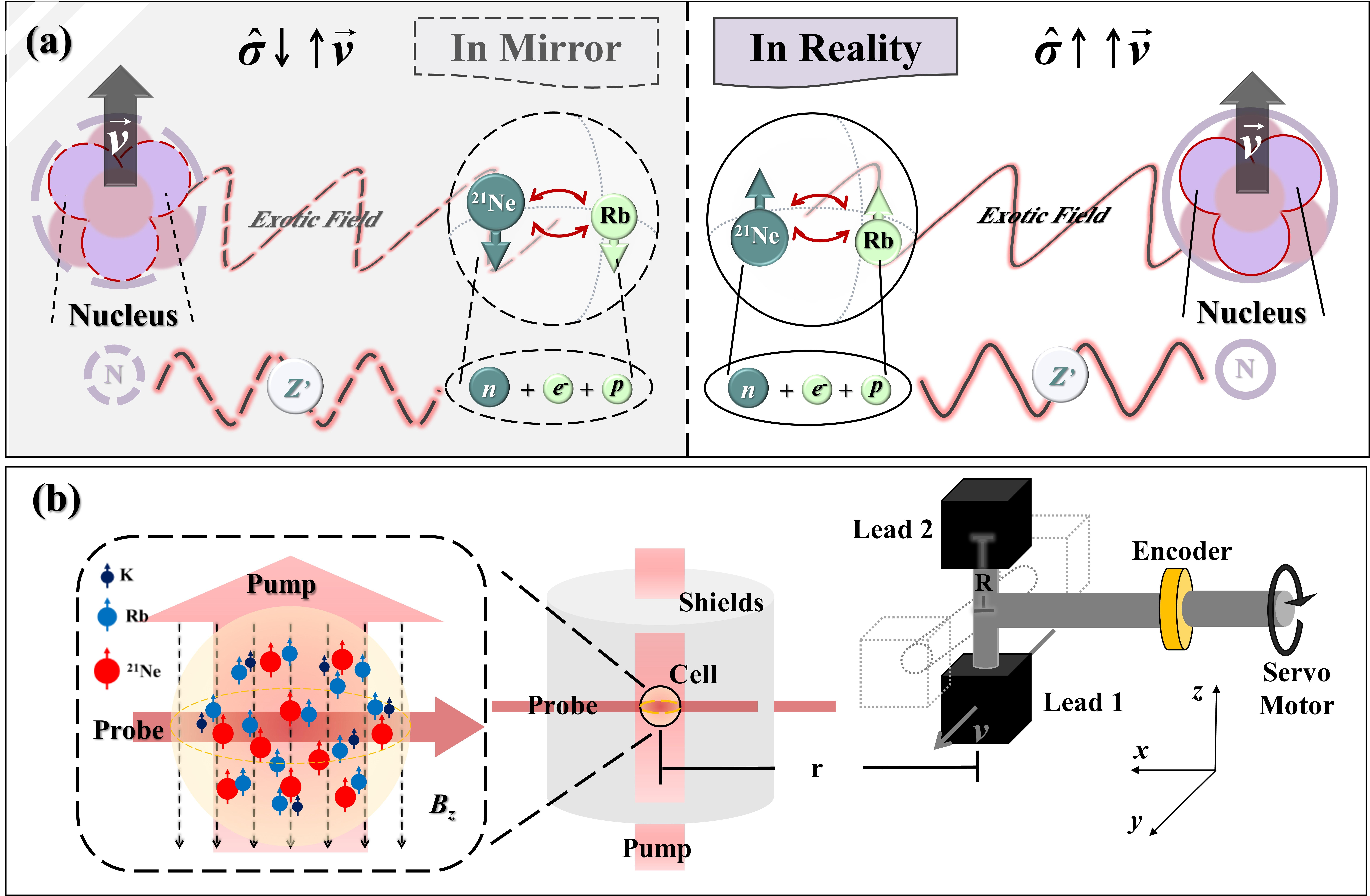
A tabletop atomic sensor, like a compass sensing an invisible rhythm, has set the tightest constraints on forces that could reveal dark matter.
Links in the knowledge graph 1
The map of physical laws seems complete, but in the barely perceptible oscillations of atoms lie uncharted continents. Spinning lead blocks, a laser beam, and the silent tango of nuclear spins have just redrawn the boundaries of what's allowed for dark matter. If new forces exist, they now have to be a thousand times quieter. The next step is to teach spins to amplify this cosmic music, so we can hear it even through the noise of the vacuum.
🎯 The lead blocks have a density of 11.3 g/cm³—almost one and a half times denser than steel, making them a powerful source of virtual particles. And suppressing vibrations 700-fold is like trying to hear a whisper during a rock concert while hiding in a soundproof room.
V_{PV} = \frac{g_A g_V \hbar}{4\pi} (\boldsymbol{\sigma} \cdot \mathbf{v}) \frac{e^{-r/\lambda}}{r}
Pseudomagnetic parity-violating interaction potential: the force depends on the spin and relative velocity of particles and decreases with distance according to the Yukawa law.
Scientists
Christian DopplerD. B. McLaughlinDidier QuelozMichel MayorR. A. RossiterAlbert EinsteinStandard Model
dark matter
axion
quantum measurement
gravitational waves
spectroscopy
electromagnetism
Quantum FieldLaws
Doppler effectgravitational lensingNoether's theoremEinstein field equationsMaxwell's equationsPlanck's law