How to Tame Infinity in Space? ✛ ✎
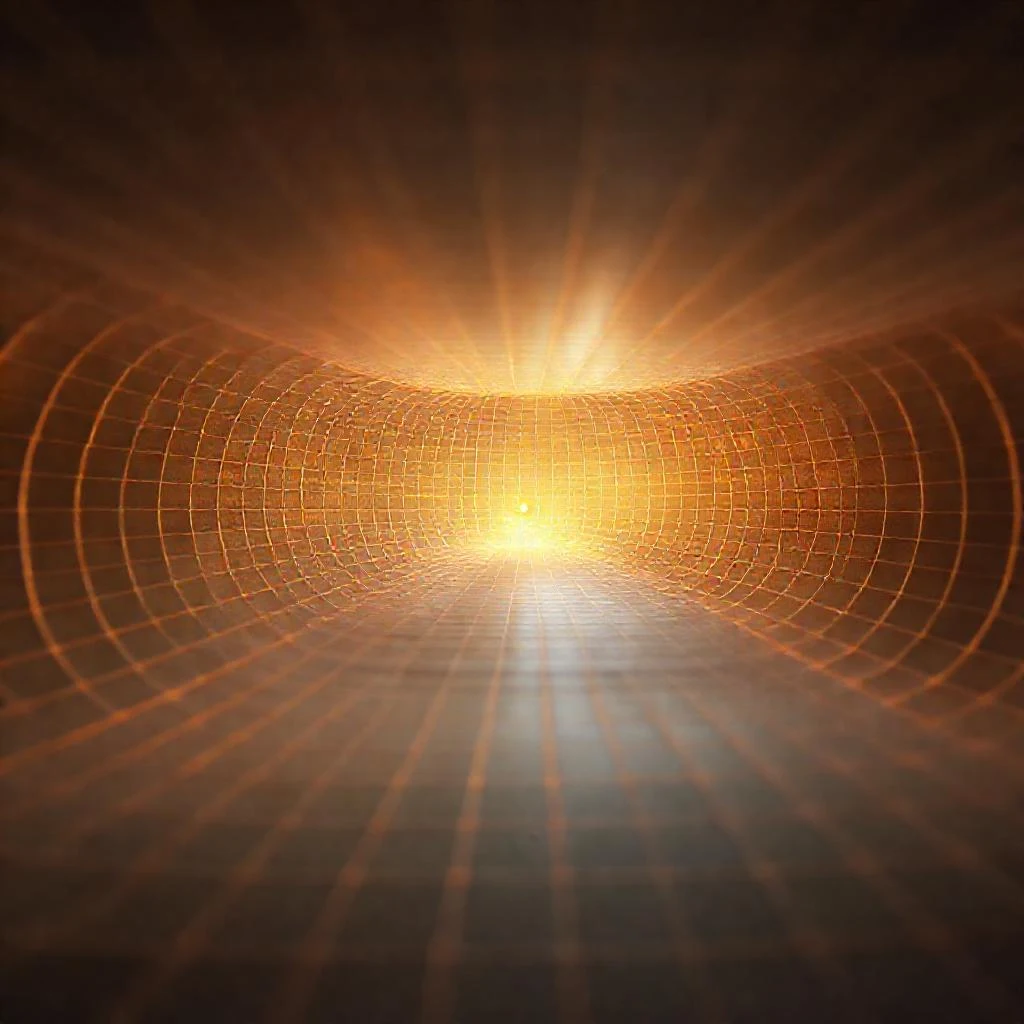
At the boundless edge of the Universe, spacetime curvature creates special twistings — superrotations. Their charge (a measure of energy) suddenly becomes infinite, like meridians converging at the pole of a globe. At that point, ordinary maps tear apart, and calculations lose meaning.
Mathematician Roger Penrose came up with a clever way out: he redrew the Universe, compressing infinity down to a manageable boundary. Now the troublesome pole is just a line on the globe. All that’s left is to smooth out the inaccuracies in the calculations through regularization — a procedure that removes the mathematical “noise.” This finally gave a finite, measurable charge.
These twistings aren’t just theory. They permanently change the shape of space after the passage of gravitational waves — giant ripples from cosmic catastrophes. Understanding superrotations will reveal how energy is transmitted across the Universe and may even lead to new physical laws.
Superrotations were discovered ten years ago, but they already explain why gravitational waves permanently change the shape of space.