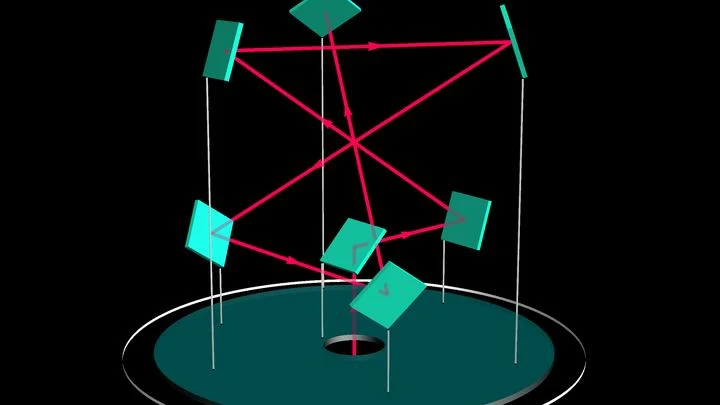
The rotation number is a concept from dynamical systems that quantifies how much a map on a circle rotates points on average with each iteration. Imagine a point moving around a circular track, where each step is determined by a rule that may not be perfectly uniform. The rotation number tells you the net angular advance per step, averaged over many steps, even if individual steps vary. It is a fundamental invariant that helps classify the behavior of circle maps, distinguishing between periodic motion (where the rotation number is rational) and quasiperiodic motion (where it is irrational).
History
The concept was formalized by Henri Poincaré in the late 19th century while studying dynamical systems and celestial mechanics.
How it works
For a circle map, you track the position of a point after each iteration, unwrapping the circle into a line to measure the accumulated angle. The rotation number is the limit of the total angle change divided by the number of iterations, as the number of iterations goes to infinity. This limit exists for many well-behaved maps and is independent of the starting point, making it a robust characteristic of the map itself.
In practice
Rotation numbers are used in the study of oscillators, coupled systems, and in the analysis of quasiperiodic behavior in physics and engineering.
Fun fact
The rotation number of a circle map is intimately connected to the famous Arnold tongues, which describe regions of frequency locking in driven oscillators.
Toss a handful of sand onto a table — the grains scatter equally in all directions. But if a magnet is hidden under the table and the sand is iron, the trajectories get trickier: an invisible structure overlays the chaos. That's roughly how molecular motion works inside a living cell.
In an oven, as temperature rises, molecules move faster and disorder increases. With language models like ChatGPT, it's the opposite. When developers increase the 'temperature' parameter, the model gets access to a wider choice of words, but its long texts suddenly start looping.
A team of researchers tested 11 different AIs by generating 12,000 text continuations.
A neural network predicts the future of a system — say, how plasma will swirl in a magnetic field or how a face in a video will change. Errors are inevitable, and the further it looks ahead, the more they accumulate. Checking against the correct answer during operation is impossible: it simply doesn't exist.
Four tiny puddles, and in them ripple droplets of a superfluid. These droplets are atoms cooled to near absolute zero and paired up like little magnets. When the whole setup rotates, the fluid flows between the puddles. Simply counting how many droplets end up in each reveals the angle and angular velocity.
The night sky is full of beacons that blink on schedule. Pulsars are fast-spinning neutron stars whose radio pulses arrive with clockwork precision. But there are other beacons too: they stay silent for minutes or hours, then suddenly emit a single pulse, and go quiet again.
At the edge of spacetime, where all light rays end, live symmetries that physicists have debated for half a century. They are called superrotations, transformations of the celestial sphere that diverge at isolated points, like vortices in superfluid helium.
The devil's staircase is what mathematicians call a graph that looks like steps leading upward, but the steps are infinitely thin and packed without gaps.
A traveler in the desert sees a lake. It shimmers, beckons with coolness, but as you approach, the water recedes. So it is in mathematics: the computer draws chaos, lines dart across the screen, and it seems we are witnessing a real storm. But if you wait long enough, the storm subsides, and the trajectory settles into a simple equilibrium.