The universe is the sum total of everything that exists: all space, time, matter, and energy, along with the physical laws that govern them. It encompasses everything from the smallest subatomic particles to the largest galactic clusters, and includes the entire history of cosmic evolution from the earliest moments to the present and beyond. In physics, the universe is not just a backdrop but an active participant—its expansion, curvature, and contents shape the behavior of light, matter, and time itself.
History
The modern scientific conception of the universe emerged in the early 20th century with Einstein's general relativity and Hubble's discovery of cosmic expansion. The Big Bangtheory was formulated by Georges Lemaître in the 1920s and refined by Gamow and others in the 1940s.
A spotlight beam fades into the darkness, but if you trace it backward, you hit the lamp. The history of the universe might be the same: tracing its expansion backward, we run into a beginning.
Physicists took the simplest model — a universe that stretches equally in all directions, like a cube with all sides growing.
Newton gave us a world where bodies move in a void and clocks tick the same for everyone. For three centuries, this picture worked flawlessly. But it relies on many invisible props: absolute position, the 'up-down' direction, and a single rhythm of time for the entire universe. We have never measured these directly — only through the relations between objects.
Boiling water in a pot is a good place to start. Bubbles of steam rise, pop, and the surface settles down. Something similar might have happened in the first moments of the universe's life with a special field filling space: bubbles of a new phase inflated and collided, like islands of steam in liquid.
In the grand orchestra of the universe, every instrument has its own rhythm. Electrons in an atom make quantum leaps in femtoseconds, neurons in the brain exchange signals in milliseconds, and a human needs tenths of a second to become aware of the 'now.' Physicists have long sought the conductor…
The story began with a missing mass. In the 1930s, Fritz Zwicky, measuring velocities in galaxy clusters, first suspected the presence of invisible matter. Later, Vera Rubin showed that the outskirts of spiral galaxies rotate too fast for the visible matter.
From childhood, we're used to thinking of space as infinite and isotropic. But Einstein and Lemaître were already asking: could the Universe be closed in on itself, like a Möbius strip or a 3-torus?
Light cones are not about light; they are boundaries in spacetime that separate causes from effects. These cones are not rigid: a massive object curves them, like a heavy ball pressing into a stretched sheet.
An eternal Universe where the measure of disorder (энтропия) grows is, for most of its time, a homogeneous void. In it, complex structures occasionally assemble by chance, such as fleeting consciousnesses — ‘мозги Больцмана’.
The classic story of the Universe’s birth from a blazing point called the Big Bang raises uncomfortable questions: why is the cosmos so homogeneous, and what was before the singularity?
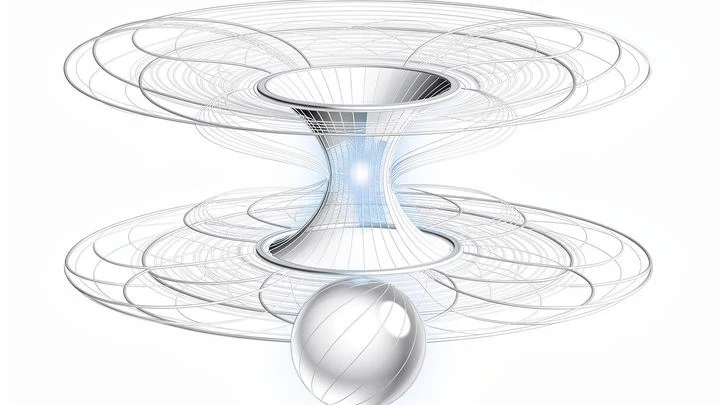
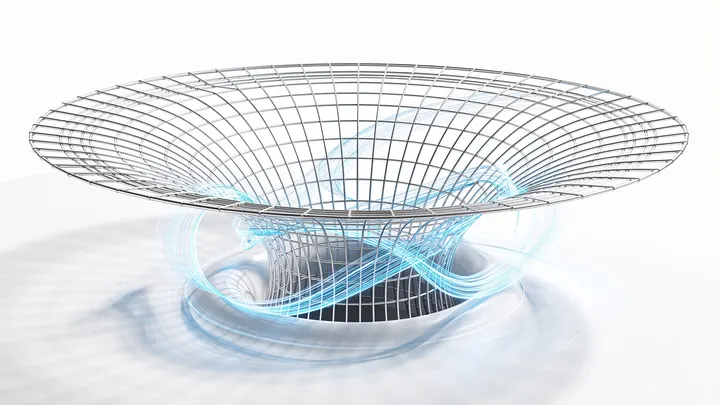
First thing that comes to mind when thinking about the birth of the Universe is an explosion. But modern cosmology paints a more refined picture: birth through the neck of a wine glass. This geometry is not a sommelier's fantasy, but a rigorous form of Euclidean wormhole that connects two anti-de Sitter worlds.
A lightning strike splits the sky in a fraction of a second, leaving a branched trail. At the same moment, in a tiny superconducting crystal cooled to near absolute zero, an avalanche of magnetic field rushes through — thin fingers of magnetization piercing the material.
The universe abhors monotony. A century ago, Edwin Hubble and Georges Lemaître gave us an elegant picture: an expanding cosmos, smooth as the surface of an inflated balloon.
Drop two identical pebbles from a mountain peak: one lands a centimeter to the left, and a minute later they end up in different valleys. A galaxy is the same mountain, only with billions of pebbles and a slope that stretches over millions of years. The authors of a new study simulated a disk of 40 million point-like stars and tested how quickly it forgets where it started.
It all started with tiny quantum flickers on the primal canvas. Inflation — an avalanche-like expansion proposed by Alan Guth — stretched those brushstrokes to the scale of galaxies.
Traditional cosmology begins with the Big Bang — the idea of Georges Lemaître. However, a new approach, inspired by the work of Stephen Hawking, bypasses the mystery of the initial moment.
A stone drops into a pond — ripples spread across the water. Do short waves outrun long ones? No, in deep water it's the opposite: long waves overtake short ones. In metal, sound of one pitch travels at one speed, another pitch at another.
The night sky is full of stars, but they are only a small part of everything that exists in the universe. Astronomers have long noticed a strange thing: galaxies rotate so fast that they should fly apart, yet they don't. Something invisible holds them together, like invisible threads linking beads on a spinning wheel.
This "something" was named dark matter.
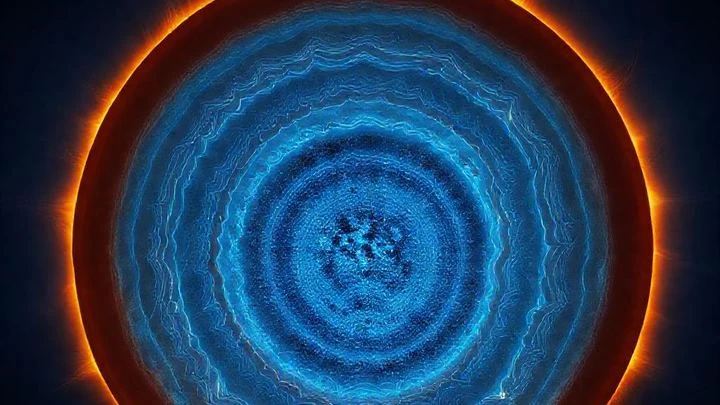
The Sun’s gravity creates an invisible goblet, in which dark matter of a special kind — ultralight — doesn’t splash around chaotically, but occupies strict energy steps, like transparent layers of liquid. So around the Sun, a natural spectroscope emerges, sorting the invisible substance into levels, just like electrons in an atom.
When entropy reaches its maximum, the play is over. The curtain falls, the actors leave, the scenery freezes. But the stage remains. So it is with time: the heat death of the universe erases the direction 'past—future', but not time itself.
The clock on the kitchen wall ticks, and each tick relentlessly carries us from breakfast to lunch. This is so familiar that it seems like a law of nature, but physics says otherwise. In Einstein's equations, time is reversible: you can rewind the film, and no frame will give the trick away.
At night, an astronomer points a telescope at the edge of the visible universe and sees not stars but ripples — the imprint of the first moments. He knows these ripples should obey statistics, like the heights of people in a crowd. But he has only one crowd, and nothing to compare it with.
This is cosmic variance.