Rotation is the motion of an object around an axis, where every point of the object traces a circular path around that line. In physics, it is described by transformations that preserve distances and angles, forming the mathematical group SO(3) in three-dimensional space. Rotation is fundamental to understanding everything from planetaryorbits and spinning tops to the behavior of subatomic particles and the structure of spacetime itself.
History
The formal study of rotation dates back to Leonhard Euler in the 18th century, who established the rotation theorem and the Euler angles. The quantum theory of angular momentum was developed in the 1920s by Wolfgang Pauli and others.
How it works
A rotation is characterized by an axis and an angle. Mathematically, it can be represented by a rotation matrix or a quaternion, which transforms coordinates while keeping the origin fixed. In quantum mechanics, rotation is described by angular momentum operators, which obey specific commutation relations and lead to quantized spinstates. In general relativity, rotation of massive objects drags spacetime around them, an effect known as frame-dragging.
In practice
Rotation is used in gyroscopes for navigation, in the design of rotating machinery, and in particle accelerators where magnetic fields steer charged particles along curved paths.
Fun fact
A neutron star can rotate hundreds of times per second, and its surface moves at a significant fraction of the speed of light.
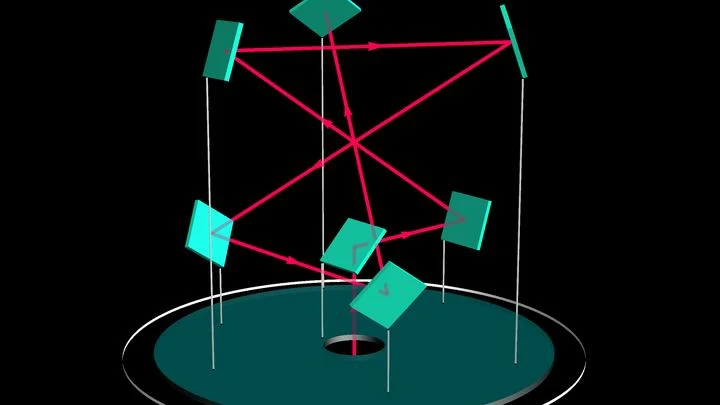
A laser beam is like a swift vortex that briefly captures a passing electron. As the particle moves through the pulse, its spin (the intrinsic rotation, like a tiny top) experiences a weak kick. After leaving the beam, the top no longer points in the same direction; it has turned a little.
A thrown stone arcs through the air and falls. A planet orbiting a star is the same stone, but it falls forever, looping around the star in a closed curve. In Newton's world, that curve is a perfect ellipse, and the planet returns to the same point each orbit. In reality, the orbit slowly rotates: its closest point to the star, the perihelion, shifts.
Dim the lights. The stage belongs to a shadow theater, with just r puppeteers, but the screen obeys the laws of hyperbolic geometry. Every wave of the hand births a pattern that mathematicians call a discrete group of isometries.
A supersolid is matter that is both crystalline and fluid. It is created from atoms cooled almost to absolute zero. In new work, physicists obtained such a substance as a triangular lattice of droplets. Each droplet oscillates in its own rhythm.
Two pebbles drop into water, and the ripples on the surface intersect, blending their patterns. Neutrinos behave much the same way: light particles that pierce us by the billions every second. They can transform from one type to another, like an actor changing masks. Physicists call this dance oscillations.
A tiny magnet levitates in a magnetic trap, like a weightless needle. Its magnetized axis is like a stubborn compass needle that is prevented from turning. An invisible wall rises before it. But in the quantum world, particles can seep through barriers — this trick is called tunneling.
Four tiny puddles, and in them ripple droplets of a superfluid. These droplets are atoms cooled to near absolute zero and paired up like little magnets. When the whole setup rotates, the fluid flows between the puddles. Simply counting how many droplets end up in each reveals the angle and angular velocity.
Sugar dissolves in tea, and then with a single motion gathers back into the spoon. In an ordinary kitchen, you won't see that — viscosity and disorder get in the way. But in the world of ultra-slow motions, where inertia vanishes, such tricks become reality.
A hot spoon in a cup of tea — heat runs along the metal from the hot end to the cold one. Textbooks describe this process as atoms jiggling and passing on their jolts to each other. But atoms don't just jiggle: they also spin, like tiny tops. Until now, physicists had no common language to describe both motions at once.
The authors of the work built such a language.
A flashlight beam in a dark room can hold a dust mote almost still: that's how optical tweezers work. But light doesn't just push the particle; it also jostles it with random kicks. Each absorbed photon strikes it like an invisible hammer. The authors of the new study have devised a light trap of a special shape.
A flock of birds or a school of fish sometimes swirls into a vortex, even though no individual commands 'spin.' Such collective rotation helps the group stay together and mix better. It is usually explained by the individuals being asymmetric, like a screw, or pushing each other with a twist. But a new study finds another route.
A superconducting contact is like a narrow bridge between two shores, carrying current without friction. Place such a bridge near a massive star, and it will feel time flowing slower near the star's surface. Clocks on the shores tick at different rates, and the current begins to oscillate differently.
But if the star rotates slowly, the picture gets more complicated.
A wormhole is a tunnel through space, connecting distant regions of the Universe. Its shadow against a bright gas background was long thought to be as round as that of a black hole. But for a rotating wormhole (one you could actually traverse), the shape of the shadow might be surprising: the edge becomes jagged, like a gear.
At the edge of spacetime, where all light rays end, live symmetries that physicists have debated for half a century. They are called superrotations, transformations of the celestial sphere that diverge at isolated points, like vortices in superfluid helium.