The rotation axis is the imaginary line through a rotating object around which it spins. For a rigid body, every point on the object moves in a circle around this axis. The axis can pass through the object's center of mass (like Earth's axis) or lie outside it (like a spinning top's axis). Understanding the rotation axis is crucial for describing rotational motion, angular momentum, and the behavior of gyroscopes.
History
The concept of a rotation axis has been implicit since ancient times, but it was formalized by Isaac Newton and Leonhard Euler in the 17th–18th centuries. Euler's rotation theorem (1775) stated that any rotation can be described by a single axis.
How it works
The rotation axis is defined by the direction of the angular velocity vector. For a spinning object, the axis is the line along which the angular momentum points. In the absence of external torques, the axis remains fixed in space (conservation of angular momentum). For objects with non-uniform mass distribution, the axis may precess or wobble.
In practice
It is used in navigation (gyroscopes), robotics (joint control), astronomy (planetary rotation), and engineering (balancing rotating machinery).
Fun fact
Earth's rotation axis is tilted at about 23.5 degrees, which causes the seasons, and it slowly wobbles over a 26,000-year cycle called precession.
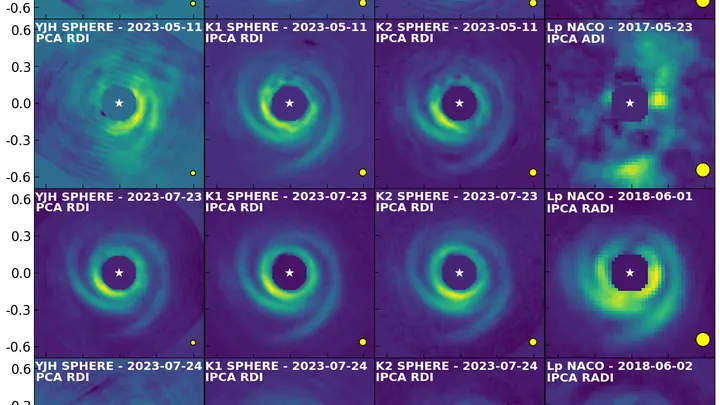
460 light-years away, around the star HD 135344B, a dense disk of gas and dust is swirling. It looks like a giant vinyl record that someone has cracked: a gap yawns in the disk, and across it, like a slender bridge, stretches a dust filament.
An octopus tentacle bends, grabs, and stretches — all without a single bone. The secret is that inside it, sections that contract alternate with sections that remain passive. Scientists have long tried to replicate this trick in artificial materials, but until now they couldn't precisely dictate how a material would change shape.
Now researchers have proposed 3D-printing elastic threads from two materials at once.
An ordinary top spun on a table slows down smoothly: friction with the air and the surface gradually eats away its energy. But if a top levitates in a magnetic field and barely touches anything, its rotation can behave surprisingly capriciously.
At the edge of spacetime, where all light rays end, live symmetries that physicists have debated for half a century. They are called superrotations, transformations of the celestial sphere that diverge at isolated points, like vortices in superfluid helium.