A Quantum Instrument Plays the Music of Primes express
Physicists have created a quantum analogue of a musical instrument. Its “notes”—the allowed energy levels — precisely replicate the first numbers from a set that governs the distribution of primes. These numbers are the imaginary parts of the zeros of the famous Riemann zeta function, a mathematical object inextricably linked to prime numbers.
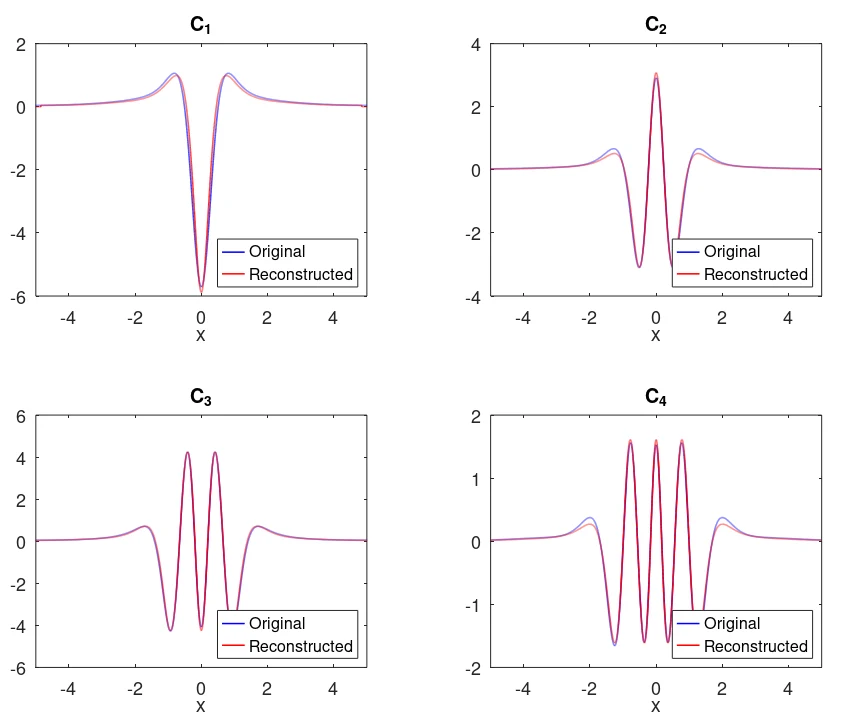
The instrument didn’t sound right at first. Scientists began with a smooth approximation, then added patch-like corrections. To their surprise, all corrections obeyed a simple rule: they were determined by the error in the well-known prime-counting formula (the Riemann–von Mangoldt formula). It was this simple mechanism that generated the fractal pattern previously noticed in the potential’s structure. Thus, the quantum spectrum reflected the hidden harmony of number theory — much like the hydrogen atom produces a strict set of spectral lines. The link between quantum disorder and arithmetic is no longer just a metaphor; it’s becoming a tool for assaulting a great mathematical problem.
Original abstract
as written by the authors arXiv:2510.16759
A series of numerical experiments are performed, where a symmetric potential is generated for the 1D time-independent Schr\"odinger equation, with an eigenspectrum that matches the imaginary part of the first nontrivial zeros of the Riemann Zeta Function. The potential is generated as a series of correction functions, where the starting point is a potential that matches the smooth Riemann -- von Mangoldt approximation. It is found that the correction functions display a clear pattern that can be explained in simple terms, almost entirely dependent on the approximation error in the Riemann -- von Mangoldt formula. This also provides an explanation for the fractal pattern in the potential that was observed by Wu and Sprung.
Prime numbers are sometimes called the “atoms of arithmetic” because they serve as the building blocks from which all whole numbers are constructed.