A spectral line is a dark or bright feature in an otherwise continuous spectrum, produced when atoms or molecules absorb or emit light at specific wavelengths. Each element and molecule has a unique set of spectral lines, like a fingerprint, revealing its presence and properties in distant objects. Spectral lines are the primary tool astronomers use to determine the composition, temperature, density, and motion of celestial bodies.
History
The connection between spectral lines and elements was established in the 1850s by Gustav Kirchhoff and Robert Bunsen, who showed that each element produces a unique line pattern. This laid the foundation for astrophysics.
How it works
When light passes through a gas, atoms absorb photons at energies matching electron transitions, creating dark absorption lines. Conversely, excited atoms emit photons at those same energies, producing bright emission lines. The exact wavelengths are determined by quantum mechanics — the discrete energy levels of electrons in atoms. By spreading light into a spectrum with a spectrograph, scientists can identify these lines and measure shifts (Doppler effect) to infer velocities.
In practice
Spectral lines are used in astronomy to measure the redshift of galaxies, in chemistry to identify substances, and in medicine for non-invasive diagnostics like pulse oximetry.
Fun fact
The element helium was discovered in 1868 as a bright yellow spectral line in the Sun's spectrum before it was found on Earth.
Imagine a huge stadium packed with people dressed in black. You're standing outside, trying to figure out what's happening inside, even though you can't see a single person. But if two people bump into each other and exchange bright T-shirts, you'd spot a flash of color.
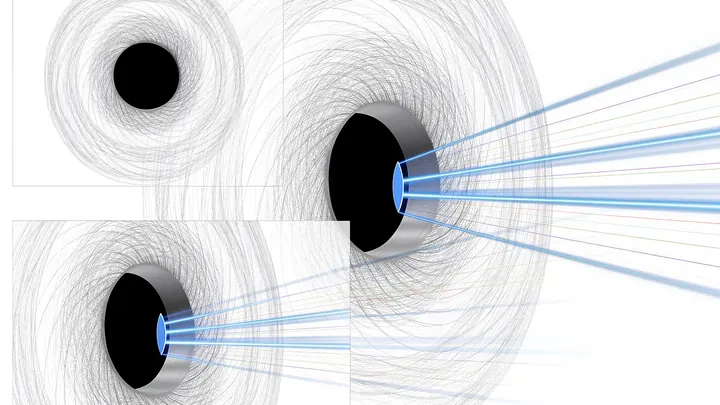
In the center of almost every large galaxy lurks a supermassive black hole, whose gravitational abyss was first mathematically described by Karl Schwarzschild. When it swallows gas, a dazzling active nucleus is born — a quasar.
Moments before totality, swift shadow bands glide across the ground, like ripples from pebbles tossed into water. For centuries, this phenomenon baffled scientists. It turns out the key is that light is a wave.
The Sun isn't a pinpoint lamp but a vast disk. When the Moon nearly covers it, a thin glowing crescent remains.
The Fermi telescope spent 17 years recording gamma rays from the active nuclei of galaxies with giant black holes at their centers. The glow of their jets resembles a chaotic cacophony: it constantly changes.
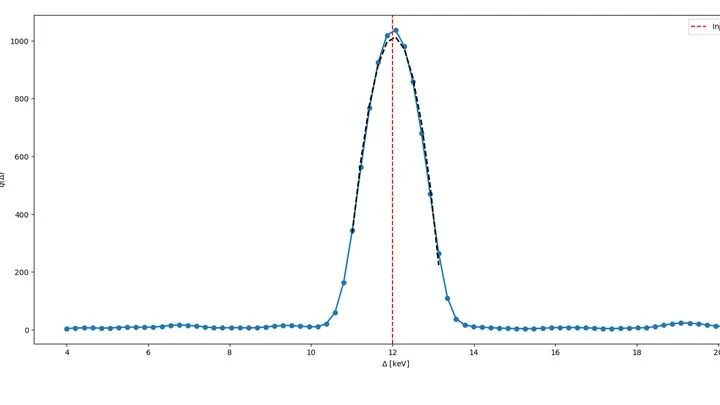
A gamma-ray spectrum looks like a picket fence: each line is the precise energy a nucleus released as a photon. But sometimes ghosts appear in that fence — faint lines shifted by the same amount from the main ones. Such a shift could mean that part of the energy went into creating a light particle we cannot yet see directly.
Strike a tuning fork, and it rings with a single pure note. But if the fork is trembling and people are chattering nearby, the sound won't be perfect. Same with molecules: each one absorbs light of a specific color, but due to its own vibrations and the jostling of neighbors, that color gets smeared out.
The authors of the paper figured out how to show this to students without complex formulas.