Scientist

David Hilbert

1862–1943 · mathematics, mathematical physics, functional analysis, number theory, mathematical logic
David Hilbert is one of the greatest mathematicians in history, whose ideas defined the face of modern mathematics and laid the foundation for the mathematical apparatus of quantum mechanics. He developed the theory of Hilbert spaces, formulated the famous 23 problems that became a program for the development of mathematics in the 20th century, and made fundamental contributions to invariant theory, algebraic number theory, and mathematical logic.

Biography

Born in Königsberg (now Kaliningrad), he studied and worked at the University of Königsberg, where he became friends with Hermann Minkowski. From 1895, he was a professor at the University of Göttingen, which under him became a world center of mathematics. Among his students and colleagues were John von Neumann, Hermann Weyl, Emmy Noether. He was a laureate of the Lobachevsky Prize and many other awards. His scientific school became legendary.

Key discoveries

💡 Hilbert lectured slowly and often repeated difficult parts so that even the slowest students could understand the material. On his deathbed, he supposedly said about his 23 problems: 'Put me close to the mathematics department at the cemetery — maybe I'll resurrect.'
"He asserted that we must know, and we will know."
Concepts
Hilbert spacequantum entanglementquantum measurementsuperpositionuncertainty principle
Laws
spectral theorem
Scientists
Alain AspectErwin SchrödingerDavid DeutschLouis de BroglieJohn Stewart BellLeo EsakiNiels BohrSerge Haroche

Related articles

How to Make Images Taken in Different Languages Get Along
Two images of the same place: one taken in the morning from a drone, the other in the evening from a satellite. The first shows shadows from trees, the second shows glints on the water. It's like two accounts of the same event in different dialects: the words are similar, but the grammar is different.
Calibrating for Small Data: The GOAL Algorithm
An optician turns the frame, adjusts the focus, and a blurry spot becomes a sharp image. The new algorithm GOAL works much the same way: it rotates the data cloud, compresses redundant dimensions, and brings into focus what truly matters.
Quantum Physics2025-10-191 minarXiv:2510.16759express
A Quantum Instrument Plays the Music of Primes
Physicists have created a quantum analogue of a musical instrument. Its “notes”—the allowed energy levels — precisely replicate the first numbers from a set that governs the distribution of primes. These numbers are the imaginary parts of the zeros of the famous Riemann zeta function, a mathematical object inextricably linked to prime numbers.
Quantum Physics2025-12-201 minarXiv:2512.18400express
The Quantum Coin: Bohr & von Neumann's Solution
A quantum particle, an inhabitant of the elementary particle world, resembles a coin spinning in the air: neither heads nor tails, but a blend of possibilities. Yet when it lands on the table, the outcome becomes definite. What serves as the table in a measurement?
Image Processing2026-02-121 minarXiv:2602.11873express
How to Assemble an Aorta from Six Scans
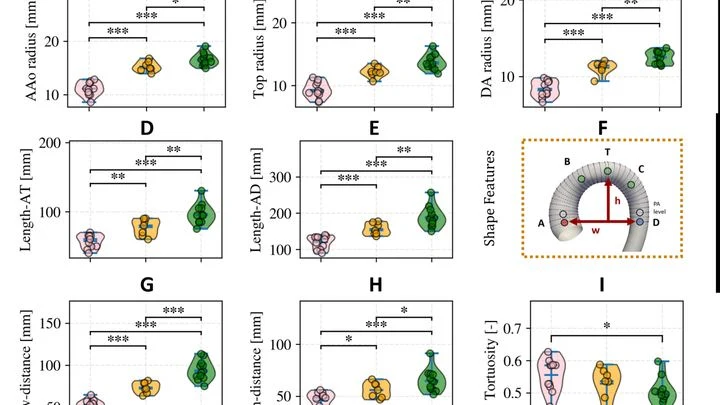
The body's main artery, the aorta, is not just a tube. With each heartbeat, it stretches and contracts like a rubber hose under water pressure. Seeing this motion in volume is hard: standard MRI gives only flat slices, and full 3D imaging over time requires expensive equipment and long periods lying in the scanner. A group of researchers found a way out.
Statistical Mech2026-02-162 minarXiv:2602.15185express
Complexity on the Edge of Order and Chaos
A magnetic film divided into tiny arrow-shaped cells behaves like a crowd in a square. While it's cold, all arrows point in the same direction — perfect order. Heat the film, and the arrows start darting around like pedestrians who have lost their purpose. Somewhere between these extremes, there is a moment when the system stops being uniform but hasn't yet dissolved into random noise.
math.OC2026-02-211 minarXiv:2602.18725express
How to Sync Different Maps of the Same City
A city can be studied in different ways: one person maps the streets, another tracks traffic flows, and a third maps population density. The maps don't match, but they describe the same place. A similar problem arises when biologists look at a cell through different instruments: one shows its shape, another the distribution of proteins inside. We need to understand how these data are related.
Quantum Physics2026-03-141 minarXiv:2603.13974express
The Evergreen Tree of Probabilities
In quantum theory, a particle can run along two paths at once. When measured, we catch it on just one. According to Niels Bohr, all other possibilities vanish instantly — like a branch snapped off a trunk. Yet Hugh Everett insisted: the tree of reality grows all its branches at once, and we only see the one we’re on.
General Relativity2026-03-212 minarXiv:2603.20747express
How the Universe's Clocks Set the Pace of Time
In everyday life, time flows on its own, like a river past its banks. But in quantum gravity, things are different: time does not flow; it emerges from relations between objects, like a pattern in a carpet that is only visible when viewed from a certain spot.
Chemical Physics2026-05-092 minarXiv:2605.08708express
Why the Same Material Glows Differently
A squad of soldiers marches across a parade ground. As long as everyone keeps in step, the movement remains sharp and coordinated. But if someone falls out of line, the order is lost. In the microworld, electrons play the role of such a squad: when their oscillations are synchronized, the substance emits a narrow, sharp line.
Materials2026-05-202 minarXiv:2605.20918express
Coloring Atoms Speeds Up Quantum Calculations
A drop of water in your palm holds roughly $$10^{21}$$ molecules, each made of three atoms surrounded by a swarm of electrons. To understand how matter behaves, physicists solve equations for these electrons. The trouble is that the number of equations grows like an avalanche: for N electrons, you need to store $$N^2$$ numbers.
Physics and Society2026-05-241 minarXiv:2605.25248express
Communities by Size: When Networks Assemble Like a Puzzle
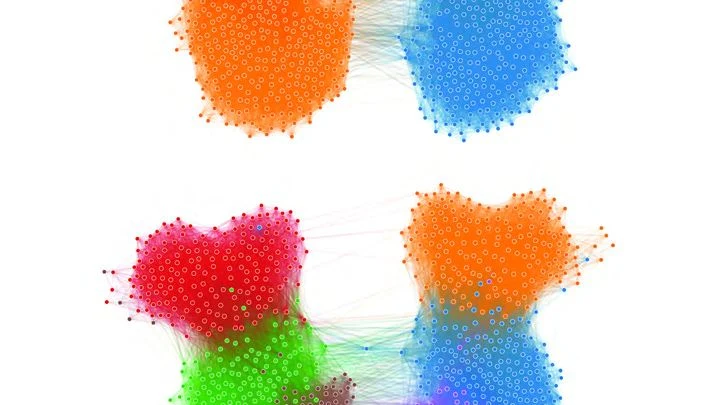
A social network is like a city: there are giant neighborhoods and tiny alleys. When an algorithm looks for tight-knit groups, it often picks out a couple of huge clusters and many small fragments. But the client (say, a municipality) needs districts of roughly equal size to distribute clinics or schools evenly.
stat.ME2026-06-242 minarXiv:2606.26061express
A New Way to See the Hidden in Data Chaos
A lab robot counts molecules, and gets it wrong. One tube shows 0, another 12, a third 3, though in reality they all hold roughly the same amount. Such 'raw' numbers are common in biology: DNA sequencing, counting species in a water sample, gene activity. There's plenty of data, but it's sparse and more scattered than simple randomness would predict.
econ.EM2026-07-013 minarXiv:2607.01429
The Data Watershed: How a Simple Yes/No Switch Reveals Multidimensional Models
On a topographic map, raindrops choose their path: falling on one slope, they flow into River A; on the other, into River B. An observer sees only the winding rivers (the response variables Y) and knows which slope the water came from (the instrument Z), but cannot see the drops themselves (the unobserved factors ε).
q-bio.QM2026-07-101 minarXiv:2607.09838express
A Protein in the Palm of Your Hand: Your Genetic Passport on Your Phone
You get a report: one 'letter' in your gene has been swapped. But what does that change? A protein isn't a flat string: it's a dense tangle, where each loop sits in its own pocket. A change deep inside that tangle is like a crack in the foundation, while one on the surface is like a scratch on the facade.
Signal Processing2026-07-141 minarXiv:2607.12656express
Shrinking 3D Scenes 160x with Blazing-Fast Unpacking
Three-dimensional worlds are made of millions of semi-transparent specks, like a giant tapestry woven from glowing droplets. Transmitting such a canvas usually takes ages and a beefy data pipe. SpeedyGS squeezes it into a tiny file, and it unfurls in a flash, like yanking a drawstring from a pouch.
math.OC2026-07-151 minarXiv:2607.13701express
How to Keep a Problem from Ballooning: A Fast Method for Machine Learning
The standard approach to a certain class of machine learning problems is like a spring that's been stretched and then forgotten: standard methods artificially inflate the problem's size, turning computations into a black hole for memory and time.
Image Processing2026-07-151 minarXiv:2607.13812express
A Fresh Perspective on 3D Medicine
The data from a single CT scan is comparable to several feature-length films. TCAM-Diff bypasses this bottleneck: the program compresses the 3D scene into three shadow projections — like a sculptor reconstructing a solid statue from silhouettes on three walls.
q-bio.QM2026-07-151 minarXiv:2607.14163express
Genes as a Dish: A Fresh Look at Cells
Data on gene activity usually looks like a long string of numbers, like a rainbow stripe (spectrum) with no visible connections. In the scVision model, these numbers are turned into a meaningful picture — not a list of ingredients, but a photo of a finished dish.
Information Theory2026-07-161 minarXiv:2607.14834express
Compressing networks: when roads become points
An ordinary road map with traffic is a heap of numbers. Sending them all as is takes too long. But you can reduce the volume without losing the gist. Researchers found a clever solution: first redraw the map so that streets become points, and intersections become bridges between these points.
Quantum Physics2026-07-252 minarXiv:2607.23240express
Quantum Formulas Gain Mathematical Rigor
Quantum calculations often resemble assembling a complex mechanism: a physicist knows a part will fit, but can't always explain why. One favorite trick is to insert a 'unity' into the middle of a formula — not an ordinary one, but one built from an infinite set of all possible states of the system. This turns a cumbersome expression into a chain of simple integrals.
Statistical ML2026-08-171 minarXiv:2608.16506express
How to See Shape When Data Are Unevenly Sampled
Two photographers shoot the same mountain. One takes a hundred shots from the summit and only a couple from the base; the other does the opposite. If you try to align their images, the algorithm might decide that the summit in one photo matches the summit in the other simply because there are many similar points there, not because it's the same spot. Sampling density throws it off.
Mesoscale2026-08-312 minarXiv:2608.30531
Invisible Rearrangement: How Twisted Crystals Find a New Order
A deck of cards in which each card is slightly rotated cannot lie flat: the backs and faces will never align. But if the cards are flexible, they will start to adjust, shifting by fractions of a millimeter to find the perfect match. Something similar happens inside crystals when two thick layers of MoS2 or MoS2 with WS2 are stacked with a twist of 1–2 degrees.
A Rough Map of the Breast: Dose Calculation 22 Times Faster
A mapmaker drawing a route through a city doesn't sketch every brick in every wall. Streets, intersections, and distances are enough. The same goes for calculating radiation dose in breast tomography: you don't need every cell, just a faithful overall picture.