Drops That Hang by a Hair express
A drop of water squeezed between two close surfaces turns into a tiny bridge. Such bridges are everywhere: they hold sand grains together in wet sand, make hair clump after a shower, and even help insects walk up walls.
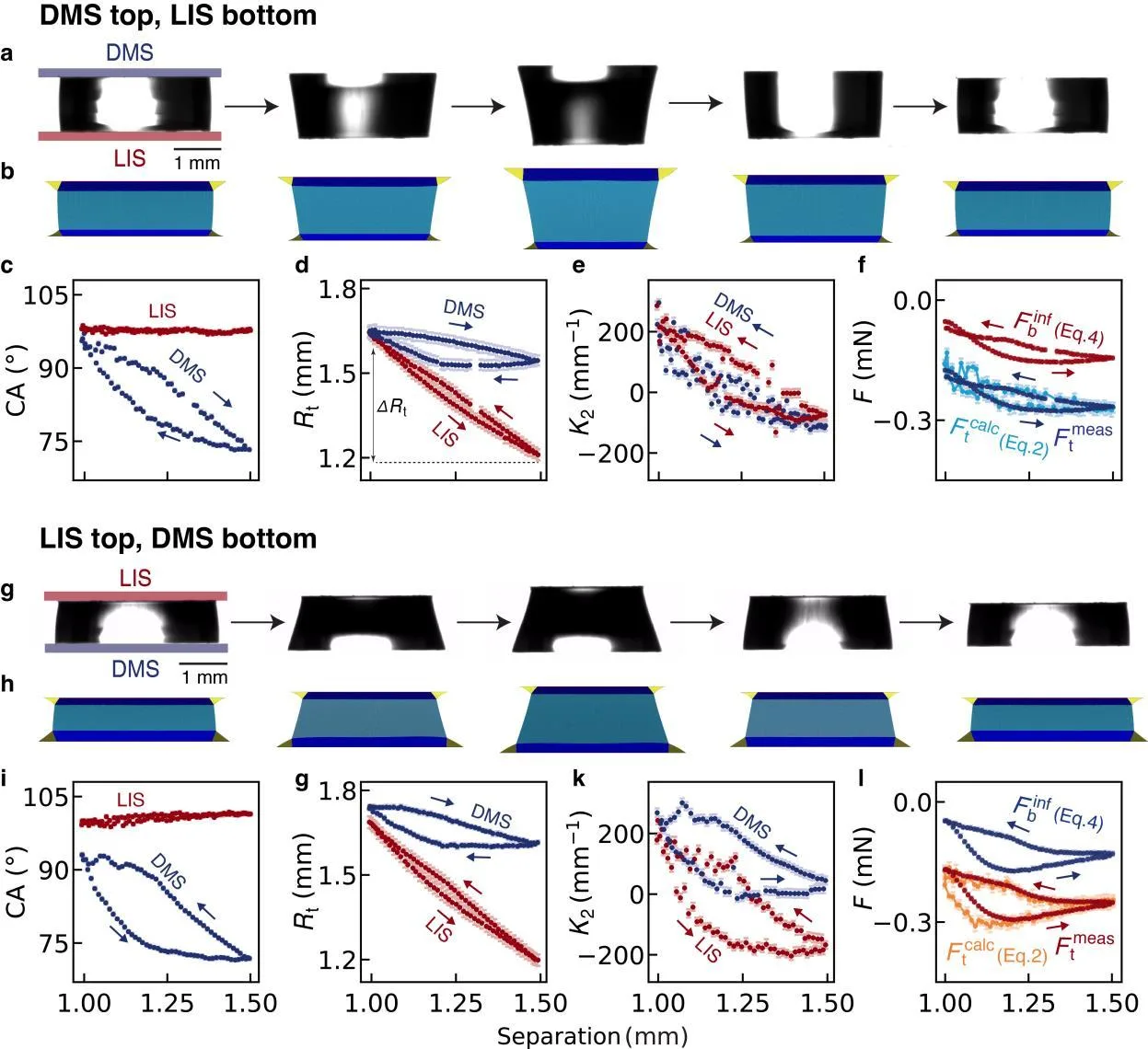
Scientists took three kinds of surfaces: plain glass, glass with a water-repellent coating, and glass infused with silicone oil. They slowly moved the surfaces together and apart, watching how the bridge changed and how much force it exerted. On plain glass, the bridge sticks to one spot and moves in jerks, like a drop stuck to a table. On the water-repellent coating, it slides more freely, but as it moves back and forth, its edges stretch and compress. On the oil-infused surface, the bridge barely clings: it slides easily and even changes shape under gravity.
Such experiments help us understand how to control tiny drops. This could be useful in microfluidics, where liquids move through narrow channels, and in creating coatings that clean themselves of water.
Original abstract
as written by the authors arXiv:2601.00345
Aqueous capillary liquid bridges are ubiquitous in nature and in technological processes. Here, we comparatively investigate capillary bridges formed between three distinct types of surfaces: (i) hydrophilic glass, (ii) hydrophobic dichlorodimethylsilane (DMS)-functionalized glass, and (iii) silicone-oil-infused LIS. We combine experimental measurements and computer simulations of the capillary bridge evolution upon changes in the gap size between the surfaces, deriving in each case the bridge geometry and the resulting capillary force. The results, also compared with predictions from the existing theory, follow expected trends on glass and DMS-functionalized surfaces: contact line pinning dominates the bridge behavior on glass with a characteristic stick-slip motion, whereas a pronounced advancing and receding hysteresis is observed on DMS surfaces. On LIS, the absence of pinning leads to minimal force variation, gravity-driven breaking of the bridge symmetry, and possible liquid exchange between LIS through bridge cloaking. These effects become particularly significant in asymmetric bridge configurations combining LIS and DMS surfaces, where the transfer of lubricant from LIS to DMS modifies the effective surface tension and alters bridge-surface interactions. Our systematic comparison of the capillary bridge behavior across solid and liquid interfaces with varying wettability provides a foundation for designing functional surface applications with controlled bridge-surface interactions.
Capillary bridges hold sand grains together in wet-sandcastles: that's why building them by the sea is so much fun.