Ductility is the property that allows a solid material to stretch, bend, or draw into a wire under tensile stress without breaking. It is the opposite of brittleness: a ductile material yields and deforms plastically before it fractures, while a brittle one snaps with little or no warning. This behavior is central to why metals can be hammered into sheets or pulled into wires, and why structural materials can bend under load instead of failing catastrophically.
History
The concept of ductility has been understood qualitatively since antiquity, as goldsmiths and blacksmiths exploited it. The scientific explanation in terms of dislocations was developed in the 1930s by G.I. Taylor, Egon Orowan, and Michael Polanyi, independently.
How it works
At the atomic level, ductility arises from the ability of planes of atoms to slide past one another without breaking the bonds that hold the material together. This sliding is mediated by defects called dislocations, which move through the crystal lattice when stress is applied. If dislocations can move easily, the material deforms plastically; if they are pinned or cannot form, the material fractures. Alloying, temperature, and microstructure all influence how easily dislocations move, which is why some materials are ductile and others are not.
In practice
Ductility is a key design criterion in engineering: it determines whether a bridge, pipeline, or pressure vessel will deform visibly before failure, giving warning, or shatter without notice. It is also essential for metal forming processes like rolling, forging, and wire drawing.
Fun fact
Gold is so ductile that a single ounce can be drawn into a wire over 80 kilometers long.
It is easier to turn a jar lid by gripping its edge than its center. Layered crystals such as graphite behave similarly when one layer is twisted relative to another: the resistance arises not from the whole contact area but only from its rim.
A crowd at the entrance to a narrow corridor behaves differently than in a spacious hall: some people get pressed against the walls, others are pushed forward. Roughly the same happens when an elongated particle finds itself in a fluid teeming with self-propelled dumbbells. Until now, it was unclear why such a particle moves faster along its long axis than across it, and how the crowd density affects its speed.
A light switch clicks, and the light comes on. But imagine a switch that, with the same press, can either turn on the lamp or leave the room dark. It also remembers what it did last time, and sometimes it seems to flip a coin to decide whether to light up.
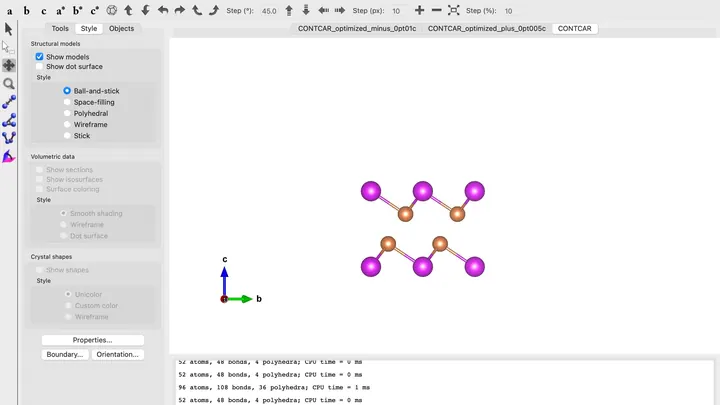
This kind of behavior was found in a crystal of black phosphorus — a semiconductor just a few atomic layers thick.
At a concert, moving through a dense crowd is tough — the tighter the pack, the less you want to move. That's how active matter usually behaves: swarms of bacteria or robot flocks freeze in tight quarters. But one research group found the opposite effect.
Two pieces of sandpaper are pressed tightly together. As you start to slide them, they first catch on the rough spots, then suddenly slip. A fault in the Earth behaves much the same way during an earthquake. But there's a crucial detail: how far do you need to push the edges before the grip gives way? This distance is called the critical slip distance.
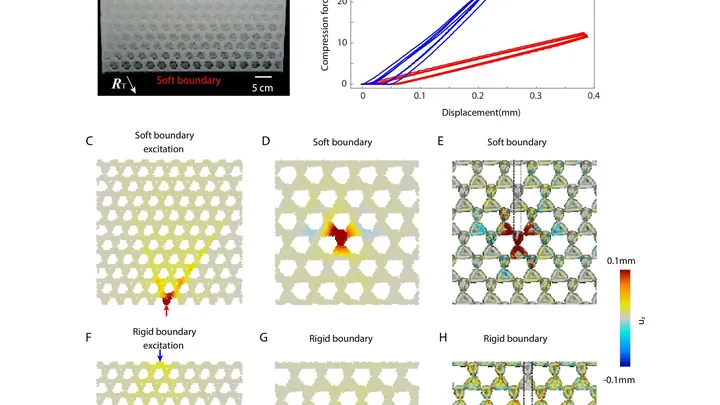
Bending a sheet of paper is easy. But compressing it by pushing from the edge is a different story: the paper will crumple but barely transmit the force further. That's how ordinary elasticity works — deformation depends on where and how you press. The new three-dimensional lattice pushes this contrast to the limit.
In 1915, Albert Einstein and Wander Johannes de Haas demonstrated that when an iron rod is magnetized, it twists slightly — the angular momentum of electrons is transferred to the crystal lattice.
The book is open to the middle. Current runs along the spine, while the pages remain cool. That's roughly how a two-dimensional topological insulator works — a material where electricity flows only along the edges, while the interior stays still.
In the new model, each active particle has an internal rhythm: it spins either left or right. Chirality is key: some twirl clockwise, others counterclockwise. But when such a particle bumps into an obstacle or a neighbor, it flips its spin, like a figure skater who, after touching the board, explodes into a reverse pirouette.
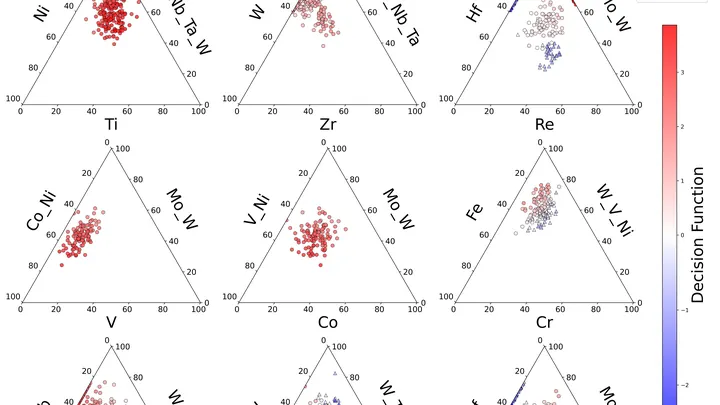
Tungsten is a true heavyweight among metals. It withstands monstrous heat and isn't afraid of radiation, which is why it's prized in fusion reactors. But there's a catch: at room temperature, it behaves like a piece of glass: it cracks on impact instead of bending.
Two-dimensional worlds never cease to amaze: here even crystal melting is not a symmetry breaking but a vortex drama discovered by Kosterlitz and Thouless. At the heart of this theater are topological сингулярности, whose energy and энтропия bargain for order. This language is common to сверхтекучести и сверхпроводимости.
A living sheet of cells resembles a crowd on an escalator. In a calm state, everyone moves smoothly, but as soon as a crush occurs, movement comes to a halt. Similarly, cell layers under load can suddenly stiffen, turning from a pliable mass into an elastic scaffold.
A lump of plasticine, when kneaded, behaves like an amorphous solid — not a crystal, but not a liquid either. Inside such a material, avalanches can occur: one tiny rearrangement triggers neighboring ones, and a wave sweeps through the entire sample.
A rubber band stretches and snaps back. A steel spring compresses and expands. Elasticity seems like a property of simple things — a piece of metal or a drop of gel. But the authors of this work looked deeper.
They showed that the electron's spin, its own tiny rotation, can also be elastic.
A cell crawls over a gel (sometimes viscous, sometimes elastic) and decides on its own when to speed up. It doesn't just glide: its internal chemical motor (noise in gene expression can affect the production of 'fuel') pushes the leading edge, while the rear detaches from the substrate.
A thin crack runs through glass. At first glance, the fracture line simply reflects the material's brittleness. But if you zoom in to the atomic level, the picture gets more complex: glass starts to resist differently when the crack accelerates.
A drop of water on a table usually sits still. But make the table slightly softer on one edge and stiffer on the other, and the drop will crawl toward the stiffer side. This phenomenon is called durotaxis: the liquid itself chooses where to flow, without pumps or electricity.
This trick works because the surface under the drop is not uniform.
When you pull on a piece of metal, it changes shape and simultaneously becomes stronger. The secret lies in tiny defects in the crystal lattice called dislocations. They are like wrinkles in a rug: moving a wrinkle shifts the rug more easily than dragging the whole rug.
In a narrow gap between two plates, water from humid air collects on its own: this is capillary condensation. If the gap is only a few nanometers wide, water no longer behaves like a continuous liquid: every molecule counts.
Inside the kidneys, liver, and other organs, fluid flows through channels that squeeze and release like a hose underfoot. The walls of these channels are not rigid: they are porous, elastic, and soaked with moisture.
A sheet of graphene one atom thick hangs in the air like a taut bedsheet. Heat waves, vibrations of atoms that physicists call phonons, ripple across it. Previously, it was thought that these waves quickly scatter due to strong interactions, and heat transfer is poor.
An alloy of palladium and tellurium with a small amount of gold added behaves like a wire that loses its resistance when cooled. At ambient pressure, the three samples with different gold contents had superconducting transition temperatures of 2.7, 4.1, and 4.6 kelvin — colder than a freezer, roughly like deep space.
A flat sheet with slits in a flow of water or air behaves like self-adjusting blinds. The pressure opens the gaps, and each strip of material tilts, turning into a miniature wing. Thus, even a sheet placed perpendicular to the flow generates not only drag but also significant lateral lift.
A sheet of graphene one atom thick is twisted at a small angle, and it starts behaving like a layered pie with layers slightly rotated relative to each other. At a certain twist angle, this material becomes a superconductor: electrons begin to move in pairs, like dancers in a waltz, without losing energy. But what exactly happens inside has remained a mystery.
A metal filament as thin as a hair grows through the ceramic like a root through asphalt. In solid-state batteries, such filaments are called dendrites, and they appear when the charging current exceeds a critical threshold. The ceramic electrolyte is solid but brittle, like glass.
In most magnetic materials, a domain wall, the boundary between regions with different magnetization, moves in one direction under current, set by the current's direction. But in ferrimagnets near a special point where the angular momenta of two sublattices cancel each other, the behavior changes.
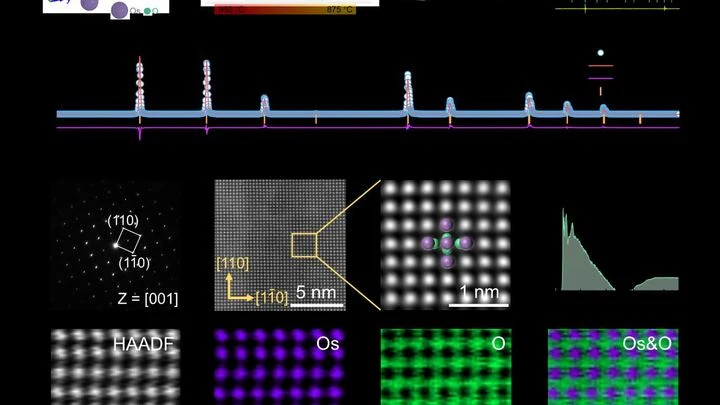
A crystal of osmium dioxide, OsO₂, is like a stubborn teenager: under ordinary conditions it behaves like a typical metal, but press hard enough and its character changes.
The layer of cells lining internal organs is like a crowd in a packed subway: everyone stands shoulder to shoulder, but sometimes the crowd starts to flow, and people slip past each other. Biologists call this behavior a transition from a jammed, solid state to a fluid one.
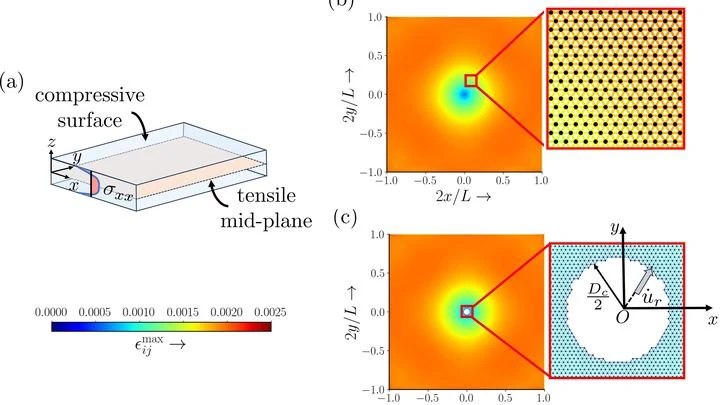
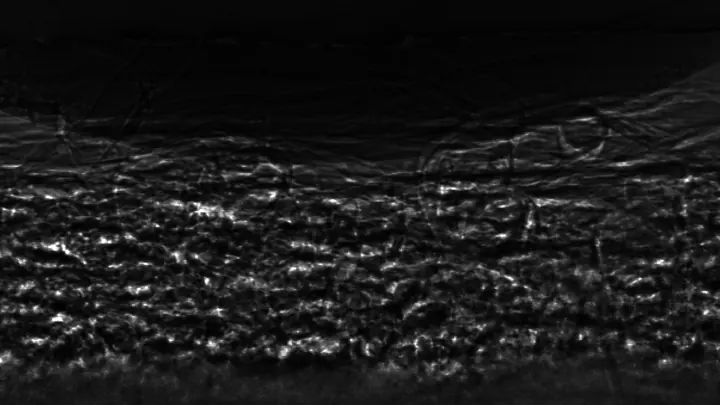
Glass is a material with attitude. It seems fragile, but powerful invisible forces can live inside it. In chemically strengthened glass, the surface is compressed like a stretched rubber band, while the interior is stretched. When a fast object hits such glass, that rubber band snaps in many places at once.
Scientists fired projectiles at glass and watched how it shattered.
When you press your finger on a piece of soft putty, it obediently dents and then slowly returns to its original shape. But if you press on a window pane, it either holds or cracks — no smooth deformation. Both materials are amorphous: their atoms are not arranged in a strict crystal lattice like in metal. Yet they behave completely differently.
Felt looks like a tangled ball of wool, but under X-rays you can see hidden trails inside. When a water drop lands on such material, it doesn't just spread across the surface — some of the liquid dives deep, like water into blotting paper. Scientists captured this process for the first time with an X-ray camera snapping hundreds of frames per second.
The secret lies in the needles.
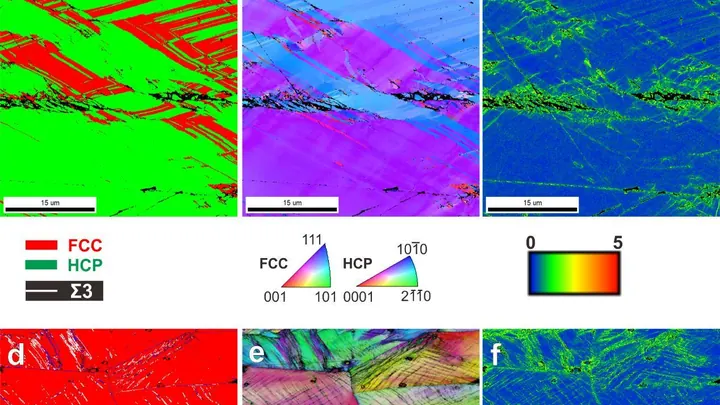
Metal is like a rope made of many strands: pull too hard and it snaps. Engineers have long sought a way to make it both strong and flexible at the same time. Typically, additives that increase strength make the metal brittle. But a team of materials scientists found a loophole: they added a small amount of nitrogen to the CrMnFeCoNi alloy, just one atom in a hundred, and got an unexpected result.
The popping lid of a jam jar is the hero of this story. Press it, and with a loud click it flips from a convex to a concave shape. Exactly the same happens with a hinged beam inside each cell of a new mechanical lattice.
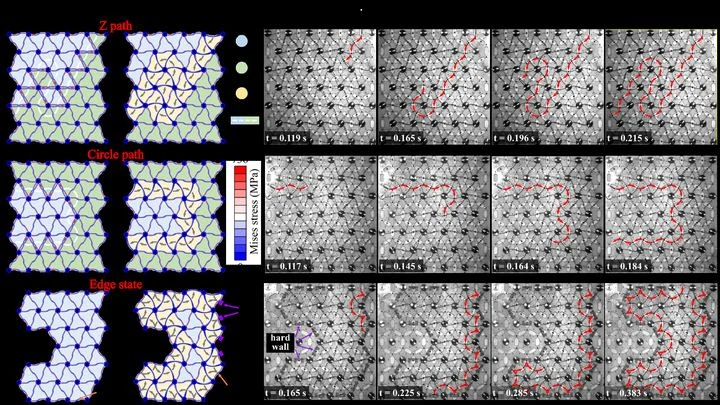
Scientists assembled these snapping beams into a hexagonal grid, like honeycomb, but made of elastic plates. When one beam is sharply compressed, it snaps and pushes its neighbor.
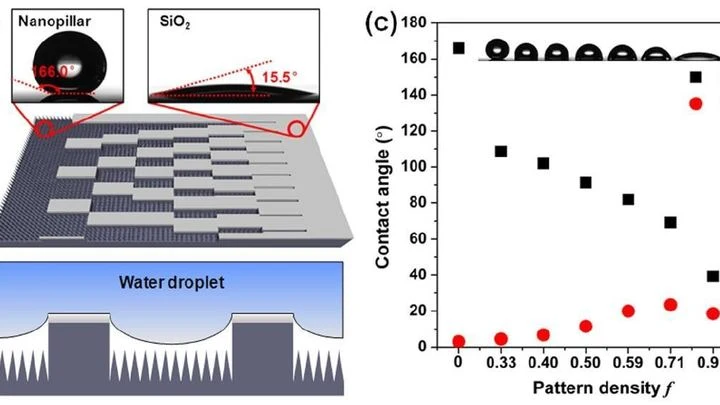
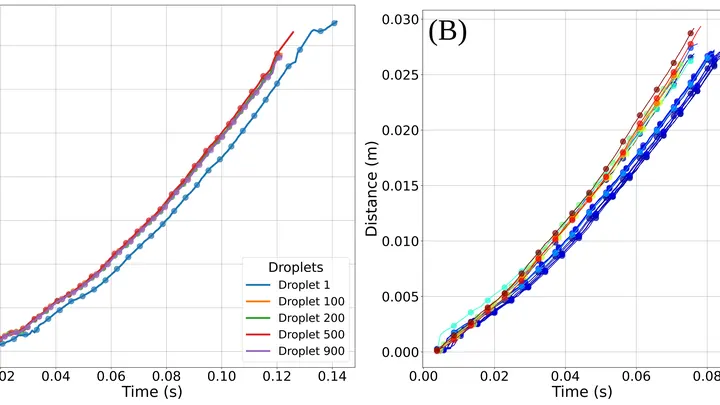
A water droplet races across a taro leaf like a bead on a freshly waxed floor. But it doesn't just glide: it picks up electricity. Thirty years ago, scientists explained why lotus leaves stay dry: their surface is covered with microscopic bumps that trap air. Now it turns out that water on leaves has another, hidden power.
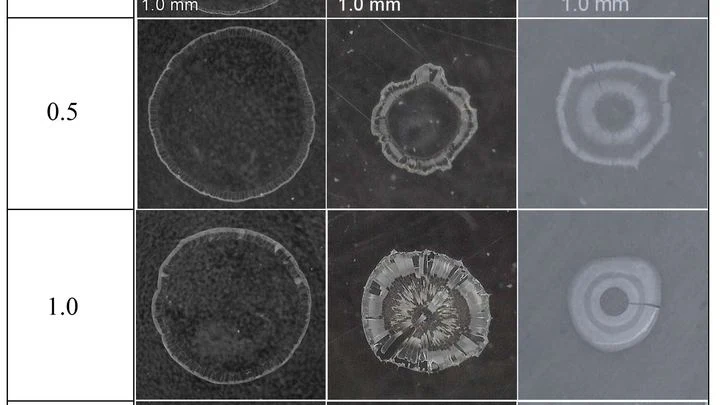
A coffee drop on a table dries and leaves a ring — coffee particles gather at the edge. But if charged nanoparticles float in the drop, the picture becomes richer: the deposit cracks like mud in a dried-up puddle. Physicists studied how the particle charge and the surface on which the drop dries change these cracks.
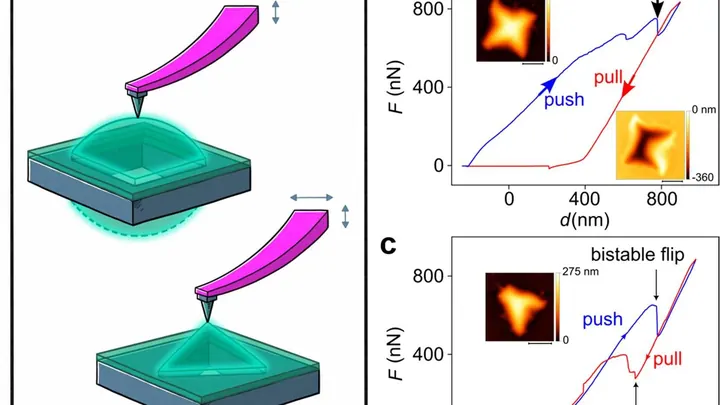
A thin film of metal oxide lies on a surface with a tiny pit. If you gently compress the film from the sides, it won't crumple — instead, it will bow downward into the pit or bulge upward like a hump. Both positions are stable, like a canning jar lid that is either concave or convex and doesn't flip back and forth on its own.
A bacterium swims like a tiny motorboat with a propeller — except its propeller is a long flagellum that rotates and pushes the body forward. But the body doesn't move in a straight line; it sways like a bobber on a wave. This swaying isn't random: it's part of the mechanics of motion.
Until now, such swaying was studied in still water.
A spider web is not just a sticky net but a delicate instrument that responds to the weather. When the air becomes humid, spider silk threads shorten and twist, like a wet towel being wrung from both ends. Previously, it was thought that the thread twists because the proteins inside are arranged in a spiral. But no direct evidence for such an arrangement was found.
Snap the bottom of a soda can: it will dent inward and stay that way. Press again: it pops outward. That's bistability: a system with two stable states, like a light switch. An elastic arch is the simplest example. It can curve upward or downward, and to flip it, you need to apply force.
A kitchen sponge squeezed in your fist springs back. But if you squeeze it slowly while letting it dry, it stays flattened. That's roughly what scientists did with tiny gel beads: they let them dry while compressing them, and watched what happened inside.
A gel is made of tiny particles that stick together into an open, lacy network, like cereal flakes in a bowl of milk.