Friction is the resistance to relative motion between two surfaces in contact. It arises from the microscopic interactions of surface asperities, including adhesion, deformation, and plowing. Friction is not a fundamental force but a macroscopic manifestation of electromagnetic forces between atoms and molecules. It plays a crucial role in everyday life, from walking and writing to braking and machinery, and its absence in superfluids and superconductors leads to remarkable phenomena like persistent flow without energy loss.
History
The classical laws of friction were formulated by Leonardo da Vinci and later formalized by Guillaume Amontons in 1699 and Charles-Augustin de Coulomb in 1785. The modern understanding of friction as a multi-scale phenomenon developed in the 20th century with contributions from Bowden and Tabor.
How it works
When two surfaces slide, the real contact area is only a small fraction of the apparent area, consisting of microscopic peaks (asperities) that deform and bond. The friction force is proportional to the normal load, with a proportionality constant called the coefficient of friction. At the atomic scale, friction involves the excitation of phonons and electrons, dissipating kinetic energy as heat. In superlubricity, certain crystalline surfaces can slide with nearly zero friction due to incommensurate atomic lattices that cancel lateral forces.
In practice
Friction is engineered in brakes, tires, and clutches for safety, and minimized in bearings, lubricants, and microelectromechanical systems to reduce wear and energy loss.
Fun fact
In superfluids, friction vanishes entirely, allowing liquid helium to flow through microscopic cracks and even climb up and over the walls of its container.
It is easier to turn a jar lid by gripping its edge than its center. Layered crystals such as graphite behave similarly when one layer is twisted relative to another: the resistance arises not from the whole contact area but only from its rim.
Two pieces of sandpaper are pressed tightly together. As you start to slide them, they first catch on the rough spots, then suddenly slip. A fault in the Earth behaves much the same way during an earthquake. But there's a crucial detail: how far do you need to push the edges before the grip gives way? This distance is called the critical slip distance.
A speed of 7,5 kilometers per second is the threshold beyond which a cosmic collision turns dust grains into a chemical reactor. In the interstellar medium drift tiny cosmic dust grains — the legacy of dying stars.
A tuning fork struck once rings pure and long. But if you shake the fork itself while it sounds, the tone wavers and dies out quickly. Something similar happens to electrons in any piece of matter. Atoms in a lattice never stay put: thermal vibrations keep them jittering.
Two grains of salt fall into a glass of water. They dissolve, and sodium and chloride ions spread throughout the volume. The schoolbook truth is simple: like charges repel, opposite charges attract. But recent experiments with tiny spheres in liquids have revealed a picture that breaks this rule.
A thin crack runs through glass. At first glance, the fracture line simply reflects the material's brittleness. But if you zoom in to the atomic level, the picture gets more complex: glass starts to resist differently when the crack accelerates.
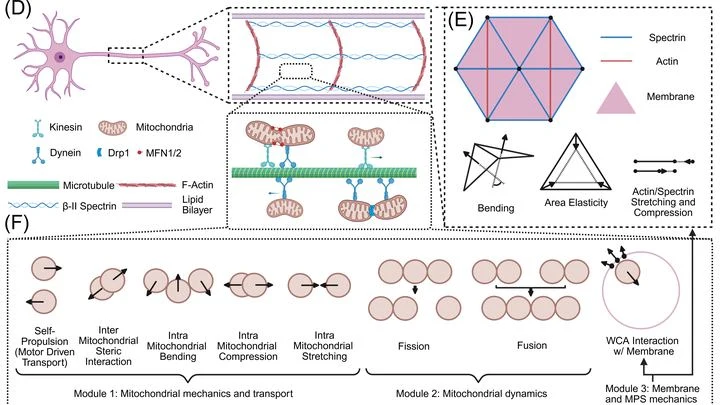
Inside every neuron, there's a long, thin channel, the axon, through which signals travel from the cell body to other cells. To keep this channel working, mitochondria constantly shuttle along it. These tiny organelles produce energy and move in both directions, like cars on a narrow road.
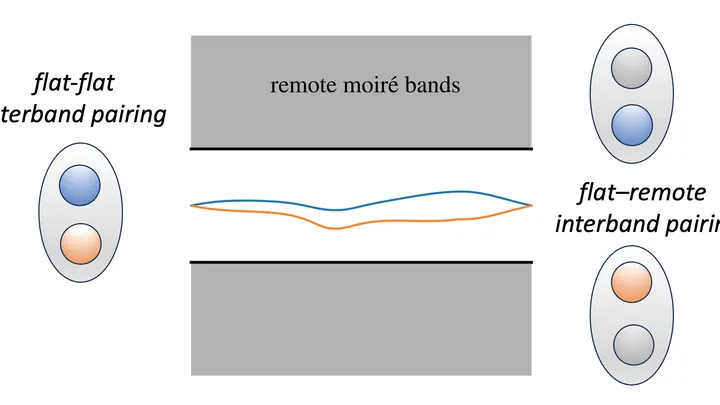
A sheet of graphene one atom thick is twisted at a small angle, and it starts behaving like a layered pie with layers slightly rotated relative to each other. At a certain twist angle, this material becomes a superconductor: electrons begin to move in pairs, like dancers in a waltz, without losing energy. But what exactly happens inside has remained a mystery.
The boundary between two liquids is like an invisible skin: it's there, but you can't touch it with your finger. Scientists have found a way to measure its elasticity without touching it. They made a tiny probe oscillate above the surface, and between the probe and the interface lay a thin film of liquid.
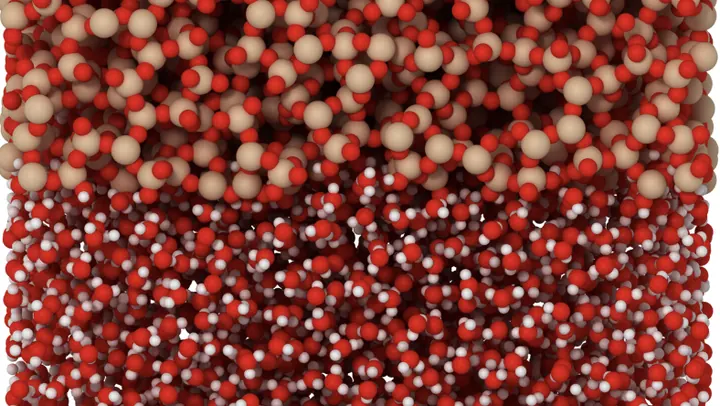
Ice slips away from under a skate blade like a bar of soap in wet hands. For a hundred years, scientists argued about where this slipperiness comes from. Some said there is already a thin layer of water on top: it acts as a lubricant. Others countered that water only appears when you start moving, due to friction.
Inside every cell, there is a scaffold of filaments, like construction scaffolding that gives the cell its shape and allows it to move. These filaments are connected by crosslinking proteins: some simply hold them together like ropes, while others act as tiny motors that crawl along the filaments and pull them toward each other.
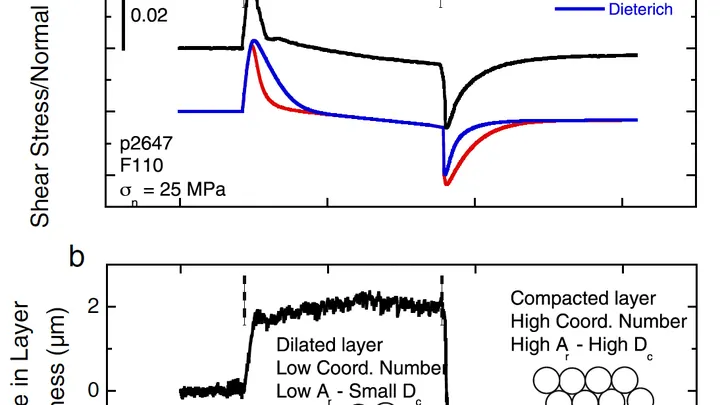
When two tectonic plates grind against each other, a layer of pulverized rock ends up between them, like sand between your palms. This layer, which geologists call fault gouge, behaves not like solid rock but like a thick paste: it can compact, dilate, and slide. Whether a fault ruptures in a devastating earthquake or creeps slowly and safely depends on its whims.
Two pieces of graphite rub against each other, and the resistance vanishes as if an invisible film of oil separated them. Previously, this was only seen under a microscope, on tiny contact patches.
A thin rubber film lies on a table. Someone grabs it by the middle and slowly pulls upward. The film doesn't just rise: it arches into a dome, then wrinkles run along the dome's edge, like pleats on a skirt. Pull higher — the wrinkles gather into large folds that cross the entire film. And if you start lowering it, the folds don't disappear but collapse into new shapes.
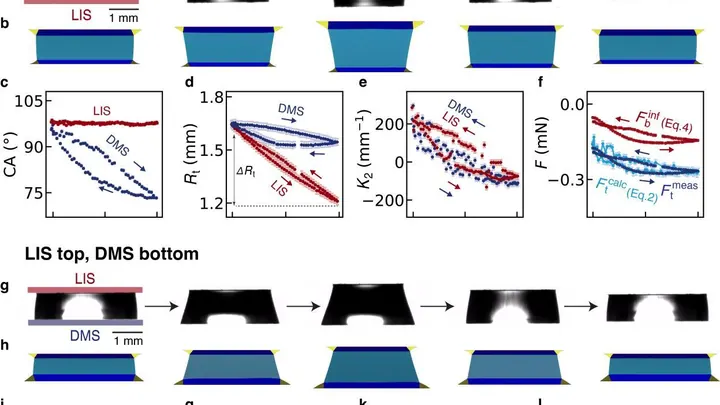
A drop of water squeezed between two close surfaces turns into a tiny bridge. Such bridges are everywhere: they hold sand grains together in wet sand, make hair clump after a shower, and even help insects walk up walls.
Scientists took three kinds of surfaces: plain glass, glass with a water-repellent coating, and glass infused with silicone oil.