substance

glass

A hard, brittle, typically transparent material used as a standard substrate in wetting experiments.
14 related articles

Description

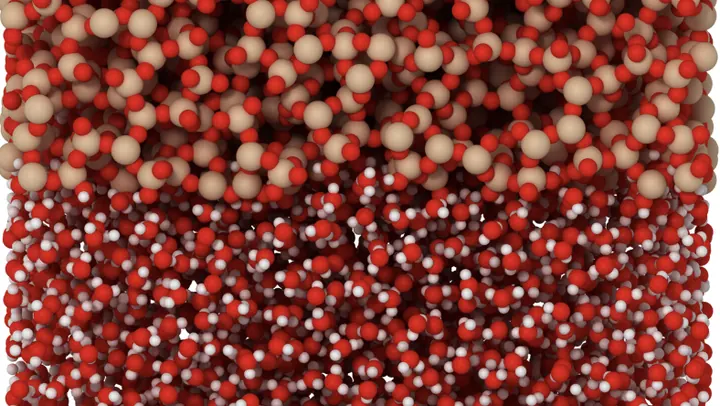
Glass is a hard, brittle, and typically transparent amorphous solid, commonly made by rapidly cooling molten silica. Unlike crystalline materials, glass has no long-range atomic order, which gives it unique properties: it is isotropic, transparent to visible light, and can be formed into smooth, chemically stable surfaces. In wetting experiments, glass is a standard substrate because its surface chemistry is well understood and can be easily cleaned or modified.

History

Glassmaking dates back to at least 3500 BCE in Mesopotamia, but the scientific understanding of its amorphous structure emerged in the 20th century with X-ray diffraction studies. The concept of the glass transition was formalized in the 1920s.

How it works

Glass is produced by cooling a melt fast enough to prevent crystallization, leaving the atoms in a disordered, frozen-liquid state. Its surface is typically covered with silanol (Si-OH) groups, which make it hydrophilic—water spreads easily on it. This predictable surface energy allows researchers to study how droplets interact with different coatings, roughness, or chemical modifications. The brittleness of glass arises from the lack of plastic deformation mechanisms; cracks propagate easily once initiated, which is why glass shatters rather than bends.

In practice

Glass is used as a standard substrate in microfluidics, contact angle measurements, and biological assays. Its transparency and chemical resistance also make it essential in optics, laboratory equipment, and architectural windows.

Fun fact

Glass is not a liquid that slowly flows; ancient window panes are thicker at the bottom because of the manufacturing process, not because of gravity-driven flow over centuries.

Concept graph →

Related articles · 14

Optics2026-08-193 minarXiv:2608.19016
A Silicon Atom in the Dark: A Trap That Doesn't Glow
The laser beam in an optical tweezer is not just a spot of light but a force bag. A particle caught in it usually rolls toward the brightest point, like a ball into a dimple.
Optics2026-08-131 minarXiv:2608.13548express
Twisting Light in a Nanocrystal
A light beam usually travels in a straight line, but you can make it spin around its axis, like water swirling into a vortex as it drains. This 'twisted' light carries more information and is needed for ultra-fast communication and quantum computing.
Materials2026-07-032 minarXiv:2607.03465
Freezing Chaos: How Cubic Ice Builds Symmetry
In water cooled to –40°C, a paradoxical pause sets in: perfect hexagonal ice is in no hurry to form. Instead, a disordered structure with interspersed cubic layers emerges — a real cradle for future symmetry, brimming with disorder yet already charged with hidden architecture.
Optics2026-06-201 minarXiv:2606.21825express
Broadband Plasmonic Cloaking: How a Multilayered Shell Makes Objects Invisible Across the Visible Spectrum
Imagine a multilayered shell where metal and insulator layers alternate like pages in a book. Such a structure can make an object hidden inside invisible to an observer. Light bends around it as water smoothly flows around a smooth stone: no ripple, no splash — no reflection, no shadow.
Exoplanets2026-06-132 minarXiv:2606.15472express
The Golden Pressure for Life
Deep beneath our feet, in the scorching mantle, iron leads a double life. It can be divalent or trivalent, like a coin that lands heads or tails. Which side dominates determines how much oxygen stays in the planet's rocky shell and how much sinks into the core.
Optics2026-05-302 minarXiv:2606.00565express
Invisible Beads: Cooling That Doesn't Care About Size
Two white sheets lie in the sun — one rough, one smooth. Which one heats up less? The rough one scatters light more strongly, so it seems it would stay cooler. But if the coating is made of many transparent glass beads, the logic changes. Light wanders through it like in a thick fog, and at some point it stops noticing individual droplets.
Materials2026-05-052 minarXiv:2605.03457express
Glass That Gets Stronger on the Fly
A thin crack runs through glass. At first glance, the fracture line simply reflects the material's brittleness. But if you zoom in to the atomic level, the picture gets more complex: glass starts to resist differently when the crack accelerates.
Fluid Dynamics2026-04-021 minarXiv:2604.01692express
The Heart That Won't Sink
A plastic heart rests on the water and doesn't tip over, no matter how you turn it. It freezes in any position, as if the water were holding it by invisible strings. This trick is possible thanks to the Zindler curve — a shape in which all lines that divide the area in half have the same length. The Zindler curve is a closed curve where any chord that bisects the area has the same length.
Materials2026-03-181 minarXiv:2603.17400express
Glass That Breathes in Picoseconds
Ordinary window glass may seem frozen forever, but inside, atoms never stay still. In amorphous germanium telluride (GeTe)—a material used in rewritable discs and non-volatile memory — physicists have for the first time directly tracked how atomic bonds stretch and bend in trillionths of a second.
Materials2026-03-121 minarXiv:2603.11539express
Ice Is Slippery Because of Heat
Ice slips away from under a skate blade like a bar of soap in wet hands. For a hundred years, scientists argued about where this slipperiness comes from. Some said there is already a thin layer of water on top: it acts as a lubricant. Others countered that water only appears when you start moving, due to friction.
Materials2026-02-271 minarXiv:2602.24248express
The Mystery of the Silicon Crystal, Solved
Silicon is like a universal building block: it goes into the chips in your phone, solar panels, and lasers. But if you squeeze it with immense force, the atoms rearrange into new patterns: these forms are called allotropes. One of them, Si-XIII, was first spotted more than twenty years ago, but its exact pattern remained a mystery.
Optics2026-02-101 minarXiv:2602.09732express
How to Make Tissues Transparent for Microscopy
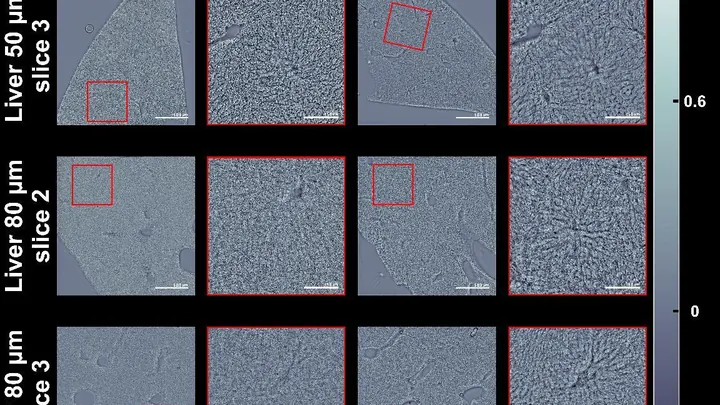
A thick slice of tissue under a microscope looks like fogged glass: light scatters and details are lost. Usually, to see cells, you stain them or cut them into very thin slices. But there's a simpler way — make the slice itself transparent, as if you've wiped the glass clean.
The Secret of Warped Webs: A New Way to Compare Networks
Graphs are considered identical if their 'terrain' matches. Imagine two maps with mountains and valleys: even if drawn differently, the heights and steepness of slopes can be the same.
Drops That Hang by a Hair
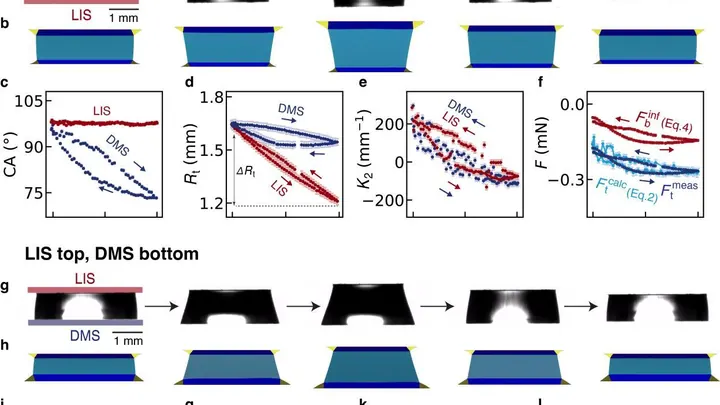
A drop of water squeezed between two close surfaces turns into a tiny bridge. Such bridges are everywhere: they hold sand grains together in wet sand, make hair clump after a shower, and even help insects walk up walls. Scientists took three kinds of surfaces: plain glass, glass with a water-repellent coating, and glass infused with silicone oil.