Glue and Springs: How to Assemble the Perfect Pattern express
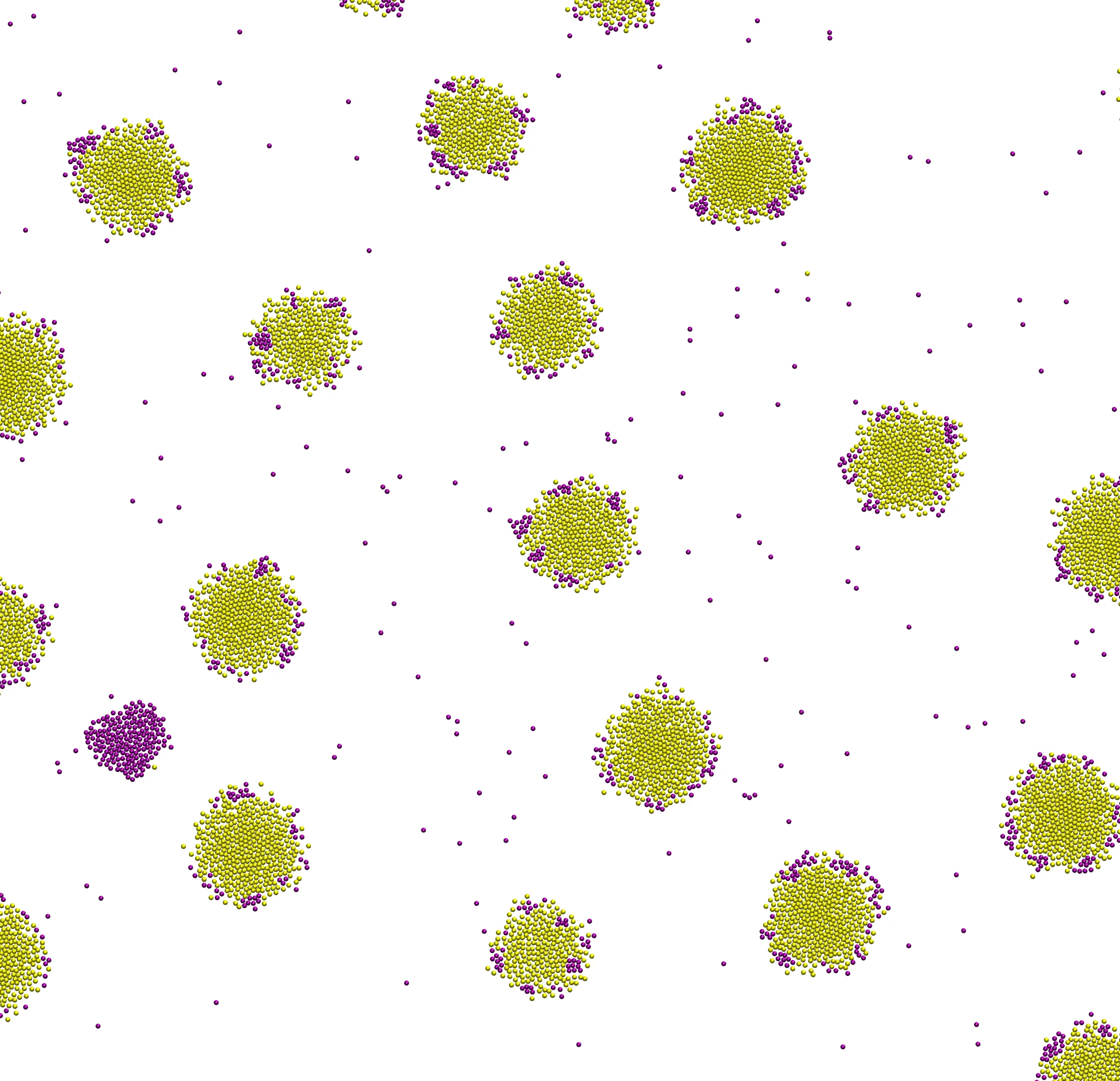
A handful of magnetic beads, when shaken, clump together. But add springs that push the beads apart at a distance, and the clumps break up into neat islands. Roughly this is how the particles in the new study behave: they attract at close range but repel from afar.
The authors simulated millions of variants of this 'glue with springs' on a computer. They varied the height of the repulsion barrier, added waves to the sticky well, and even made particles non-spherical, with sticky patches. It turned out that the size of clusters, their shape, and how ordered they are inside can be controlled almost independently. Particularly interesting: if you impose a slight ripple on the attraction, the particles inside a cluster freeze as in a crystal, while the clusters themselves continue to glide smoothly, like ice cubes in slush.
The authors also mixed two sorts of particles with different 'personalities': some stick more strongly, others more weakly. With the right tuning, inside a single cluster you get a layered cake: one sort gathers into the core, the other forms the shell. And if particles have sticky patches only on one side, their shape and the number of patches dictate whether they assemble into chains, rings, or mosaics.
This work is like an instruction manual for a construction set where the pieces are interaction laws. Knowing the rules, you can calculate in advance what pattern will emerge. This will help in creating new materials with unusual properties and in deciphering how the cell assembles its internal structures without blueprints.
In experiments with magnetic beads and springs, you can see the same patterns as in computer models: if you tune the magnet strength and spring stiffness, the beads will spontaneously arrange into a hexagonal lattice with holes.
In Stanislaw Lem's novel 'The Invincible', self-organizing microparticles form clouds capable of collective behavior — a distant echo of the assembly principles studied in this article.