A suspension is a heterogeneous mixture in which solid particles are dispersed throughout a liquid (or gas) and are large enough to settle out over time. Examples include mud in water, paint, and blood cells in plasma. The behavior of suspensions is governed by the interplay between the particles and the surrounding fluid, leading to complex phenomena like shear thickening and jamming.
History
The systematic study of suspensions dates back to the 19th century, with important contributions from scientists like George Gabriel Stokes on the motion of particles in fluids.
How it works
The particles in a suspension experience forces from the fluid (drag, lift) and from each other (collisions, electrostatic repulsion). The overall behavior depends on factors like particle size, concentration, and the viscosity of the fluid. At low concentrations, the suspension behaves like a simple liquid, but at high concentrations, particles can form structures that dramatically change the flow properties.
In practice
Suspensions are central to many industrial processes, including the formulation of paints, inks, and pharmaceuticals. Understanding their behavior is also key in fields like food science (e.g., chocolate milk) and environmental engineering (e.g., sediment transport in rivers).
Fun fact
Some suspensions, like cornstarch in water, exhibit 'shear thickening'—they become more viscous when stirred or hit, which is why you can run across a pool of it but sink if you stand still.
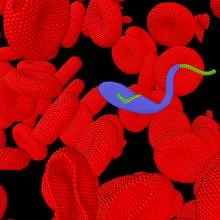
A swimmer in a pool filled with light balls pushes off them and swims faster than in clear water. That is roughly how a trypanosome, a single-celled parasite that causes sleeping sickness, behaves when it enters blood, where red cells occupy nearly half the volume.
Plasma is a gas in which electrons are stripped from atoms and roam freely. Sometimes, regions where electrons are almost absent spontaneously appear in such a gas; they are called holes. It is like a whirlpool forming in a stream, pulling everything around it in. But exactly how such a whirlpool is born has long remained a mystery.
In a glass of murky liquid where starch is settling, the eye sees only a gray haze. Particles inside are moving, but what exactly is happening remains a mystery. Conventional optical instruments cannot penetrate such a suspension: light scatters already in the top layer.
Ordinary electric current heats up wires — anyone who has touched a phone charger knows that. But there's another kind of current: instead of electrons rushing in a crowd in one direction, they spin in sync, like figure skaters in a pairs routine. This coordinated rotation is called a spin current, and it produces almost no heat.
The quantum world loves balance. When a massive particle is forced to split, to go down two paths at once, something must give way in response. That "something" turns out to be the very apparatus that split the particle.
Imagine two immiscible liquids, such as oil and water. Under normal conditions, they tend to separate, forming a clear interface. But introduce microscopic swimmers (bacteria, whose basis is carbon) and the picture changes dramatically.
A lump of plasticine, when kneaded, behaves like an amorphous solid — not a crystal, but not a liquid either. Inside such a material, avalanches can occur: one tiny rearrangement triggers neighboring ones, and a wave sweeps through the entire sample.
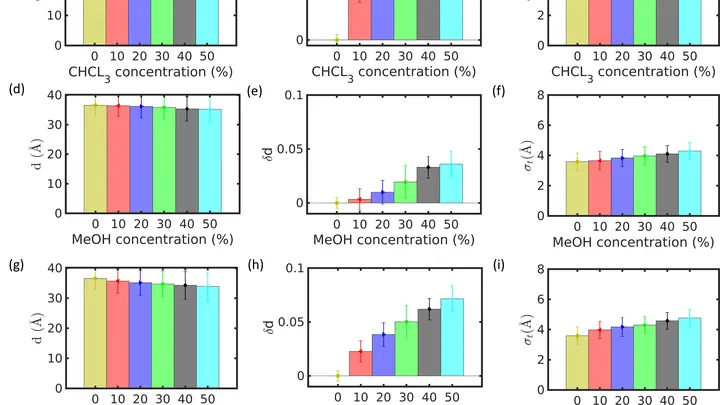
A cell membrane is like a picket fence of tightly packed molecules — long as matchsticks, with a water-loving head and a water-fearing tail. It's not just a wrapper but a living barrier: it lets the right things in, keeps the wrong ones out, and holds its shape. But add a bit of chloroform or alcohol to the water, and that fence starts to sway.
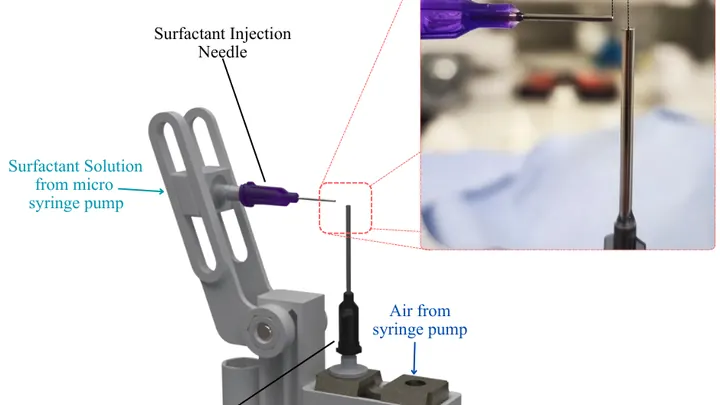
An air bubble escapes from a thin needle at the bottom of a glass and shoots upward. In clean water, it behaves like a spring: it flattens, then stretches, exchanging energy between motion and shape. Add a drop of soap to the water, and the bubble immediately calms down, becomes an almost perfect sphere, and rises smoothly without trembling.
Inside a cell, there are tiny liquid droplets, like oil droplets in water. They form from proteins and RNA and serve all sorts of purposes, from storing molecules to speeding up reactions. But if droplets start merging with each other, you'd end up with one big puddle, which would wreck the cell's organization.
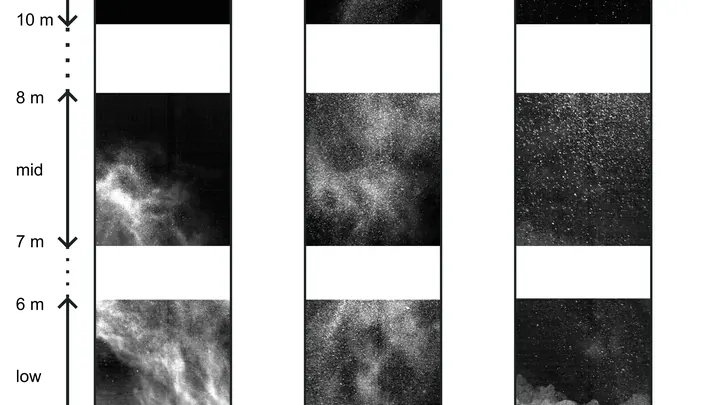
A powder avalanche isn't just a pile of snow sliding down a mountain. It's a cloud racing downhill at car speed. Inside, snow doesn't lie still: it flies: thousands of tiny particles are caught up in air vortices. Until now, no one had seen what actually happens to each snowflake in this chaos. Now scientists have the first footage.
In a protoplanetary disk, a cloud of gas and dust around a young star, dust grains don't just fly in circles. They are carried by the gas flow, like sand by the wind, and in turn alter that flow. Layers emerge, sliding past each other, and at their boundaries an instability arises — waves and vortices.
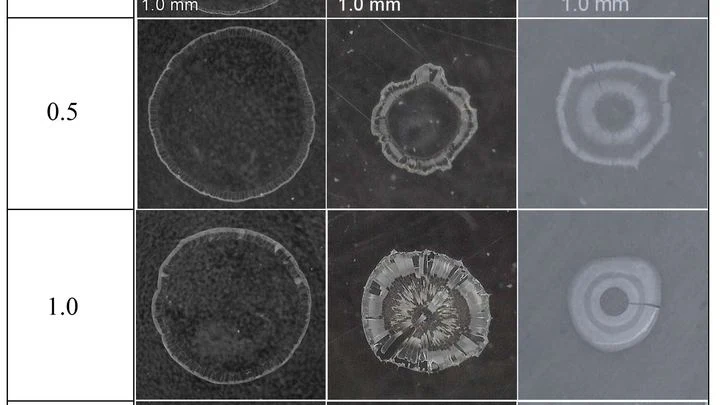
A coffee drop on a table dries and leaves a ring — coffee particles gather at the edge. But if charged nanoparticles float in the drop, the picture becomes richer: the deposit cracks like mud in a dried-up puddle. Physicists studied how the particle charge and the surface on which the drop dries change these cracks.
A sheet of paper released from a window flutters, tumbles, and sometimes pauses flat for a second. Until now, to honestly predict such behavior, you had to run millions of equations on supercomputers for every drop of air. That's like simulating every atom of a cash register to count change at a store.
The new approach is smarter.
A drop of oil in water behaves like a tiny ball: it seeks the spot with the least energy. If a wall is nearby, the drop often sticks to it, just as a raindrop spreads on glass. In a mixture of two immiscible liquids, such as polyethylene glycol and dextran, tiny droplets of one liquid form inside the other.
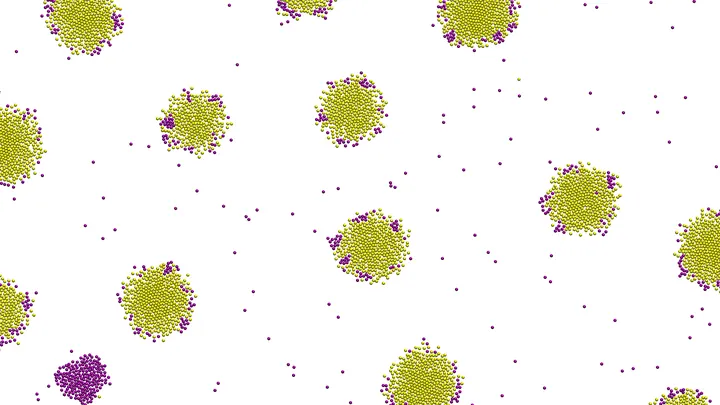
A handful of magnetic beads, when shaken, clump together. But add springs that push the beads apart at a distance, and the clumps break up into neat islands. Roughly this is how the particles in the new study behave: they attract at close range but repel from afar.
The authors simulated millions of variants of this 'glue with springs' on a computer.
Matter is like a house. In some rooms, there is the strict order of a crystal, where every atom is in its place. In others, the chaos of superfluid helium, where atoms forget about their neighbors.