A Drop on Glass: Why Solution Elasticity Doesn't Change the Stain
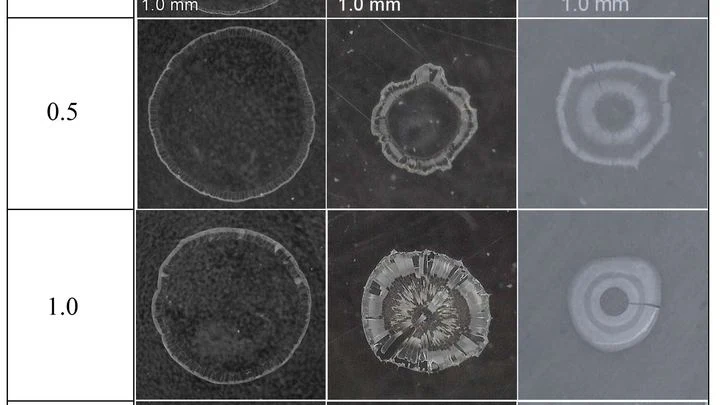
A raindrop falls on glass and flattens into a pancake. Add a bit of polymer to the water, and it becomes elastic, like jelly. You'd think such a jelly would spread differently.
A class of materials that are easily deformed, including gels, foams, and biological tissues.Soft materials are a broad class of substances that deform easily under mechanical stress, including polymers, gels, foams, colloids, and biological tissues. Unlike hard solids like metals or ceramics, soft materials have a characteristic mechanical response that is highly nonlinear, time-dependent, and often dominated by entropy rather than energy. They are ubiquitous in everyday life—from food and cosmetics to rubber and living organisms—and their behavior is governed by weak intermolecular forces and thermal fluctuations.
The field of soft matter physics was formally established in the late 20th century, with Pierre-Gilles de Gennes playing a pivotal role. His 1991 Nobel Prize in Physics recognized his contributions to understanding order in complex systems, including polymers and liquid crystals, which laid the foundation for the discipline.
The defining feature of soft materials is their low elastic modulus, meaning they require little force to change shape. This arises because their constituent particles (molecules, colloids, or cells) are held together by weak bonds, such as van der Waals forces or hydrogen bonds, and are often suspended in a fluid. The structure is typically disordered and dynamic, with thermal motion playing a significant role. When deformed, these materials can exhibit viscoelasticity—a combination of viscous flow and elastic recovery—and can undergo large strains without breaking, often with intricate responses like wrinkling, buckling, or shear thinning.
Soft materials are used in countless technologies, from flexible electronics and soft robotics to drug delivery systems and tissue engineering scaffolds. Their tunable mechanical properties also make them essential in consumer products like adhesives, foams, and lubricants.
Biological tissues, such as skin and muscle, are soft materials, and their mechanical properties are crucial for cell behavior—cells can sense the stiffness of their surroundings and change their migration, growth, and even gene expression accordingly.