A cluster is a group of particles bound together by attractiveforces, ranging from a few atoms to millions of stars. In physics, clusters appear at every scale: atomic nuclei are clusters of protons and neutrons, atoms can form clusters held by van der Waals forces, and galaxies assemble into galaxy clusters via gravity. The defining feature is that the system's behavior is governed by the collective interplay of attraction and repulsion, not just the properties of individual members.
History
The concept of clustering emerged gradually across disciplines, from Dalton's atomic theory (1803) to the discovery of galaxy clusters in the 20th century. The specific term 'cluster' became standard in nuclear physics in the 1930s and in astronomy by the 1950s.
How it works
Clusters form when attractiveforces overcome the kinetic energy of particles trying to fly apart. The balance depends on temperature, density, and the nature of the force — nuclear forces bind quarks into protons, electromagnetic forces bind electrons to nuclei, and gravity binds stars into galaxies. In some cases, repulsive forces can mimic attraction, as seen in certain quantum systems where particles effectively pull together despite like charges.
In practice
Clusters are used in quantum computing research (e.g., cluster states for measurement-based computation) and in astrophysics to study dark matter distribution via galaxy cluster dynamics.
Fun fact
Some atomic clusters, like the helium-4 cluster in carbon-12, are so finely tuned that a slight change in nuclear forces would prevent carbon from forming — and thus life as we know it.
Two ink reservoirs stand on opposite sides of the cell junction. From them, two types of monomers flow onto the membrane, and when they meet, they form viscous droplets of complexes. The droplets barely move, but the free monomers dart around as fast as perfume molecules in a room.
Deep inside a neutron star, where matter is compressed to the density of an atomic nucleus, neutrons form a superfluid and protons form a superconductor. A neutron vortex is a quantized vortex in the superfluid, akin to a miniature whirlpool that cannot stop spinning.
Water droplets shoot out of a nozzle one after another, like cyclists on a narrow track. The faster ones catch up with the slower ones and merge into larger drops. This simple mechanism is called ballistic aggregation, and until now it had only been observed on cosmic scales: this is how dust particles stick together to form planets.
Usually, the complexity of systems, from satellite motions to heart rhythms, is assessed with averaged entropy (a measure of unpredictability, as understood by Boltzmann). But that's like evaluating the ocean only by wave height: the average figure hides the full richness of underwater currents.
The early universe expanded at a breakneck pace: this phase is called inflation. But how exactly did it do it? Some models describe the expansion as a steep exponential surge, others as a more gentle power-law motion.
The carbon nucleus was long imagined as a uniform ball of protons and neutrons, evenly mixed like dough. But physicist George Gamow suspected otherwise: particles inside might group into tiny, sturdy blocks — helium nuclei, or alpha particles.
In nuclear physics, the belief long reigned that two neutrons cannot form a bound state — they attract too weakly and immediately fly apart. However, on the surface of neutron-rich nuclei, where the matter density drops to a thousandth of normal nuclear density, the situation changes dramatically.
At first glance, the atomic nucleus is a cramped communal apartment where protons and neutrons (together called nucleons) live by strict rules. Each occupies its own orbit, like electrons in an atom, and on average everything looks orderly.
A handful of rice thrown into a glass of water scatters — the grains spread apart. Now imagine each grain propels itself forward with stubborn persistence and bounces off softly upon collision. Such particles are called active: they spend their own energy to move, like bacteria or microscopic robots.
Gravity is like a stretched trampoline: massive bodies press into it, making other bodies roll toward them. This shared curvature of space, gravity, affects everyone, but it doesn't convey secret messages.
A cold cloud of atoms is like a swarm of fireflies drawn to one another. The attraction between atoms tries to pack them into a single dense ball. But quantum jitter, the unavoidable motion of particles, keeps the ball from collapsing. When the attraction is strong, the cloud breaks into separate clumps.
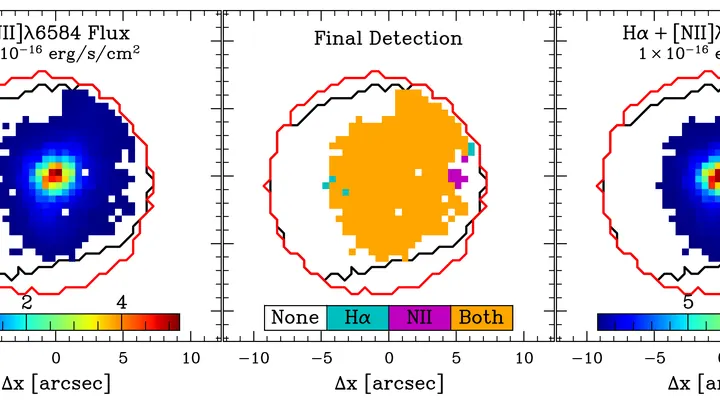
A galaxy cluster is like a busy intersection where galaxy-cars race through a headwind of hot gas. This wind, called ram pressure, strips galaxies of their cold gas — the fuel for star formation. Astronomers from the SAMI survey traced how this happens in hundreds of galaxies across eight nearby clusters.
In the dense, star-forming gas cloud W44, the ALMA telescope has spotted eight tiny clumps racing at enormous speeds. In position–velocity maps, each one looks like the letter V, just like the previously discovered 'Bullet'. This resemblance hints at a common origin.