How Tilting the Tube Saves the Brain During Heart Surgery express
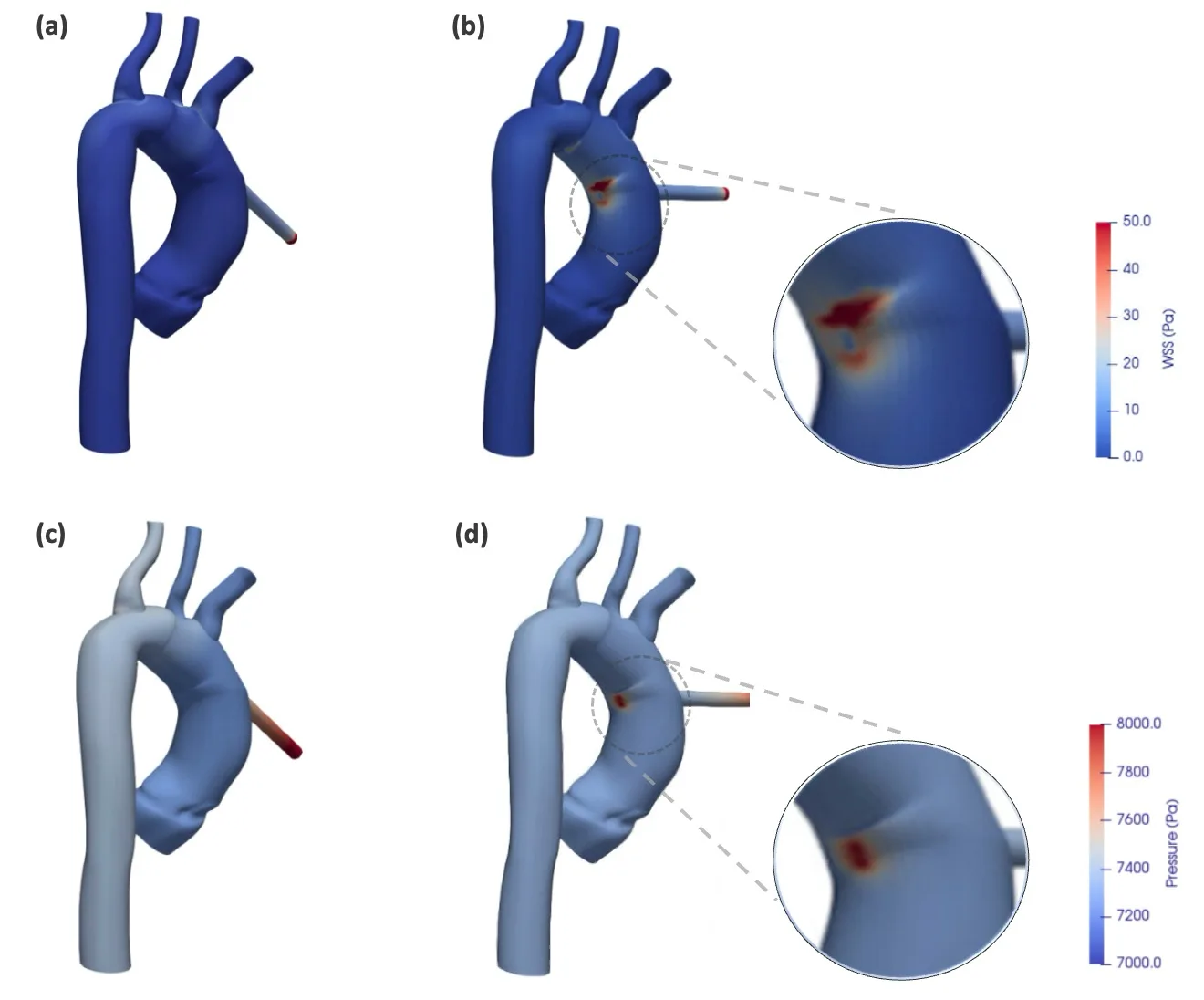
A surgeon inserts a tube into the aorta to reroute blood around the heart. The jet from the tube hits the vessel wall like a garden hose blasting a flowerbed, dislodging particles that can then travel to the brain.
Scientists built computer models of aortas from four individuals: a child, a teenager, an adult, and an elderly person. They varied the tube angle — straight (90 degrees) and angled (30 degrees) — as well as blood viscosity and particle size. It turned out that the angled tube sends 18–50% fewer particles toward the brain's vessels than the straight one. The effect is strongest in the elderly aorta.
The child's aorta proved the most sensitive: if the blood is thinner and particles are larger, noticeably more particles head to the brain. Tilting the tube is a simple way to make surgery safer, especially for the elderly.
Original abstract
as written by the authors arXiv:2601.07881
Embolic stroke during cardiopulmonary bypass (CPB) is strongly influenced by cannula induced flow disturbances that govern emboli transport and aortic wall loading. This study quantifies how aortic cannula orientation affects embolic distribution and atherosclerotic plaque disruption risk across patient specific, age-dependent aortic anatomies under clinical CPB conditions. A validated computational fluid dynamics and Lagrangian particle tracking (CFD-LPT) framework was applied to four patient-specific aortic models representing pediatric, adolescent, adult, and geriatric anatomies. Two clinically relevant cannula orientations: perpendicular (90 deg) and angled (30 deg), were evaluated under varying blood viscosities (1.5 to 3.5 cP) and embolus sizes (0.5 to 2.5 mm). Aortic branch exit percentage, wall pressure, and wall shear stress (WSS) were quantified. The 30 deg angled cannula reduced embolic transport into the aortic branches by 18 to 50 percent compared with perpendicular cannulation, with the largest reduction observed in the geriatric model. Perpendicular cannulation produced concentrated jet impingement, resulting in significantly elevated posterior wall pressure (24 percent) and up to an 8 fold increase in local WSS. The pediatric anatomy exhibited the highest sensitivity, where decreasing viscosity and increasing embolus size increased branch exit by 8.4 percent and 25 to 44 percent, respectively, consistent with higher particle Stokes numbers and inertial decoupling from the core flow. Angled cannulation redistributes jet momentum along the aortic curvature, weakens jet impingement, reduces localized pressure and wall stress, and limits embolic delivery towards the cerebral circulation. These findings provide mechanistic, patient-specific evidence supporting angled cannula orientation to reduce CPB complications.
The biggest difference between the straight and angled tube is in the elderly: tilting reduces particle flow to the brain by half.