The left ventricle is the main pumping chamber of the heart, responsible for propelling oxygenated blood into the systemic circulation — the vast network of arteries that delivers oxygen and nutrients to every tissue in the body. It is the thickest-walled chamber of the heart, as it must generate enough pressure to overcome the resistance of the entire circulatory system. Each beat, it ejects roughly 60-100 milliliters of blood, and over a lifetime, it pumps millions of liters.
History
The ancient Greek physician Galen (2nd century CE) recognized the heart as a pump, but it was William Harvey in 1628 who correctly described the circulation of blood and the role of the ventricles in propelling it.
How it works
During diastole, the left ventricle fills with oxygen-rich blood from the left atrium. Then, during systole, the muscular walls contract forcefully, increasing the pressure inside the chamber until it exceeds the pressure in the aorta. This forces the aortic valve open, and blood is ejected into the aorta and onward to the body. The ventricle's spiral-shaped muscle fibers produce a twisting motion that makes ejection highly efficient.
In practice
Understanding left ventricular function is central to diagnosing and treating heart failure, hypertension, and myocardial infarction. Medical imaging techniques like echocardiography and cardiac MRI measure its ejection fraction to guide clinical decisions.
Fun fact
The left ventricle's wall is about three times thicker than the right ventricle's, because it must pump blood to the entire body rather than just to the lungs.
At night, when we sink into deep, dreamless sleep, a tide begins in the depths of the brain. Each heartbeat and each breath sends gentle pulses through the fluid-filled cavities (the ventricles). During the day, these pulses are timid and monotonous — the fluid sloshes back and forth almost in place.
But with the onset of slow-wave sleep, the rhythm changes.
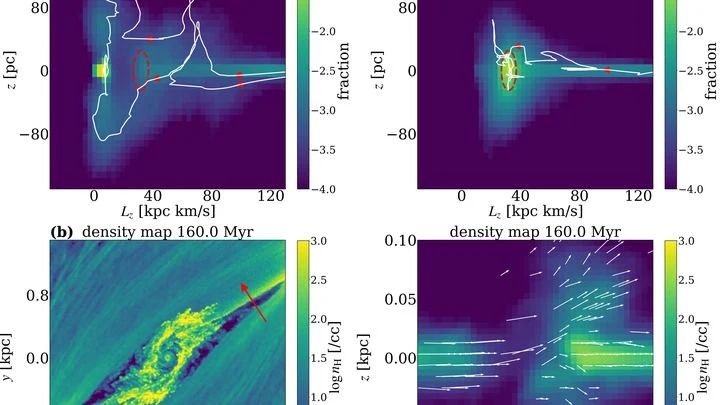
A river flows toward a whirlpool, but a dam with a notch blocks the way. Most water piles up before the dam, but some, gaining height, leaps over it and falls straight into the funnel. So it is with gas in a galaxy: it streams toward the center but hits a ring of stars and gas, like a dam. Usually, everything stops there, swirling into a dense vortex.
Lymphatic vessels are one-way streets. Through them, fluid flows only forward thanks to tiny flap valves. These valves open in just one direction, creating asymmetry, directionality, without which the flow would stop.
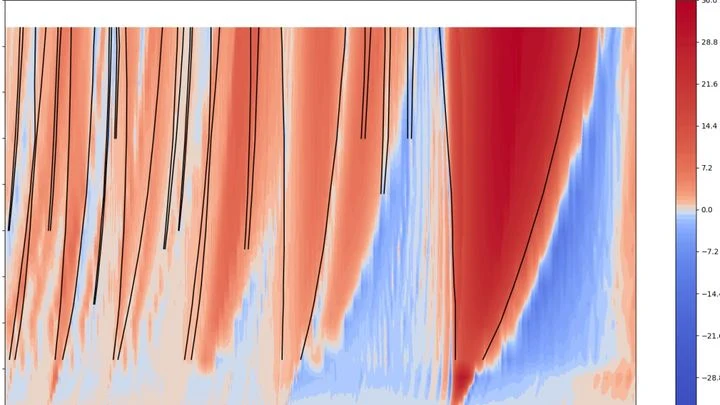
In the lab, scientists modeled a vessel and sent compression waves along it, like a parade of gentle nudges.
Each breath slightly speeds up the heart, and each exhale slows it down. This rhythm, visible on an ECG, is called respiratory sinus arrhythmia. For a long time, it was dismissed as a mere side effect of the nervous system. But new research shows that this coordination is not a coincidence: it's a way to save energy.
Fluid flows in the narrow gaps between brain cells. It doesn't stay still: each heartbeat pushes it forward, and breathing adds its own waves. This was seen in images ten years ago, but only now have researchers calculated how this pulsing accelerates molecules.
If you drop ink into a stream, it drifts with the current. But if the stream speeds up and slows down, the ink spreads wider.
Water in a circular hose, pumped around by a pump, won't stop even if you pinch one section: the flow finds a detour and keeps going around. That's roughly how some parts of our circulatory system are arranged — not as single pipes but as closed loops.
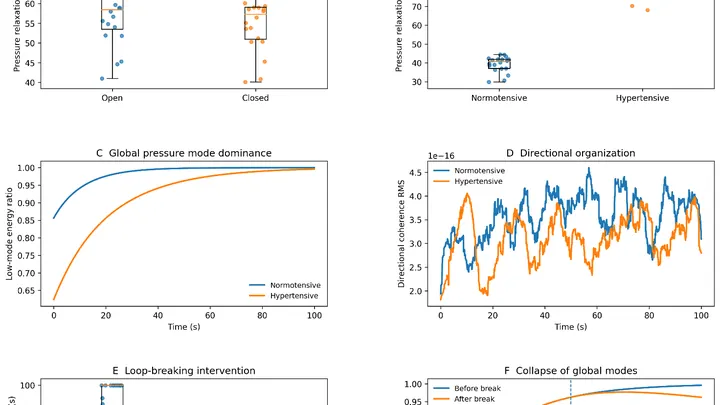
Scientists built a computer model of blood flow and compared two scenarios: an open vessel and a closed loop.
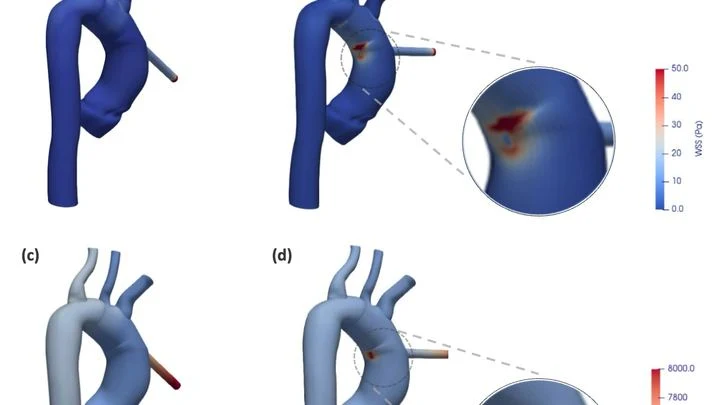
A surgeon inserts a tube into the aorta to reroute blood around the heart. The jet from the tube hits the vessel wall like a garden hose blasting a flowerbed, dislodging particles that can then travel to the brain.
Scientists built computer models of aortas from four individuals: a child, a teenager, an adult, and an elderly person.