A pulsewave is the pressure wave that travels through arteries with each heartbeat. When the heart contracts, it ejects blood into the aorta, creating a local increase in pressure that propagates along the arterial tree as a wave. This wave is not the blood itself moving — it is the pulse of pressure that travels much faster than the blood flow. It is what you feel when you take your pulse at the wrist.
History
The pulse has been known since antiquity, but its wave nature was first described by Thomas Young in 1808, who related wave speed to arterial elasticity.
How it works
The pulsewave arises because arteries are elastic. The sudden volume of blood from the heart stretches the arterial wall, and the elastic recoil pushes the blood forward, transferring the pressure disturbance to the next segment. The wave speed depends on the stiffness of the arterial wall and the blood's density. Stiffer arteries (as in aging or disease) transmit the wave faster, which can affect how the wave reflects off branch points and returns to the heart, potentially increasing cardiac workload.
In practice
Pulsewavevelocity (PWV) is a clinical measure of arterial stiffness, used to assess cardiovascular risk. It is also relevant in designing artificial hearts and understanding blood flow dynamics in surgery.
Fun fact
The pulsewave travels at about 5–10 meters per second in healthy arteries, which is roughly 10 times faster than the actual blood flowspeed.
The pulse at the temple beats like a city's main artery: it shows how the roads are aging. At the wrist, the signal looks more like a back street where traffic noise drowns out the important details. Scientists compared these two sites to figure out where age leaves the clearest mark.
An optical sensor shines light through the skin and catches every heartbeat.
In a quiet room of a Budapest laboratory, a bracelet lies on the table, and instead of a strap, it has a thin conductive thread stretched in a zigzag. It doesn't heat up or glow, but when pressed against the wrist, it starts to listen. Each heartbeat sends a pressure wave through the radial artery, and the thread, deforming, changes its electrical resistance.
Pulsar PSR J1740+1000 is a city-sized star spinning faster than a kitchen blender. After a supernova explosion, it left behind a dense core that accelerates particles to near-light speeds. These particles fly into space, and previously it was thought they scatter in all directions, like splashes from a stone thrown into water.
A disease outbreak is like a wildfire: the fire runs through dry grass, and its speed depends on wind and humidity. But an infection has its own 'wind'—how often people infect each other. When this rate changes along with the fraction of already infected, the epidemic wave can behave differently.
A subway train races through a tunnel, yet passengers in the last car barely sway. Blood flow in the lungs works much the same way: the heart pumps blood in powerful spurts, but by the time it reaches the veins, the pulsation has almost vanished.
Space is full of invisible sprinters — particles racing nearly at the speed of light. They are caught in the solar wind, near neutron stars, and even in the intergalactic void between galaxies. But what accelerates them where there are no shock waves or magnetic reconnections?
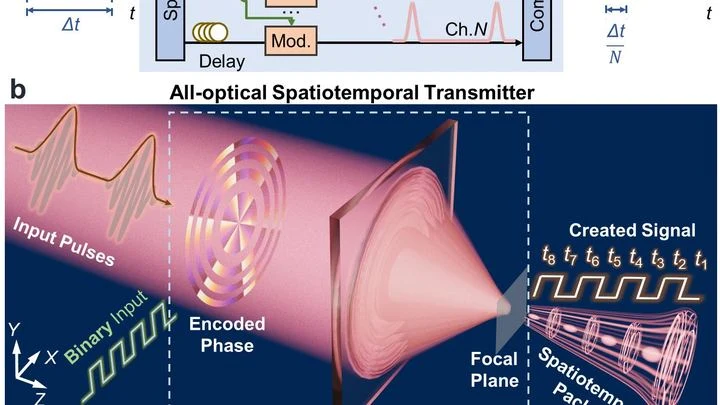
Light can carry information faster than any electronics. But usually, between a computer and a laser sits a digital-to-analog converter — a device that turns zeros and ones into electrical signals. It's the bottleneck.
The new transmitter does away with this middleman.
Each breath slightly speeds up the heart, and each exhale slows it down. This rhythm, visible on an ECG, is called respiratory sinus arrhythmia. For a long time, it was dismissed as a mere side effect of the nervous system. But new research shows that this coordination is not a coincidence: it's a way to save energy.
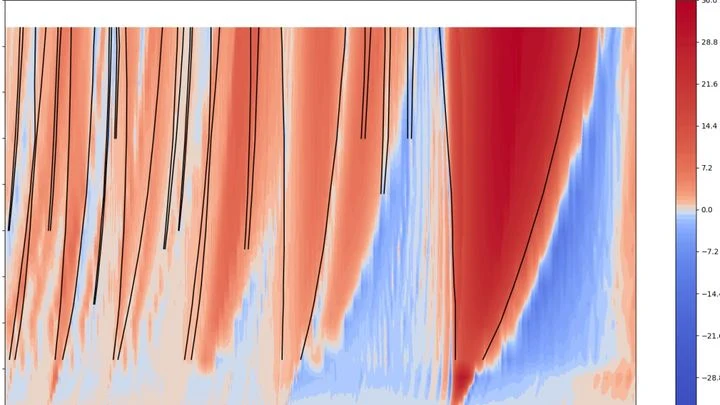
Above the Sun's surface hang long ribbons of glowing gas — streamers. They look like giant harps stretched across the corona. When a wave runs along such a ribbon, it trembles and bends like a string after being plucked.
For a long time, it was thought that only a very fast ejection of material, one traveling at more than 500 kilometers per second, could launch such a wave.
Cilia are tiny hairs on cell surfaces. They beat like oars, moving fluid. In the lungs, they push dust and microbes out. But their lengths vary: in humans, they are thousandths of a millimeter; in comb jellies, several millimeters. How do such different cilia work together?
Scientists built a machine that jerks fluid sharply, as if a cilium had struck. They filmed it with a high-speed camera.
Fluid flows in the narrow gaps between brain cells. It doesn't stay still: each heartbeat pushes it forward, and breathing adds its own waves. This was seen in images ten years ago, but only now have researchers calculated how this pulsing accelerates molecules.
If you drop ink into a stream, it drifts with the current. But if the stream speeds up and slows down, the ink spreads wider.
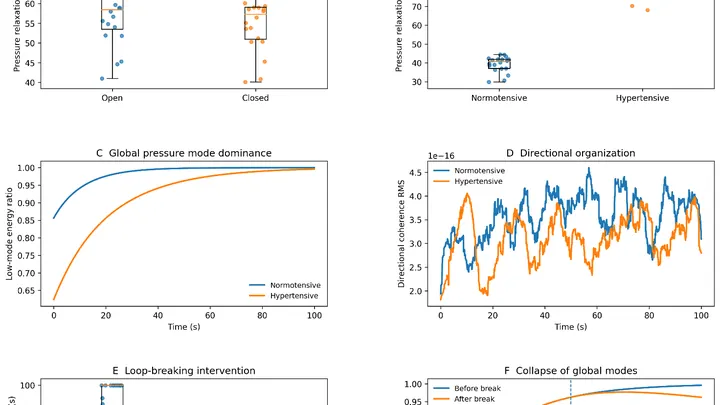
Water in a circular hose, pumped around by a pump, won't stop even if you pinch one section: the flow finds a detour and keeps going around. That's roughly how some parts of our circulatory system are arranged — not as single pipes but as closed loops.
Scientists built a computer model of blood flow and compared two scenarios: an open vessel and a closed loop.
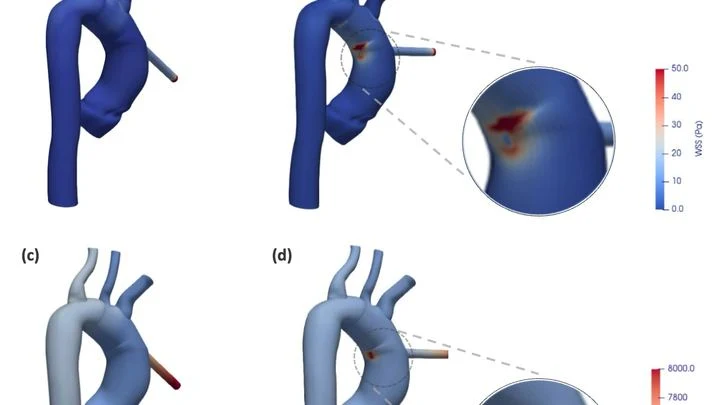
A surgeon inserts a tube into the aorta to reroute blood around the heart. The jet from the tube hits the vessel wall like a garden hose blasting a flowerbed, dislodging particles that can then travel to the brain.
Scientists built computer models of aortas from four individuals: a child, a teenager, an adult, and an elderly person.