Is the Universe Not Quite Flat? express
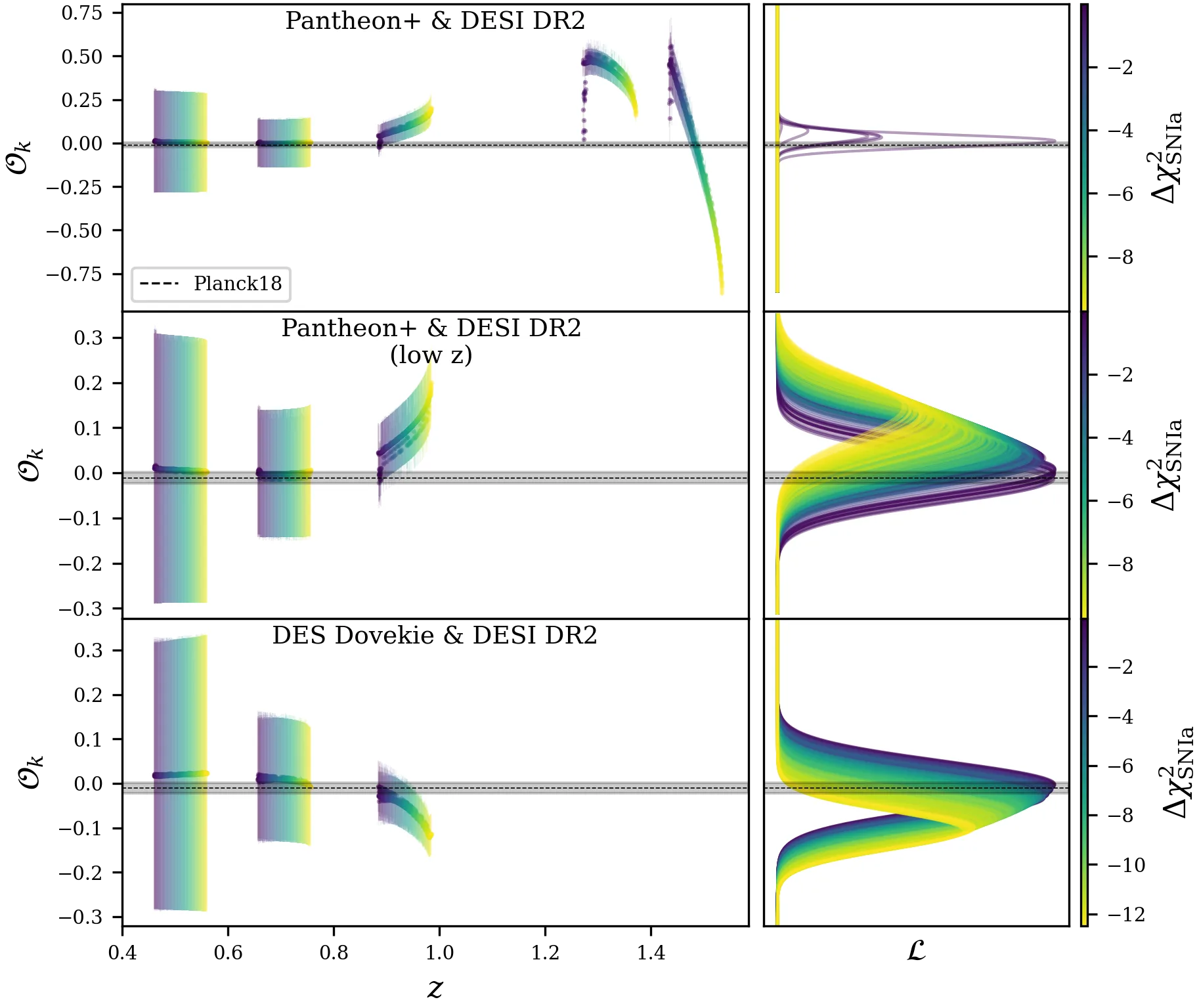
Light from distant stars travels for billions of years, and during that time space itself stretches. How can we check whether it stays as flat as a sheet of paper or bends like a saddle? Astronomers gathered data on supernova explosions, such flashes are visible from enormous distances and act as beacons. They added a map of galaxy positions from the recent DESI survey. Then they applied a clever trick: instead of assuming the Universe is flat from the start, they let the data reveal the shape on its own.
The result is intriguing. When the scientists allowed space to be curved, the data slightly favored a not-perfectly-flat option. This does not mean the Universe is definitely curved — the uncertainties are still large, and a flat model cannot be ruled out. But there is a hint. If space is indeed curved, the familiar picture of cosmic expansion will need refinement.
Checking the shape of space is like checking how level the floor is in a huge hall. If the floor is perfectly level, a ball rolls in a straight line. If the floor is slightly concave or convex, the ball will deviate. Light from distant objects is that ball, and its path tells us about the geometry of the Universe.
Original abstract
as written by the authors arXiv:2601.20293
We perform a data-driven test of the FLRW metric and the flatness of the Universe, independently of any Dark Energy model, and in light of the latest DESI DR2 results. We use Pantheon+ and DESY5 SNIa data to reconstruct the distance modulus, dimensionless comoving distance and Hubble parameter, using an iterative smoothing algorithm. Then, combining the various reconstructions with the recent BAO measurements from DESI DR2, we perform the $$\mathcal{O}_k$$ diagnostic, a litmus test of the FLRW metric and the flatness of the Universe. We obtain robust results that do not depend on Dark Energy models and test some of the underlying hypotheses of the concordance model. We find that when the reconstructed $$\mathcal{O}_k$$ diagnostic is consistent with the FLRW metric, then the median value of $$\Omega_{k,0}$$ over all reconstructions that provide an improved fit relative to the flat $$\Lambda$$CDM model are: $${\Omega}_{k,0}^\text{med} = 0.035 ^{+0.046}_{-0.079}\pm 0.037$$ for the Pantheon+ \& DESI DR2 data combination, $${\Omega}_{k,0}^\text{med} = 0.092 ^{+0.055}_{-0.132} \pm 0.064$$ for the same data but with the Pantheon+ SNIa cut at redshift $$z=1.13$$, which is the maximum redshift of the DES~Y5 data, and $${\Omega}_{k,0}^\text{med} = -0.119^{+0.113}_{-0.047}\pm 0.043$$ for DES~Y5 \& DESI DR2. The first uncertainties correspond to the spread in $$\Omega_{k,0}$$ over all reconstructions, followed by the median 1$$\sigma$$ error.
If the Universe were noticeably curved, very distant galaxies might appear as their own copies — light would loop around all of space and come back from the other side.
The idea of curved space is explored in the film Interstellar, where characters travel through a wormhole, a fold in spacetime.