Maximum likelihood estimation (MLE) is a cornerstone of statistical inference. It provides a principled way to choose the parameters of a probability distribution that best explain observed data. Given a set of data points and a candidate model (e.g., a normal distribution with unknown mean and variance), MLE selects the parameter values that make the observed data most probable under that model. This 'most probable' is quantified by the likelihood function, which measures how likely the data is as a function of the parameters.
History
The method was introduced by Ronald Fisher in the 1920s, building on earlier work by Carl Friedrich Gauss and others. Fisher formalized the concept and established its desirable properties, such as consistency and efficiency.
How it works
The likelihood function L(θ | data) is constructed as the product of the probabilities (or probability densities) of each observed data point, given the parameter vector θ. MLE finds the θ that maximizes this product. In practice, one often maximizes the log-likelihood (the natural logarithm of L) because it turns the product into a sum, which is easier to differentiate and numerically stable. The maximum is found by setting the derivative of the log-likelihood with respect to θ to zero and solving, or by using iterative numerical optimization algorithms when no closed-form solution exists.
In practice
MLE is ubiquitous in science and engineering: it underpins regression analysis, neural network training (via cross-entropy loss), and parameter estimation in physics experiments, from particle physics to cosmology.
Fun fact
MLE is not always unbiased: for example, the maximum likelihood estimate of the variance of a normal distribution is biased downward by a factor of (n-1)/n, which is why the sample variance uses n-1.
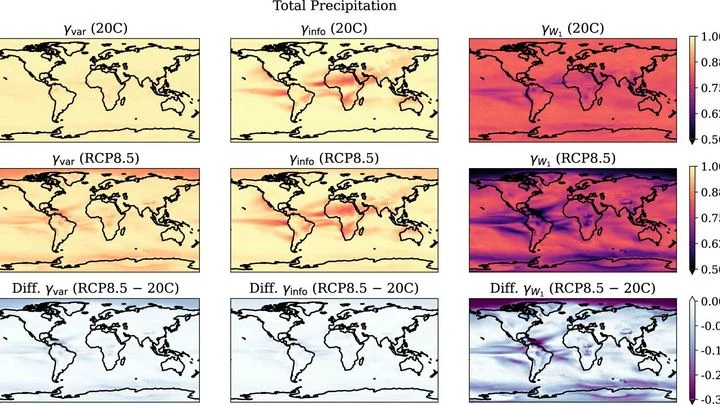
In winter, one part of town gets three times as much snow as the neighborhood next door. One year is a scorcher, the next is a cold snap. That's the whims of weather. But over decades, a different, slow shift emerges: winters, on average, get milder. Telling the two apart is the central challenge for climate scientists.
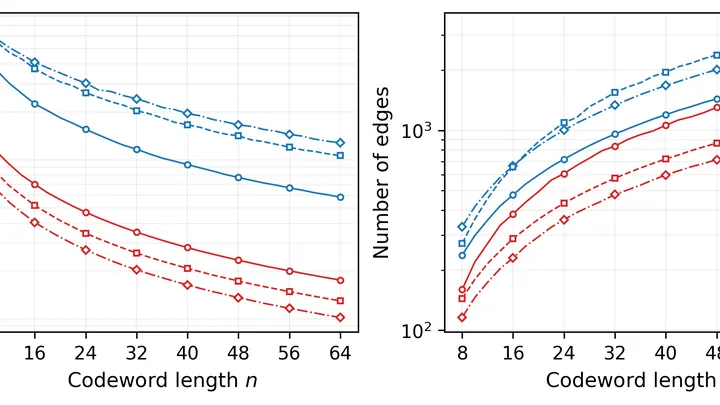
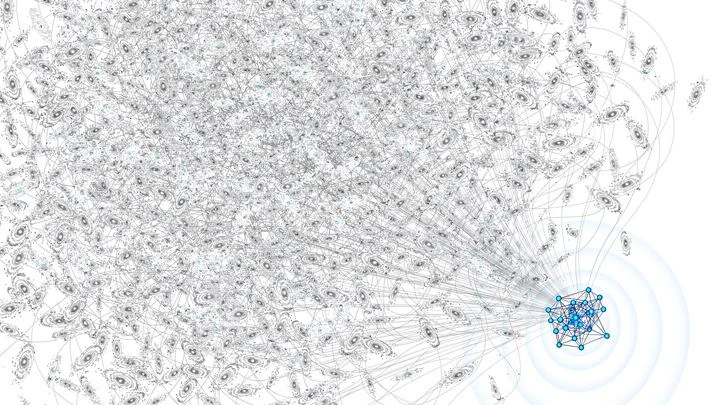
In 1998, mathematician David Boyd noticed something strange. He was studying the Mahler measure of polynomials, a quantity that gauges the "complexity" of their roots, and found that for a family of curves, it always equals a special rational number times the derivative of an L-function.
Two galaxies (our Milky Way and its satellite, the Large Magellanic Cloud) slowly circle each other. Their gravitational pull stirs the distant outskirts of the Milky Way, like a pebble thrown into a pond makes the water ripple.
Two hundred million stars. In the heart of the Galaxy, where the future survey by the Nancy Grace Roman telescope will aim, about 250 times during its mission the light of one of them will flicker at an invisible touch.
4 610 universes — that's exactly how many cosmological models astrophysicists needed to show that the familiar Gaussian mask no longer works for next-generation data. Future sky surveys, such as the Euclid mission and the Vera C.
Reconstructing a full picture from fragments is like discerning an orchestra's melody in a noisy hall. Such challenges arise in photometry, where a star's brightness is recovered from faint twinkling. Traditional methods need precise noise information, which is almost always unknown.
Imagine a cookbook that gets rewritten from generation to generation. One day, the borscht recipe receives a secret ingredient from a pastry chef, and from that moment, the taste remembers not only ancestors but also a neighbor. In the Standard Model of evolution, genes behave the same way.
When a radio wave encounters a building in its path, it doesn't just reflect or get absorbed: it bends around it, much like ocean waves flowing around a rock, leaving calm water behind. In radiophysics, this phenomenon creates a radio shadow — a complex pattern of zones where the signal is amplified or attenuated, which scientists call a radio portrait.
Neurochips work differently from conventional computers, which are built according to the blueprints of von Neumann with separate memory and processor. At the core of these chips is a network of simple cells, similar to neurons, and, like water that evenly fills containers of any shape, they easily find a solution without unnecessary steps.
Code-writing assistants often behave like a chef who, to boil a single egg, rereads the whole cookbook. When asked to make a tiny fix, they reopen dozens of files and retrace long-familiar connections. This is unnecessary work — energy going to waste.
Researchers took 16 everyday activities — from washing dishes to squatting — and broke the movements down into elementary components, much like a spectroscope splits light into a spectrum. Comparing three approaches, they found an unexpected key to recognition: a single averaged snapshot is enough. Only nine joints out of dozens carried the crucial information — the rest hardly mattered.
Look into the night sky — before you is not a scattering of lights, but a multi-layered manuscript. Under the bright ink of stars and galaxies appears a faded, almost erased text.
Light flows like an invisible river. If you place an obstacle in the stream, the water whirls into eddies. Likewise, specially designed surfaces create light 'whirlpools' that catch nanoparticles like wood chips.
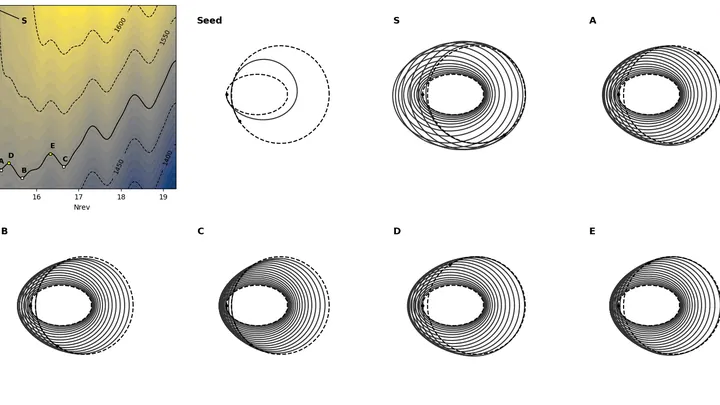
A space tug with an ion engine accelerates slowly, but it sips fuel. To get from one orbit to another, you have to solve a tricky problem: how long to fire the engine and where to point it. Usually, the goal is to find the fastest transfer for a given spacecraft mass.
A doctor scrolls through a patient's chart and sees a line: "The drug reduces risk." But how much can you trust that? Is the claim based on a couple of case reports or on tens of thousands of patients in a blinded trial? The answer determines the treatment.
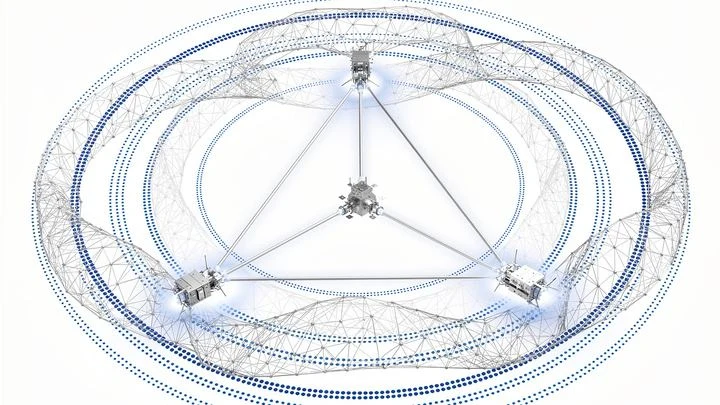
The Universe is not silent: it is filled with a continuous gravitational-wave hum. In a decade, the LISA space observatory will tune its "ears" to the millihertz range, and the richest source will be our Galaxy — tens of thousands of white dwarf pairs whirling in a frantic dance.
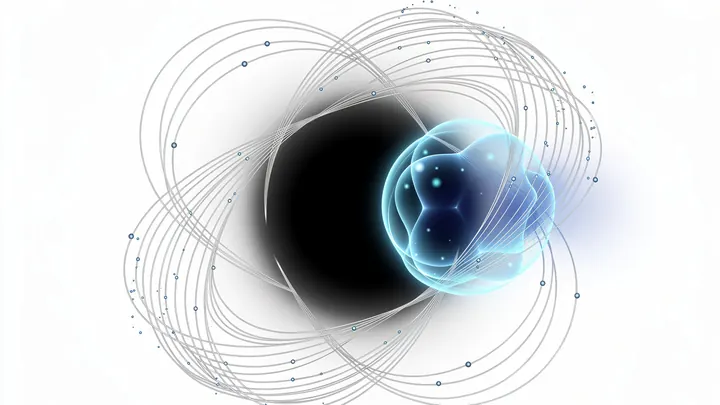
A black hole is not a frozen void, but a living magnetic engine. Its 'heart'—the accretion disk, pulsates: inhale, matter spirals into the funnel, exhale — magnetic reconnection tears the field lines, and plasma shoots away from the horizon.
We're used to thinking that noticing only confirmations of our guesses is a mistake. But recent calculations, inspired by wave behavior, flip that view. It turns out that the habit of seeking the familiar is the best way to reduce information noise (scientists call it entropy).
Photographing a delicate spiderweb trembling in the wind: that's roughly what it takes to look into the blood vessels of a living brain. Ultrasound localization microscopy (ULM) turns ordinary ultrasound into a tool capable of seeing individual capillaries, but only if you get the settings just right.
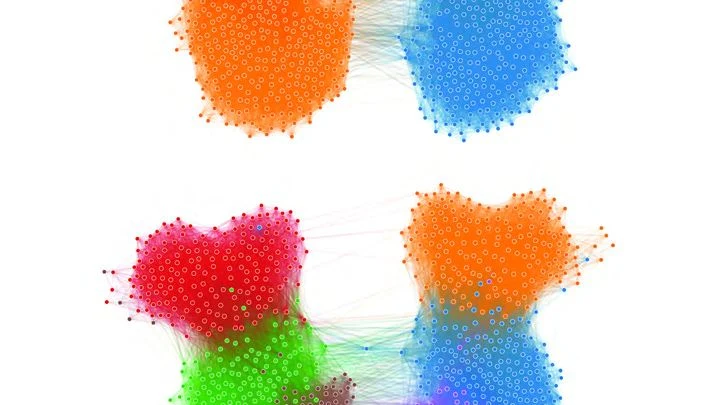
A social network is like a city: there are giant neighborhoods and tiny alleys. When an algorithm looks for tight-knit groups, it often picks out a couple of huge clusters and many small fragments. But the client (say, a municipality) needs districts of roughly equal size to distribute clinics or schools evenly.
A voice recorder captures a city square. You hear the hum of a crowd, footsteps, snatches of conversation, the rumble of traffic. Somewhere in that sonic stew, a street musician plays a simple tune on a flute. Hearing it isn't easy: there's just too much mixed together.
Imagine a factory where hundreds of tiny assembly lines run nonstop. Each line is a molecular motor that converts chemical fuel into motion. To make the motor go faster or in the right direction, an engineer tweaks the settings — the shape of parts, the strength of interactions.
You're trying a dish at a restaurant, but you haven't seen the menu. You ask the waiter questions — too salty? what spices?—and from the answers you try to guess what kind of chef prepared it.
A thermostat keeps a room at 20 degrees. Open a window in winter, and it kicks on the heat to restore equilibrium. The brain does something similar: it constantly predicts what will happen a moment ahead and corrects itself when wrong. That's how it learns.
Quantum calculations are a recipe with perfect ingredients, but nature-the-chef cooks in her own way. Machine-learned models of atoms memorize the recipe and predict material properties in seconds instead of weeks.
A library of 27,000 books, and every one of them is about concrete. Each contains a mix recipe, temperature, and strength. But the information is scattered across paragraphs, tables, and footnotes. For a human, gathering it all together would take years. The program did it in an hour.
A thin film for a solar cell or display is like a dense crowd in a square: each person faces a different direction, and whether light passes through the crowd or gets stuck depends on which way everyone is looking. In organic electronics, molecules play the role of passersby. Until now, instruments could only measure the crowd's overall direction — the average head tilt and its spread.
An epidemic is not just a virus: it's millions of personal decisions. One person keeps riding the subway; another locks themselves at home. Classical models describe the average behavior of a crowd but don't ask why each individual acts that way.
When a neutron or proton enters an atomic nucleus, it behaves like a ball hitting a rough wall: it can bounce off in different ways, depending on where it hits.
An optical tweezer is a beam of light that holds and moves tiny objects like bacteria or dust grains. If you need to carry a particle from point A to point B, you could simply pull it straight there. But that would consume more energy than a cleverly chosen detour.
An active particle is a microscopic object that propels itself forward, like a tiny swimmer.
A chemist searching for a new drug is like a cook without a recipe: they have a list of desired properties but millions of possible ingredients. Each trial is costly and time-consuming, so you need to experiment wisely.
The new program SEISMO acts like a chef who tastes the dish after every step and immediately decides what to add next.
When a top quark is born in a particle detector, it immediately decays into a shower of other particles. Catching a hint of new physics in that shower is like hearing a whisper at a rock concert. You need not just a good microphone, but the ability to subtract the roar of the amplifiers and the hum of the crowd.
Electrons — tiny particles in molecules — constantly maneuver, avoiding collisions like passengers during rush hour. To calculate their behavior, scientists set a personal distance rule: a mathematical function that indicates how close one electron can get to its neighbor.
In a room with 80 advisors, each shouts their own opinion, and if you simply listen to everyone and take the average, you get mush. So it is with El Niño forecasts: a model produces 80 possible futures, but not all are equally useful. Some err less often, others more, and still others talk about something else entirely.
The ocean doesn't always stick to the same schedule. Sometimes the warm El Niño current strengthens, sometimes it weakens, and each regime dictates its own reaction speed to the past. These hidden regimes are like shifts in currents that remember their path with different depths.
A rough sketch of a portrait: a few confident lines define the shape, but the details are not yet refined. That is how a parametric model, such as vector autoregression (VAR), describes a time series: it captures the main structure, but if the real data deviate from its assumptions, the portrait comes out distorted.
The Indian summer monsoon feeds a fifth of humanity, but its seasonal forecast has been considered nearly hopeless for decades: the potential predictability limit was estimated at only 45% of explained variability.
The puppet master pulls the strings, and the marionette dances. In forecasting the future from time series, the puppet masters are the few variables that truly control the system. The rest merely echo their movements, creating an illusion of complexity. The challenge is to find these puppet masters and watch only their fingers, not the whole stage.
On an old film strip of rainfall, only the brightest frames are visible, and between them lies noise. A meteorologist assessing flood risk long looked only at such frames, that is, at annual rainfall maxima. Everything else, thousands of daily observations, remained off-screen. The new method develops the entire film, and details that were previously invisible come into view.