Neural Networks Learn to Read a Fish's Brain express
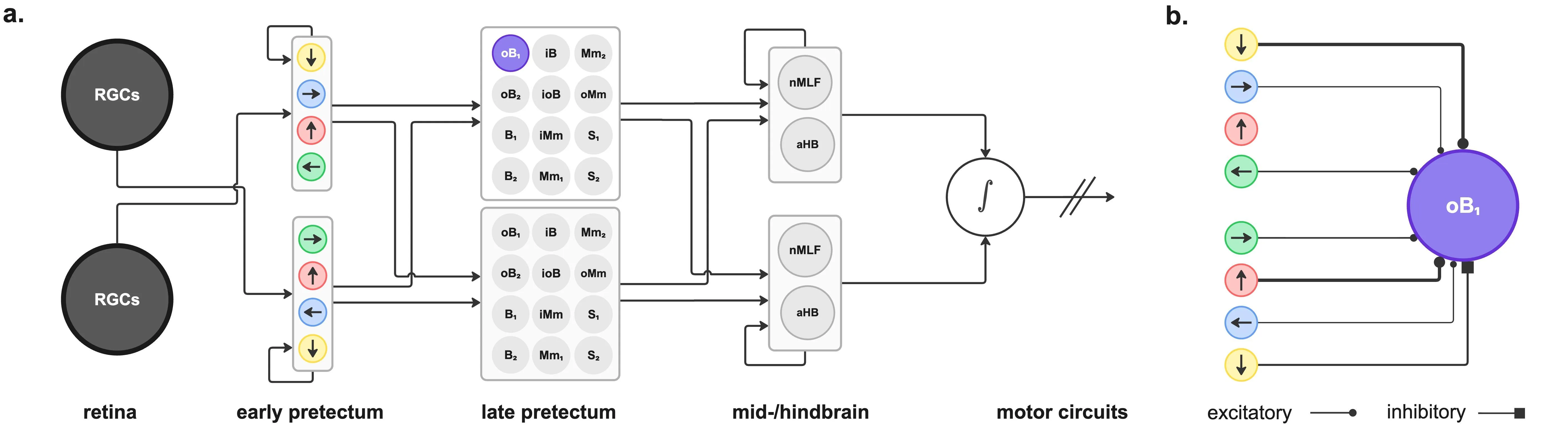
The zebrafish larva is almost transparent, and its brain can be examined under a microscope. But even in such a tiny creature, neural connections are so tangled that sorting them out by hand is nearly impossible. Scientists made a clever move: they built an exact computer replica of the larva, where every connection is known. The result is a virtual proving ground for testing methods.
They unleashed an algorithm on this proving ground that searches for patterns on its own. It sifts through possibilities like a chess player thinking through moves, building a model that predicts neuron activity. The result surprised them: the models it found predicted brain activity more accurately than time-tested classical approaches. But when the algorithm was given only external signals (light, water movement) it found sneaky workarounds: short statistical correlations that work only on familiar data.
This approach isn't just for fish. Real brain activity recordings, from mice to humans, suffer from the same problem: plenty of data, little understanding. The virtual proving ground shows what hints are needed so that artificial intelligence doesn't just fit numbers but discovers how the brain actually works.
Original abstract
as written by the authors arXiv:2602.04492
Constructing mechanistic models of neural circuits is a fundamental goal of neuroscience, yet verifying such models is limited by the lack of ground truth. To rigorously test model discovery, we establish an in silico testbed using neuromechanical simulations of a larval zebrafish as a transparent ground truth. We find that LLM-based tree search autonomously discovers predictive models that significantly outperform established forecasting baselines. Conditioning on sensory drive is necessary but not sufficient for faithful system identification, as models exploit statistical shortcuts. Structural priors prove essential for enabling robust out-of-distribution generalization and recovery of interpretable mechanistic models. Our insights provide guidance for modeling real-world neural recordings and offer a broader template for AI-driven scientific discovery.
Zebrafish larvae are so transparent that scientists can see individual neurons right through the skin, without surgery.