A microscope is an instrument that magnifies objects too small to be seen with the naked eye, such as cells, bacteria, or individual atoms. The core challenge in microscopy is stability: any vibration or drift blurs the image, so high-resolution microscopes are built on heavy, isolated tables and use feedback systems to correct for thermal expansion or mechanical noise. Modern microscopes extend far beyond simple magnifying glasses, using electrons, X-rays, or even quantum effects to probe matter at scales from micrometers down to picometers.
History
The first compound microscopes were built in the late 16th century by Dutch spectacle makers, with Antonie van Leeuwenhoek later using simple single-lensdesigns to observe bacteria and sperm cells in the 1670s. The electron microscope was invented in 1931 by Ernst Ruska and Max Knoll, and the scanning tunneling microscope followed in 1981, developed by Gerd Binnig and Heinrich Rohrer at IBM Zurich.
How it works
Most microscopes work by focusing some form of radiation—visible light, electrons, or X-rays—onto the sample and then magnifying the resulting signal with lenses or detectors. The resolution is limited by the wavelength of the radiation used: visible light can distinguish features about 200 nanometers apart, while electron microscopes, using much shorter wavelengths, can resolve individual atoms. For scanning probe microscopes, a sharp tip physically scans the surface, measuring forces or electric currents point by point to build an image without any lenses at all.
In practice
Microscopes are essential in biology, medicine, materials science, and nanotechnology—from diagnosing diseases in tissue samples to inspecting semiconductorchips and developing new materials at the atomic scale.
Fun fact
The scanning tunneling microscope is so sensitive that it can image individual atoms, and its tip is typically sharpened down to a single atom at its very end.
A tiny needle glides over the surface like a finger over a page written in Braille. That's how a scanning tunneling microscope works: it feels the atomic landscape and turns bumps into a picture. But when you need to add a magnetic field, the design hits a wall.
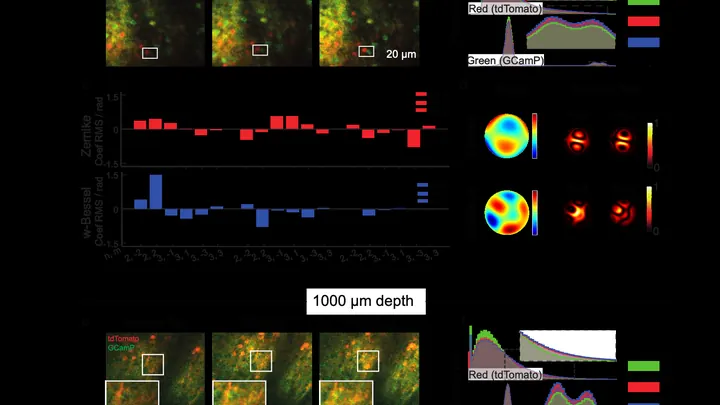
The laser beam in a three-photon microscope works like a flashlight shining through murky water. The deeper you need to illuminate, the more the water scatters light and the dimmer the picture gets.
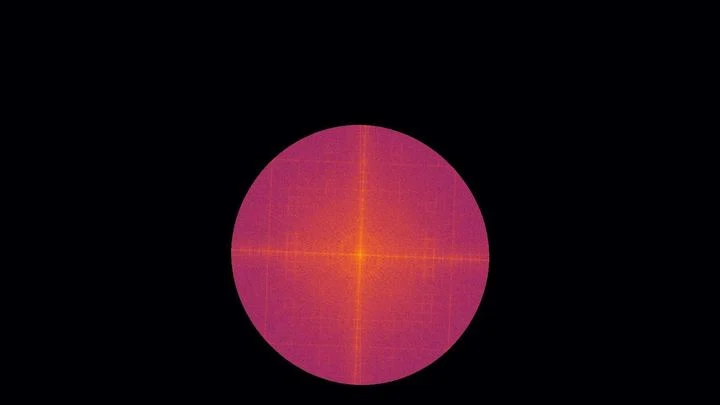
An X-ray image of a battery looks like a photo taken through frosted glass: fine details blur into a gray smudge. The culprit is the detector itself, which cannot distinguish features smaller than its pixel size. Engineers proposed getting around this barrier by illuminating the sample not with a uniform beam but with a striped pattern.
A storm is brewing somewhere far away, and the Geiger counter is already clicking more often. That's how cosmic rays, a stream of charged particles from deep space, make themselves known. When they slam into the atmosphere, they create showers of secondary particles, including muons: heavy cousins of electrons that can reach the ground.
A heart cell in a Petri dish contracts, and at that moment, an electrical wave sweeps across its surface. Previously, to catch that wave, you had to poke the cell with an ultra-fine electrode needle. Now, you just look at it under a microscope.
The method is called electrochromic recording.
You can't catch X-rays from stars with an ordinary mirror: they pass through glass like light through a window pane. To reflect them, you need a mirror almost parallel to the beam: then the X-rays skim along the surface like a flat stone skipping on water, only slightly changing direction.