Superconductivity in Iron Layers express
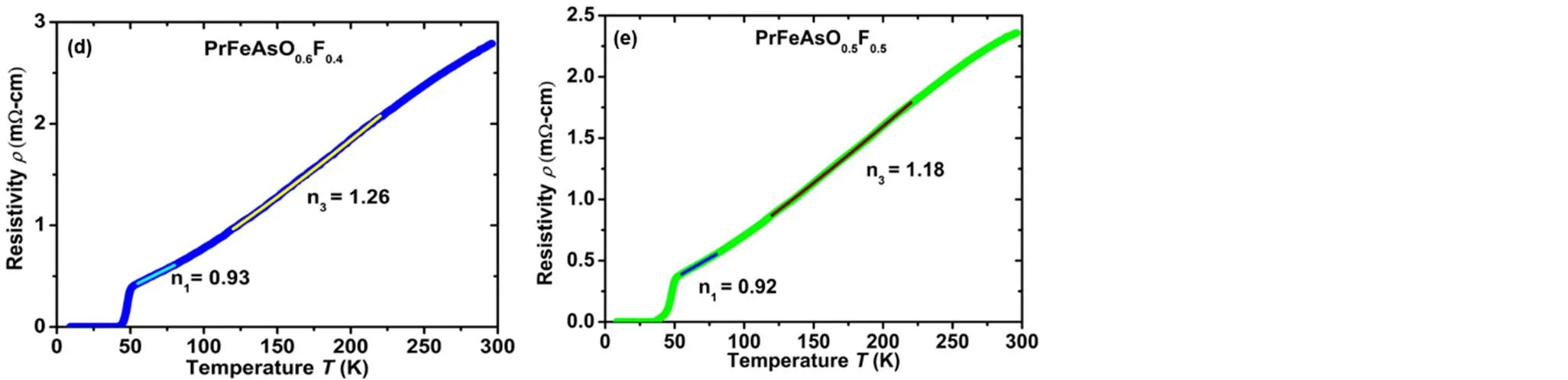
Iron is a magnet, not a resistance-free conductor. But if you add a bit of fluorine to an alloy of iron, arsenic, and oxygen, the picture changes. Scientists took the compound PrFeAsO and gradually replaced oxygen with fluorine. At a certain fluorine concentration, the material lost its electrical resistance: it became superconducting.
This is like tuning an instrument: too little fluorine, no effect; too much, also none. Superconductivity appears in a narrow range, forming a "dome" on the diagram. Inside this dome, the transition temperature reached 52.3 K: that's about −220.85 °C. For comparison, conventional superconductors only work at temperatures below −250 °C.
The scientists also tested how the material behaves in a magnetic field. It turned out that it retains superconductivity even in fields stronger than 100 tesla — millions of times stronger than a refrigerator magnet. The study showed that the material's properties are directly linked to how much fluorine is added to its crystal lattice.
Original abstract
as written by the authors arXiv:2602.07481
Establishing a complete electronic phase diagram for REFeAsO (RE = rare earth, RE1111) ironbased superconductors has remained experimentally challenging. Here, we report a systematic investigation of PrFeAsO1-xFx over the full nominal fluorine-doping range 0 to 1 and construct the first comprehensive electronic phase diagram for this system. The evolution from the nonsuperconducting parent compound to the fluorine-rich limit reveals a broad dome shaped superconducting region. Structural refinement demonstrates a systematic lattice contraction with increasing fluorine content (x), corroborated by Raman spectroscopy through softening of the Pr(A1g) phonon mode and hardening of the Fe(B1g) mode, confirming effective fluorine incorporation at the oxygen sites. The maximum superconducting transition temperature (Tc) reaches up to 52.3 K, approximately 5 K higher than previous reports for Pr1111. Magnetotransport measurements yield large upper critical fields Hc2(0) exceeding 100 T, while analysis of resistive transition broadening reveals thermally activated flux flow with a crossover from single-vortex to collective pinning regimes. Specific-heat measurements exhibit a reduced jump deltaC/{\gamma}Tc < 1.43, reflecting strong superconducting fluctuations and multiband pairing. These results establish clear structure property correlations and provide a unified description of superconductivity across the entire doping range of the Pr1111 system.
A temperature of 52.3 K (−220.85 °C) is still very cold, but for superconductors it's already the "warm" zone. Ordinary metallic superconductors require temperatures below −250 °C.