A refrigerator is a device that transfers heat from a colder interior to a warmer exterior, using external work to drive the process. It operates on the principles of thermodynamics, specifically the second law, which states that heat naturally flows from hot to cold — a refrigerator reverses this flow by doing work. The key measure of its performance is the coefficient of performance (COP), which is the ratio of heat removed to work input.
History
The first practical vapor-compression refrigerator was built by Jacob Perkins in 1834, building on earlier experimental work by Oliver Evans. The concept of mechanical refrigeration dates back to the 18th century.
How it works
A typical refrigerator uses a working fluid (refrigerant) that undergoes a cycle of compression, condensation, expansion, and evaporation. The refrigerant absorbs heat from the interior when it evaporates at low pressure, then releases that heat to the surroundings when it is compressed and condensed at high pressure. The compressor provides the work needed to maintain the pressure difference.
In practice
Refrigerators are used everywhere from household kitchens to industrial cold storage, and in scientific research for coolingdetectors and samples to cryogenic temperatures.
Fun fact
The most efficient refrigerators approach the Carnot limit, but real ones typically achieve only 30-50% of that theoretical maximum efficiency.
A quantum lab is like a kitchen where the chef waits a day for the stove to cool down. Superconducting qubits only work at temperatures of a few hundredths of a kelvin, and each 'cool, measure, warm up' cycle eats a whole day. A team of engineers built a fridge the size of a melon, weighing 3 kg, that does the job in just two hours.
A regular battery releases heat smoothly: what you store is what you get. The power is fixed once and for all, like a faucet that pours water in a single stream. But sometimes you don't need a steady flow; you need a short, powerful burst: to instantly heat a part, trigger a reaction, or dump excess heat.
Inside an MRI magnet, current flows through a closed superconducting loop, like water circling in a bucket after you give it a spin, it just keeps going on its own. To change that current, you heat the loop with a small heater: it stops being superconducting, becomes an ordinary resistor, and then an external source can 'top up' or 'draw off' current.
Microwave plasma in a vortex is like a kitchen mixer that simultaneously heats and stirs the gas. In the reactor, the gas is swirled, and microwaves heat it to thousands of degrees, tearing carbon dioxide molecules apart. Scientists created a computer model of such a reactor to understand how pressure affects the process.
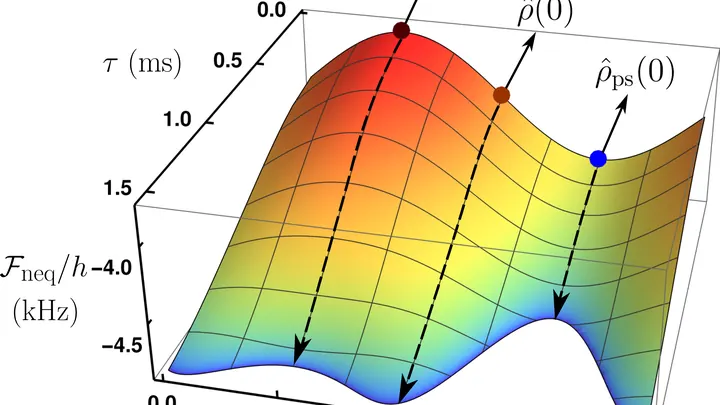
Inside an ultracold chamber, two atomic clouds collide: a few dozen cesium atoms acting as the working fluid, and thousands of rubidium atoms serving as the heat reservoir.
A mountain pass connects two valleys. In one, the protein is folded; in the other, it is unfolded. To get from one to the other, you must cross the saddle — the highest point on the path. In protein science, this point is called the transition state, and the coordinate that shows the distance to it is the committor.
The race for fusion energy is like trying to bottle a lightning bolt. For decades, physicists have struggled to recreate on Earth the processes that power the Sun. The main challenge is getting light nuclei to fuse despite their mutual repulsion, while extracting more energy than was spent heating and confining the plasma.
Hot tea cools down, and ice cream melts — heat always flows from warm to cold, and this law seemed unbreakable. But in the quantum world, even familiar rules can be rewritten. Physicists placed a tiny mechanical resonator (a vibrating bridge the size of a microbe) in an optical cavity between two mirrors.
In a glass of water, oil gathers into droplets: that's equilibrium separation dictated by chemistry. But there are systems where order arises not from rest but from a constant flow of energy.
Inside every cell, logistics is in full swing: tiny protein motors, like couriers, haul cargo along a network of microtubules. One of the main workhorses is kinesin, which steps using the energy of ATP (the cell's main energy currency). For a long time, researchers tried to evaluate it like a car: how much fuel it burns, how fast it gets there.
Tea in a cup cools quietly on the table. But if you zoom past at near-light speed, the thermometer will read higher — even though no one heated the tea. Calculations confirm: the needle will creep up.
A century ago, physicists split into three camps.
Heat a nail in a fire, and it will lengthen — everyone knows that. But heat only the tip and leave the other end cold, and the nail doesn't just get longer: it bends, because hot metal expands more than cold metal. It's this very bending, but at the atomic level, that physicists have turned into electricity.
A tuning fork grows quieter not because someone stops holding it, but because the very hand that strikes it creates an invisible haze around it that damps the vibrations. A superconducting resonator behaves much the same way — a tiny track along which a microwave signal runs with almost no loss.
A heat engine doesn't have to be made of iron. In the microworld, a single electron can play the role of a piston, and the measurement process itself can serve as fuel. Two neighboring 'pockets' for electrons are connected by a narrow bridge.
Heat flows through matter like water through pipes: sometimes fast, sometimes barely. Engineers seek materials that almost don't let heat pass — like clogged pipes. Such insulators are vital for energy saving and devices that turn heat into electricity. The neural network KappaFormer quickly evaluates the "throughput" of an atomic structure.
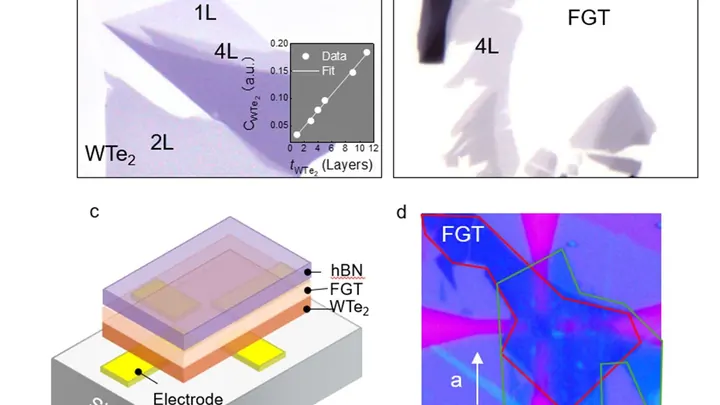
Usually, current in a metal acts like boiling water on ice: it heats the material and destroys magnetic order. But in a layered structure of tungsten ditelluride and the ferromagnet Fe3GeTe2, current behaves differently.
The magnetic refrigerator of the future won't hum with a compressor. Instead, it will cool your groceries by exploiting a special material that heats up in a magnetic field and cools down when the field is removed. This cycle resembles the compression and expansion of gas in a conventional fridge, but here a magnet does the work of a piston.
When servers in a data center run at full tilt, they get as hot as a forgotten iron. That heat goes to waste, and cooling them eats up even more energy. Engineers in Germany have proposed putting that heat to work: let it drive liquid through thin tubes all by itself, with no motors or pumps.
Their device looks like a flat box with an asymmetric bottom.
A quiet tube with a heated grid inside. The voltage on the grid is suddenly raised, and the tube starts to hum, sustaining itself. This is not a malfunction but a transition to another stable state, like a ball rolling over a hill into a neighboring hollow.
Gas is nearly invisible, but it has a temperature, and you can read it from how the gas 'shadows' the thermal background. In the experiment, a camera looks at a warm screen through a jet of carbon dioxide. If the gas is cooler than the background, it appears as a dark spot; if warmer, it appears bright.
Ice on a warm frying pan doesn't just melt: it starts to move. A thin layer of water forms beneath it, and the piece glides as if on oil. The speed of this sliding depends on how quickly heat travels through the water film and how steep the incline is.
An ordinary heat engine is like a mill between the hot and cold banks of a river: the greater the drop, the stronger the current. Here, the drop is tiny, just one or two degrees, but water can still turn the wheel. The secret is that water is made to boil not by heating but by a sudden drop in pressure, so steam bursts out even from barely warm liquid.
A metal alloy is like a cocktail: mix a few elements and you get a material with new properties. But while a bartender tastes the drink, engineers need to know in advance how an alloy will behave in service.
Your kitchen fridge cools everything to a single temperature. But in labs where quantum phenomena are studied, you often need two different levels of cold at once. Previously, that meant assembling two separate cooling circuits — bulky and heavy.
Tiny particles that look like flowers can do two things at once: heat up and tell you how hot they are. This isn't science fiction: it's the result of working with nanoparticles made of cobalt ferrite, a magnetic material that responds to magnetic fields.
In a freezer, ordinary water turns to ice, but in living cells, such ice is a disaster: sharp crystals tear membranes apart like needles popping a balloon. Scientists who preserve cells for medicine have learned to avoid this calamity, but each method speaks its own language. A new study offers a common vocabulary — thermodynamics.
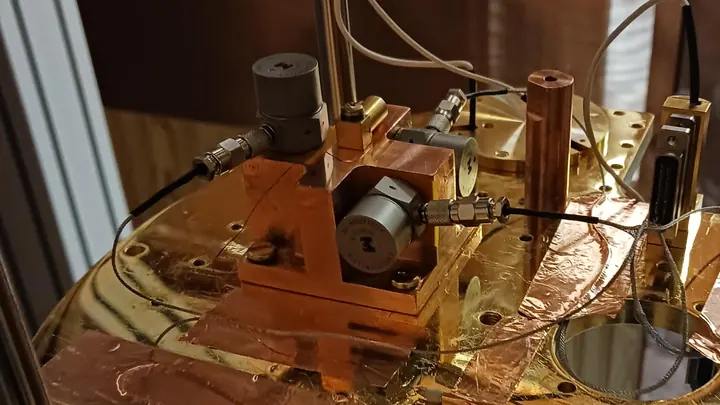
Inside a refrigerator that cools matter to near absolute zero beats a mechanical heart — the pulse tube. It pumps gas and extracts heat, but along with the cold it brings tremors. Each beat of this heart shakes the instruments sitting next to the sample and ruins delicate measurements.
An ice core from Antarctica is a time machine that recorded the climate for 130,000 years straight, year after year, with no gaps. Air bubbles trapped in the ice preserve the carbon dioxide of those ancient eras.
Run a current through a wire, and the wire heats up. Anyone who has ever touched a phone charger knows this. Physicists call this heating Joule heating, after James Joule, who in the mid-19th century measured how much heat electricity produces. Since then, the formula has been simple: the greater the resistance and the current, the hotter the wire.
The idea of a expanding universe, proposed by Georges Lemaître, finds an unexpected analogy. Space behaves like a piston in a cylinder: dark energy pushes it, much like steam. The relationship between pressure and volume in this 'engine' is strikingly similar to that of a steam boiler.
Water in a glass cools, ice melts, and a kettle heats the stove: that's how the world works: heat always flows from hot to cold. This is the second law of thermodynamics, a law that has never been broken.
The Mpemba paradox, hot water sometimes freezes faster than cold, has gained a quantum sequel. In the microworld, a particle pushed farther from the finish line gets there first. Experimenters demonstrated this on a single spin: like a racer, they pushed it farther from equilibrium, and it reached it faster than after a weak nudge.
Water always flows downhill, and heat from hot to cold. That's what энтропия dictates. But the quantum world finds loopholes.
Physicists made light particles interact with hot and cold environments in an uncertain sequence — like a flipped coin that hasn't landed yet.
Atoms, like a swarm of fireflies, shine in unison. When they flash together, the light multiplies — a hundred atoms shine ten thousand times brighter than one. Physicists have turned this trick into a heat engine. A typical motor needs both a hot and a cold source, but here the atoms operate with just a cold one.
A heat engine is like a sailboat: to move forward, it needs a difference. Usually that means a temperature difference between hot and cold reservoirs. But what if the reservoir itself starts moving? The wind that fills the sails is created not only by a pressure difference but also by the motion of air masses.
Two qubits, quantum bits, two-level systems, glide through hot and cold thermal baths. One moves at 0.8 times the speed of light. At that moment, familiar thermodynamics cracks: a moving qubit senses temperature differently than a stationary one. For it, the cold bath can feel hotter, and the hot bath colder.