An alloy is a metallic material created by melting and mixing two or more elements, where at least one is a metal. The resulting substance often has properties superior to its constituent elements, such as increased strength, corrosion resistance, or lower melting point. Alloys are ubiquitous in modern life, from steel (iron and carbon) to brass (copper and zinc), and they are fundamental to engineering, construction, and electronics.
History
Alloys have been used since ancient times; bronze, an alloy of copper and tin, gave its name to the Bronze Age around 3000 BCE. The scientific understanding of alloys developed in the 19th century with the advent of metallurgy as a discipline, and modern alloy design continues to advance with computational modeling.
How it works
When metals are melted together, the atoms mix and, upon cooling, form a new crystalline structure. The added elements can occupy interstitial spaces between the main metal's atoms or substitute for them in the lattice, distorting the regular arrangement. This distortion impedes the movement of dislocations—defects that allow metals to deform—making the alloy harder and stronger. The specific properties depend on the types and proportions of the added elements, as well as the cooling process, which can be controlled to produce different microstructures.
In practice
Alloys are used in virtually every industry: aluminum alloys in aircraft, titanium alloys in medical implants, and nickel-based superalloys in jet engine turbines.
Fun fact
The oldest known alloy, bronze, was so revolutionary that it marked a distinct era in human history, enabling tools and weapons that were far superior to pure copper.
A thin film of neodymium nickelate, fifteen nanometers thick, sits on a neodymium gallate substrate. Below one hundred eighty kelvin it behaves as an insulator: electrons are locked inside their atomic cells and cannot move freely.
When sugar goes into tea, it dissolves. But why doesn't it just fall back out? It's all about chemical potential — a quantity that shows how 'favorable' it is for a substance to be in a given place and state. For a pure substance, it's easy to calculate, but for a mixture of several components, it's a real puzzle.
A chef pours hot sugar syrup onto a cold table, and it sets into crystals. That's roughly how engineers pictured metal solidification: the liquid instantly becomes a scatter of crystalline grains. But close-up imaging revealed an extra stage wedged between liquid and solid.
A bridge of aluminum just a few atoms thick is the heart of many quantum devices. Current flows through such a bridge without resistance, and it can be controlled with a magnetic field. These bridges are called Josephson junctions, after the British physicist who described their behavior.
In a solid piece of tin-lead alloy, the layers of the two metals lie like pages in a book. When heated from one side, the layers don't melt uniformly but in whimsical tongues and fingers. Scientists studied this process using a transparent alloy that can be seen through under a microscope and compared it with a computer model.
A copper wire hit by a laser is like a kitchen where the chef turns on the stove and watches the stopwatch at the same time. Copper atoms start to dance, losing the order of the crystal lattice, while electrons, like waiters in the dining room, instantly feel the change. But how much disorder do they need to notice?
When you pull on a piece of metal, it changes shape and simultaneously becomes stronger. The secret lies in tiny defects in the crystal lattice called dislocations. They are like wrinkles in a rug: moving a wrinkle shifts the rug more easily than dragging the whole rug.
A film as thin as a spider's web, made of five metals, took the hit from a laser. Inside, the pressure soared to 55 gigapascals — imagine a hundred elephants balanced on your thumbnail. The alloy withstood it, compressing for a fraction of a nanosecond without breaking.
One gigapascal is a thousand megapascals.
A piece of aluminum alloy is heated, and it quietly tells you about its strength. You just need to listen to that story in how the metal absorbs heat.
The usual way to find out how strong an alloy is — pull it until it breaks. That takes time and destroys the sample.
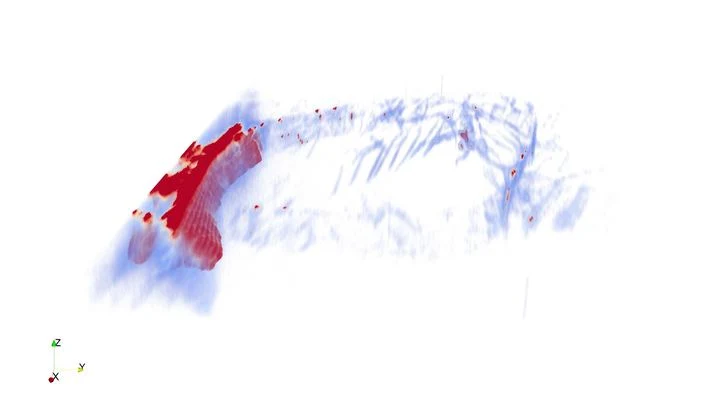
A metal part grown on a 3D printer looks indistinguishable from a forged one. But when load is applied, a very different story unfolds inside. A synchrotron X-ray beam is like a microscope that sees through steel and reveals what's happening right at the crack tip.
In ordinary forged steel, a crack blunts before it can propagate further.
Metal is like a rope made of many strands: pull too hard and it snaps. Engineers have long sought a way to make it both strong and flexible at the same time. Typically, additives that increase strength make the metal brittle. But a team of materials scientists found a loophole: they added a small amount of nitrogen to the CrMnFeCoNi alloy, just one atom in a hundred, and got an unexpected result.
A crystal one atom thick is like a sheet of paper you can write on with electricity. Such a material promises to become the foundation for tiny, fast microchips. But before putting it into production, you need to know exactly what it's made of. And that's where the usual formula falls apart.
The classic BCS theory of superconductivity, developed by John Bardeen, Leon Cooper, and Robert Schrieffer, describes the mechanism by which electrons pair up into Cooper pairs and move without resistance.
A piece of chromium exposed to air gets covered in invisible armor, an oxide film, within a minute. That film protects the metal from rust, but for a battery it's a disaster: the film blocks chromium ions, so no current flows.
Scientists mixed five metals — chromium, bismuth, copper, tin, and nickel.
Bricks of different sizes laid in a single wall leave cracks in it. Atoms in superalloys behave much the same way: when two different metals form a common crystal lattice and their atoms differ slightly in size, stress appears inside the material. It accumulates and eventually destroys the alloy when heated.