How Needles Make Fabric Drink express
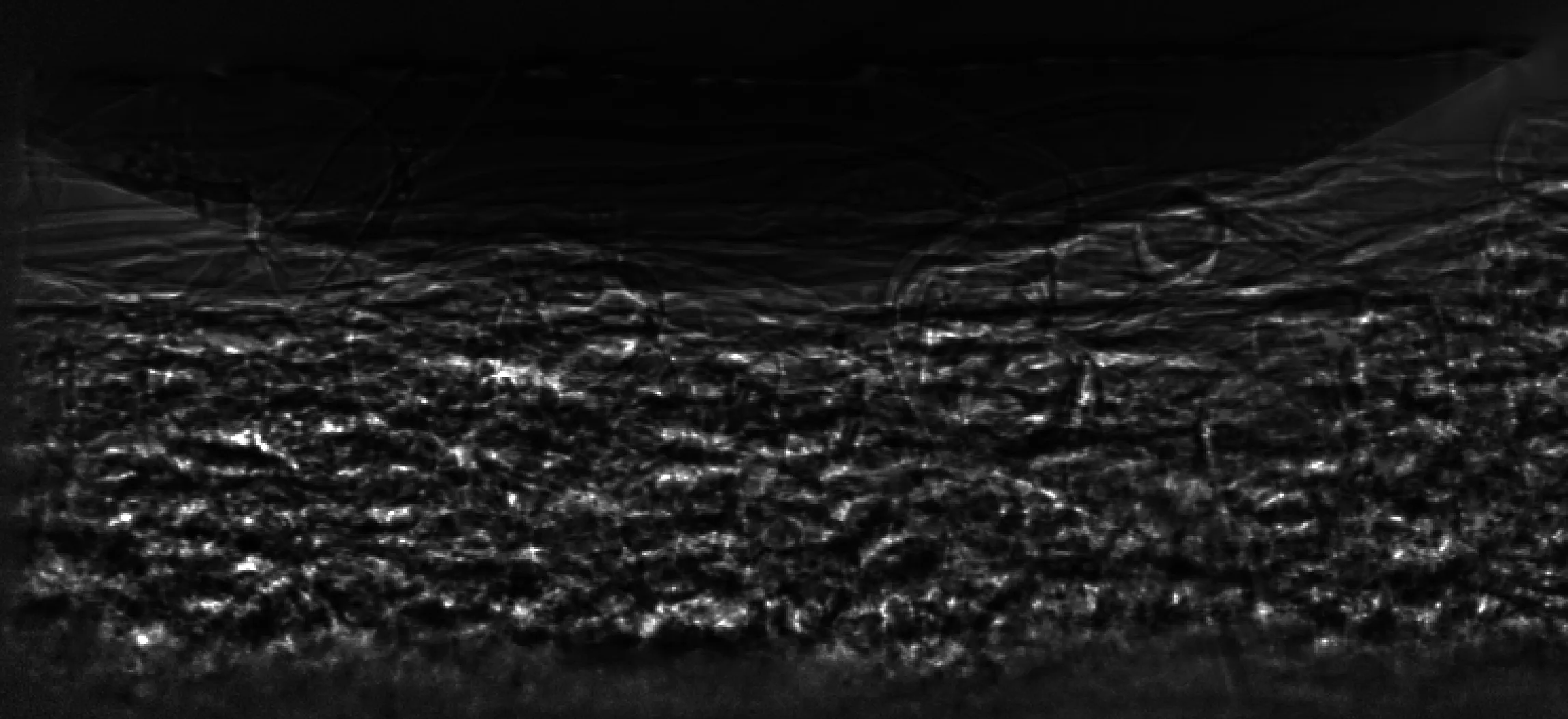
Felt looks like a tangled ball of wool, but under X-rays you can see hidden trails inside. When a water drop lands on such material, it doesn't just spread across the surface — some of the liquid dives deep, like water into blotting paper. Scientists captured this process for the first time with an X-ray camera snapping hundreds of frames per second.
The secret lies in the needles. Felt is made by punching a layer of fibers with barbed needles. Each needle catches fibers and drags them downward, like a knitter's hook. The more punches, the more fibers stand upright — creating 'pillars' that water races down tens of times faster than through ordinary tangled material.
Previously, it was thought that denser felt should be worse at letting water through, since it has fewer voids. But experiments showed the opposite: if needles worked longer, absorption speed increased even as the material became denser. It's all about fiber orientation — vertical channels act like straws, not a maze.
Now manufacturers of filters, insulation, and geotextiles can tune the material's 'thirst' simply by changing the number of needle punches. It's like adjusting a faucet: more needles (faster absorption, fewer) slower.
Original abstract
as written by the authors arXiv:2602.15176
Nonwoven fibre networks underpin filtration, insulation and geotextiles, where liquid uptake, redistribution and release govern performance. In needle-punched felts, barbed needles mechanically entangle fibres and partially reorient them toward the thickness direction ($$z$$), creating out-of-plane "pillars" and heterogeneity. While mechanical and structural consequences of needling are well documented, dynamic $$z$$-direction transport in partly saturated networks remains difficult to access due to opacity and sub-second timescales. Here we combine micro-CT ($$\mu$$CT) of dry structure with time-resolved X-ray radiography during droplet addition to quantify through-thickness transport as a function of saturation and needling intensity, using a compact Washburn-type descriptor for dynamics. Results show an exponential dependence of $$z$$-directional liquid transport on saturation, consistent with previous models for in-plane relative permeability of nonwoven networks. Additionally, increased needle-punch intensity reorients fibres toward the $$z$$-direction, forming preferential flow pathways that enhance through-thickness transport, even as single-phase permeability decreases. These findings underscore needle-punch as a key design parameter for tuning liquid transport in nonwoven fibre networks. The approach provides an experimental and modelling framework for dynamic, capillarity-driven transport in opaque fibrous materials.
Felt needles are made with barbs like a fishhook, so they catch and flip fibers rather than just piercing them.