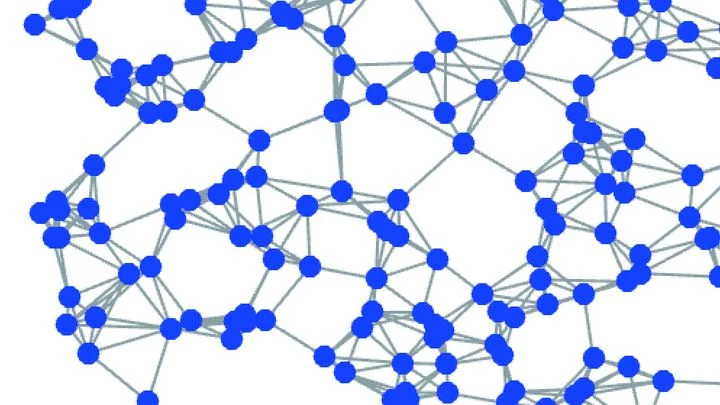
In network science, a weight is a numerical value assigned to a connection (edge) between two nodes, quantifying the strength, capacity, or intensity of that relationship. Unlike an unweighted network where all connections are equal, a weighted network captures heterogeneity: a weight could represent the number of interactions, the amount of flow, or the similarity between nodes. For instance, in a social network, the weight of a friendship edge might be the frequency of communication; in a transportation network, it might be the number of passengers or the travel time. Weights are fundamental to analyzing network structure and dynamics, as they influence path lengths, centrality measures, and community detection.
History
The formal use of weights in networks dates back to the 1950s in the study of social networks and transportation, but it became widespread with the rise of complex network theory in the late 1990s, particularly through the work of physicists like Mark Newman and Albert-László Barabási.
How it works
Weights are typically assigned based on empirical data or model assumptions. Once assigned, they modify the mathematical operations on the network: the shortest path between two nodes is computed by summing weights along edges, and centrality measures like PageRank or eigenvector centrality incorporate weights to give more influence to stronger connections. In many algorithms, weights are normalized or transformed to ensure stability, and they can be directed (different weights for each direction) or undirected.
In practice
Weighted networks are used in internet routing (where link weights represent bandwidth or latency), in recommendation systems (where user-item weights are predicted), and in neuroscience (where brain connectivity weights reflect synaptic strength).
Fun fact
In the famous 'six degrees of separation' experiment, the weights of social ties are not all equal—a close friend counts more than a distant acquaintance, which is why the effective networkdiameter is often smaller than the raw hop count.
A jazz trio plays in the dim light of a club. The pianist leads the melody, the bassist holds the rhythm, and the drummer sprinkles out rolls. If you listen only to pairs of musicians, you can catch how the pianist adjusts to the bass or the bass to the drums.
Imagine a large orchestra without a conductor. Each musician hears everyone else and adjusts to the collective hum. If every instrument amplifies its neighbors, the sound builds to a screech; if some occasionally dampen it, the orchestra may fall into silence or break into cacophony.
Two photographers shoot the same mountain. One takes a hundred shots from the summit and only a couple from the base; the other does the opposite. If you try to align their images, the algorithm might decide that the summit in one photo matches the summit in the other simply because there are many similar points there, not because it's the same spot. Sampling density throws it off.
An ordinary road map with traffic is a heap of numbers. Sending them all as is takes too long. But you can reduce the volume without losing the gist. Researchers found a clever solution: first redraw the map so that streets become points, and intersections become bridges between these points.
Communicating with a satellite is like trying to hear a whisper in a storm: the signal drowns in noise. Engineers have created an AI algorithm that runs directly on the satellite and, with minimal power consumption, detects distortions more accurately than previous methods.
A family tree becomes a tangle if you account for adopted children and remarriages. Evolution often resembles such a tangle: although the Standard Model, the traditional view of divergent evolution where species branch like a tree, paints a neat tree of species, in reality genes travel not only by inheritance but also directly between unrelated organisms — a process…
A tiny dust particle in a supersaturated solution sprouts into a large crystal in seconds. Neighboring particles remain invisible. A similar process was recently discovered in communities of language agents.
Why do some systems, from gene networks to air travel, preserve imprints of the past longer than others? For a long time, network science blamed topology: the number of connections, modularity, spectrum. But two networks with the same skeleton can remember and forget in completely different ways.
A city is a living system: it consumes resources, produces waste, and its 'circulatory system'—the road network — delivers people and goods to their destinations. But while engineers design transport arteries as rigid geometry of straight lines, nature has spent millions of years perfecting ideal distribution networks.
At a party, guests don't just chat in pairs; they gather in circles of shared interests: three discussing movies, four debating sports. The usual acquaintance map, like a phone's contact list, can't capture that: it only sees one-on-one links.
After a game of Scrabble, the board looks like a mosaic: tiles are scattered but form a connected pattern — islands of words in a sea of empty cells. Such a pattern can be described mathematically, but usually that requires complex rules.
Every carbon atom in a molecule carries a passport — the energy with which its deepest electrons sit in their orbitals. This energy is sensitive to neighbors: add an oxygen nearby or a double bond, and the number in the passport changes. Chemists have long measured such energies with X-rays, but calculating each new molecule takes hours of machine time.
The microbial community in the gut is like an orchestra: what matters is not only the musicians but how they play together. When disease strikes, it's not just the lineup of microbes that changes: their interconnections shift too. Researchers built interaction networks of microbial genes in healthy and sick individuals.
Every group has its unspoken trios: three friends who are always together. And there are pairs that exist on their own. It turns out that how much trios "contain" pairs determines how everything, from a virus to a new idea, spreads through the group.
Scientists introduced a measure they call the nesting coefficient.
Imagine a mountain range where height represents an organism's fitness. Every point on the slope is a particular set of genes. Evolution climbs upward, but the terrain of this phylogenetic network landscape is cut by ridges and valleys.
A city map: intersections are nodes, streets are connections. For an algorithm to understand the structure, each node needs a label. The classical approach — standard model — assigns simple tags, like house numbers.
A dense social network: everyone is connected to almost everyone else, and in this web it's hard to see who really matters. Too many threads — computers choke, simulations stall. Scientists have figured out how to prune such networks without losing what's essential.
The idea is to remove connections that don't participate in shortest paths.
A mouse brain contains about 70 million neurons, and the connections between them are far from evenly distributed: some cells have only a couple of dozen contacts, while others have thousands. It's like a city with quiet alleys and bustling squares. But until now, it was unclear how this unevenness affects the brain's actual function.
Alzheimer's disease is like a tangled ball of yarn: thousands of genes are intertwined, and it's hard to tell which ones snap first. Previously, scientists looked for important genes by simply counting how many connections each node in the network had. But that approach is like judging a person by the number of acquaintances they have — the most sociable isn't always the most influential.
A good chef tastes the soup and adds a pinch of salt. Ordinary scales won't notice that pinch, but sensitive ones will. In the quantum world, pairs of entangled particles play the role of such scales. It was previously thought that the entanglement had to be as strong as possible, otherwise precision wouldn't improve.
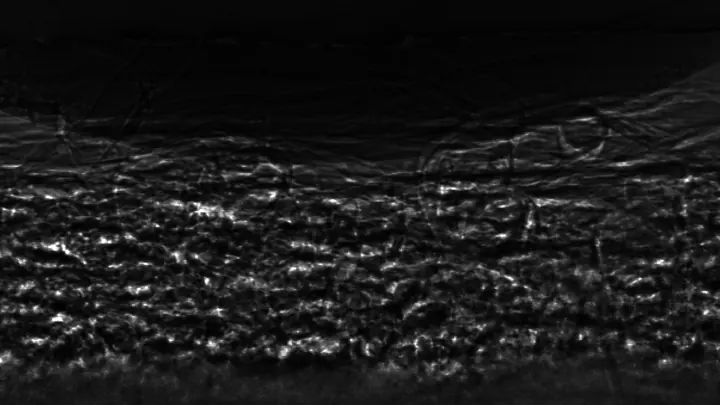
Felt looks like a tangled ball of wool, but under X-rays you can see hidden trails inside. When a water drop lands on such material, it doesn't just spread across the surface — some of the liquid dives deep, like water into blotting paper. Scientists captured this process for the first time with an X-ray camera snapping hundreds of frames per second.
The secret lies in the needles.
Picture a globe divided into cells: near the poles they shrink into narrow wedges, while at the equator they stretch into wide bands. If you connect random points on such a globe with lines, the compass arrows will lie: connections will point to where there are more cells, not where the flows actually go.