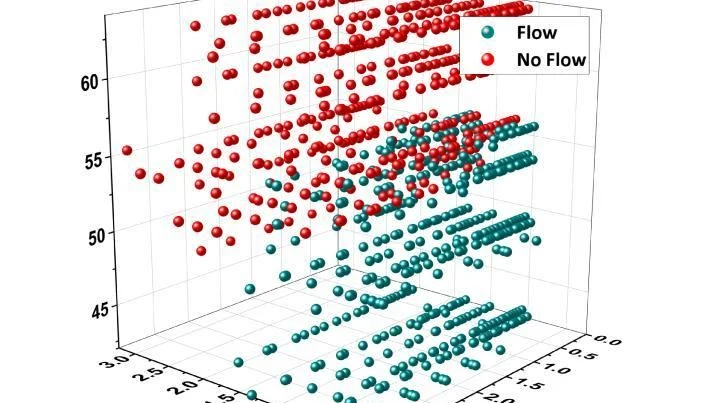
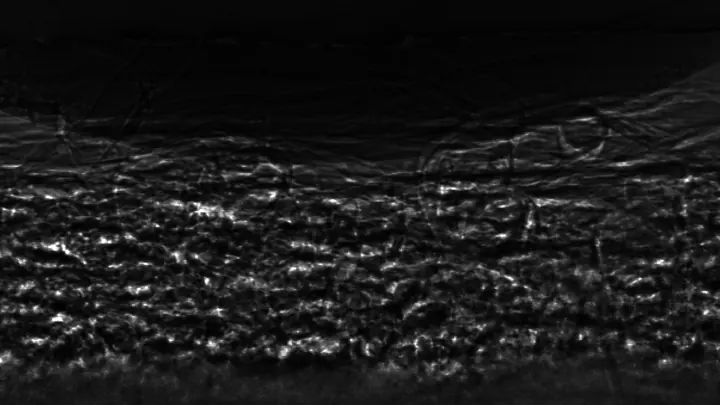
Confined water transport refers to the movement and behavior of water molecules when they are restricted to nanoscale spaces, such as carbon nanotubes, biological channels, or narrow pores in membranes. In these environments, water exhibits properties drastically different from bulk water: it can flow with almost no friction, form ordered structures like ice nanotubes, and exhibit anomalous diffusion. Understanding this behavior is crucial for designing efficient filtration systems, drug delivery mechanisms, and nanofluidic devices.
History
The field gained momentum in the early 2000s with experiments on carbon nanotubes showing exceptionally fast waterflow, followed by theoretical work on water in biological aquaporins.
How it works
At the nanoscale, the surface-to-volume ratio is enormous, so interactions with pore walls dominate. Hydrogen bonding networks reorganize, leading to reduced viscosity and enhanced flow rates. In some cases, water molecules align in single-file chains, enabling rapid, coordinated movement. Quantum effects and thermal fluctuations also play a role, making the transport highly sensitive to pore size, surface chemistry, and external stimuli.
In practice
It underpins the design of desalination membranes, nanofluidic transistors, and lab-on-a-chip devices, as well as understanding cellular water transport.
Fun fact
Water inside a carbon nanotube can freeze at room temperature, forming a solid ice tube just a few nanometers wide.
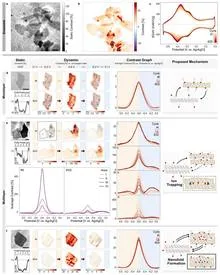
A stack of pages that has been flipped through many times remembers it: some sheets lie flat, others stick up, and creases remain here and there. Layered materials behave much the same way when ions enter them.
A weaver sits at her loom, her hands moving in a rhythm that cannot be predicted in advance. The threads converge and diverge, forming a pattern that seems random yet follows strict rules.
A crowd at the entrance to a narrow corridor behaves differently than in a spacious hall: some people get pressed against the walls, others are pushed forward. Roughly the same happens when an elongated particle finds itself in a fluid teeming with self-propelled dumbbells. Until now, it was unclear why such a particle moves faster along its long axis than across it, and how the crowd density affects its speed.
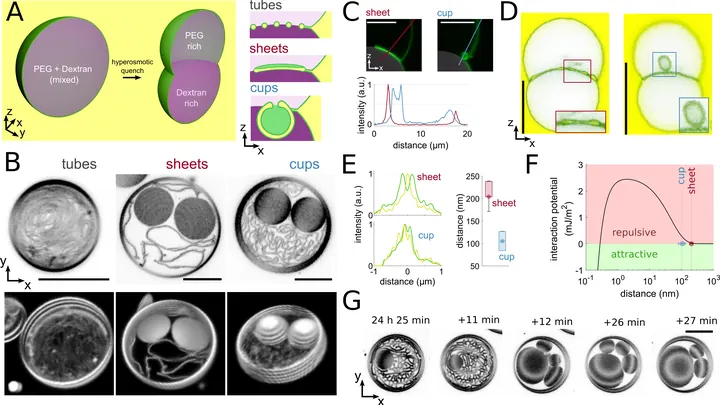
Two mica plates, smooth as mirrors, slowly approach each other in a calcium solution. At a distance of fifty nanometers, an invisible barrier suddenly appears between them: as if someone had stretched a web of molecules between the walls. This web prevents the plates from touching, even though by all calculations they should glide freely toward each other.
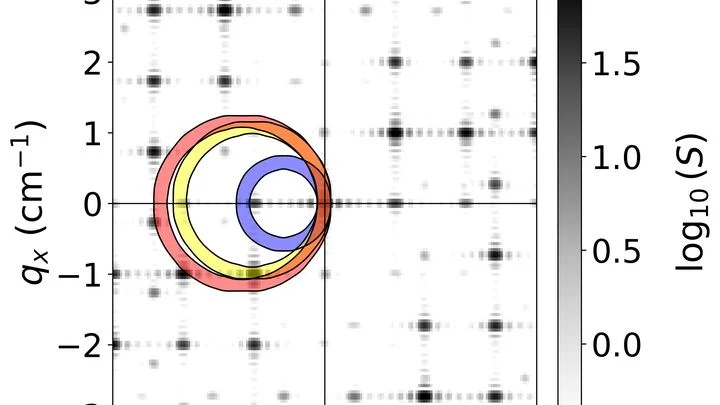
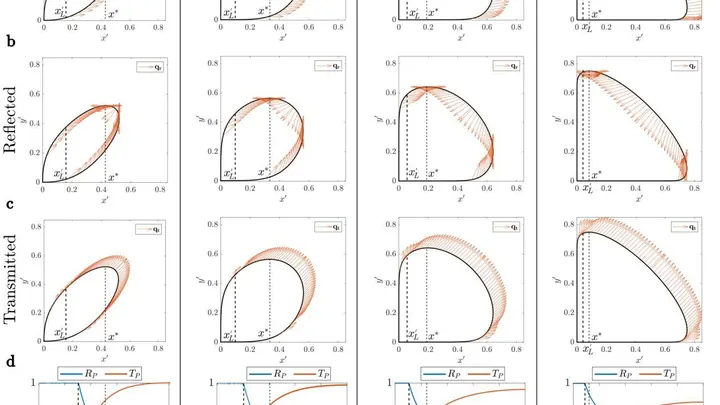
Waves on the water's surface usually break against any obstacle — a rock, a piling, an island. But what if you arrange obstacles so cleverly that the wave barely notices them? In a new study, scientists assembled a pattern of many points on the water, arranged according to special mathematical rules, and sent waves through them.
Toss a handful of sand onto a table — the grains scatter equally in all directions. But if a magnet is hidden under the table and the sand is iron, the trajectories get trickier: an invisible structure overlays the chaos. That's roughly how molecular motion works inside a living cell.
Inside every cell, things are constantly meeting and parting. Some pairs hold tight, like Velcro, while others barely touch, like pollen on the wind. These fleeting touches, where the binding strength is comparable to a grain of salt dissolving in a glass of water, govern many of the cell's signals and decisions.
The universe right after the Big Bang was like a boiling cauldron: bubbles of a new state of matter were bursting and growing everywhere. These were first-order phase transitions — exactly like water boiling, only at temperatures reaching trillions of degrees.
A layered cake where each tier conducts electricity differently: that's the structure of the crystal La3Ni2O7, a compound of nickel, lanthanum, and oxygen. Current flows differently along the layers than across them.
In the crystal CsV3Sb5-xSnx, which becomes a superconductor at low temperatures, current does not flow as a uniform stream but along narrow, winding paths. A scanning microscope with a sensitive magnetic field sensor helped reveal these paths: it picks up the faintest currents, much like a sonar probes the seafloor.
In murky mud, between two electrodes, long chains of bacteria line up: each one as thin as a microscopic cable. Every such filament conducts current over a full centimeter, a true marathon for a microbe.
Millions of cilia, thin hairs, work inside the tiny ducts of our bodies. They beat in synchrony, like the oars of a galley, pushing viscous mucus or fluid along. The authors of a new study propose viewing the ciliary carpet as an active porous medium — something like a sponge that squeezes and releases itself, driving water through.
A drop of thick shampoo falls into water and freezes into a strange rope. A liquid that both flows and springs back is called viscoelastic. In it, tiny particles under ultrasound behave quite differently than in water. Viscoelasticity is a material's ability to both spread like honey and return to shape like rubber.
When you squeeze ketchup out of a bottle, you're battling its stubbornness: it sits still at first, then suddenly shoots out in a blob. That's typical non-Newtonian behavior — resistance to flow changes with how hard you push. But the authors of a new study found a way to almost completely eliminate that resistance.
A boiling pot, a gust of wind, a wisp of smoke from a campfire — all obey equations that mathematicians call 'nonlinear and dissipative.' In plain terms, energy is lost to friction, and parts of the flow influence each other so strongly that predicting the motion ahead of time is a task on the edge of feasibility.
An ordinary crystal is like an apartment building: electrons move through shared hallways and staircases, influencing each other through the walls. Now, imagine removing all the walls, leaving just a single line of apartments. How would the residents behave?
Hydrogen has nothing to do with it, but the collective behavior of electrons takes center stage.
A drop of water on a table usually sits still. But make the table slightly softer on one edge and stiffer on the other, and the drop will crawl toward the stiffer side. This phenomenon is called durotaxis: the liquid itself chooses where to flow, without pumps or electricity.
This trick works because the surface under the drop is not uniform.
A tiny oil drop squeezes through a water channel narrower than itself. In pure water, it crawls along calmly, like a round bead. But add a little soap to the water, and the drop begins to bend, like a caterpillar.
In a narrow gap between two plates, water from humid air collects on its own: this is capillary condensation. If the gap is only a few nanometers wide, water no longer behaves like a continuous liquid: every molecule counts.
Inside a cell, there are tiny liquid droplets, like oil droplets in water. They form from proteins and RNA and serve all sorts of purposes, from storing molecules to speeding up reactions. But if droplets start merging with each other, you'd end up with one big puddle, which would wreck the cell's organization.
Inside the kidneys, liver, and other organs, fluid flows through channels that squeeze and release like a hose underfoot. The walls of these channels are not rigid: they are porous, elastic, and soaked with moisture.
When a crowd of bacteria (mostly composed of carbon) gathers in a droplet of water, a synchronized round dance begins: millions of tiny ones glide along giant ellipses, like dancers on a ballroom floor. Without a conductor, complex patterns emerge from simple movements.
The cell membrane isn't just a wall; it's a turnstile gate. Embedded within it are protein channels that let ions in and out, creating an electric charge, like a battery that powers nerves and muscles.
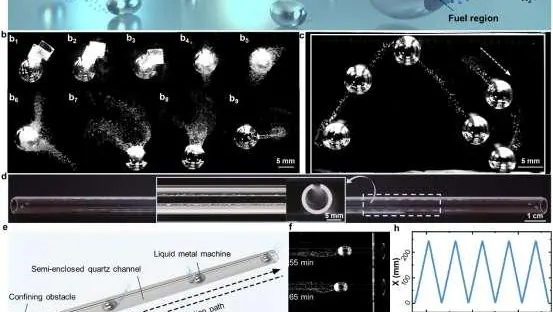
A droplet of liquid metal glides along a narrow channel like mercury from a broken thermometer. It needs no motor — the fuel is a chemical reaction with the surrounding liquid. But what happens when the droplet hits a wall? Previously, such machines were studied in open spaces, and in tight channels they behave differently.
The boundary between two liquids is like an invisible skin: it's there, but you can't touch it with your finger. Scientists have found a way to measure its elasticity without touching it. They made a tiny probe oscillate above the surface, and between the probe and the interface lay a thin film of liquid.
Inside a living cell, droplets float that don't mix with the surrounding fluid, like oil in water. These droplets aren't just passive clumps; they actively press on membranes and make them bend. Scientists observed this process in living plant cells, reproduced it in a test tube, and simulated it on a computer.
A river flows in one direction, but a wave on its surface travels in the opposite direction. The same splitting happens in hyperbolic materials: the energy of a light wave and its fronts diverge, preventing a sharp lens from being created.
In a thin film of water squeezed between two glass plates, bacteria live. Oxygen reaches them only through one wall, like air entering a room through a single window. When bacteria are few, they pay no attention to this: some stick to one wall, some to the other, and the picture is symmetric. But once they multiply, everything changes.
A membrane for water electrolysis is like a sponge soaked with water. Inside it, hydroxide ions, particles that carry electric charge, must move freely. But exactly how they move has long been a mystery: tracking each ion in an experiment is too difficult.
A cell is a city with gates. Each gate is a protein channel in the membrane: through it, ions, sugars, and signaling molecules pass in and out. Some gates are almost always open, while others open and close randomly, like subway doors that let a passenger through one moment and slam shut in their face the next.
A drop of metal on a semiconductor is like an island in the sea. For an electron to reach that island, it must pay a "toll": overcome a barrier that arises because the island is tiny, and each extra charge significantly changes its energy. This phenomenon is called Coulomb blockade. It underpins single-electron transistors, where current flows one electron at a time.
A particle wanders through a medium scattered with obstacles. Sometimes it pushes them aside like a snowplow, and it was thought that this pushing is what eventually stops the motion. But in three-dimensional space, that mechanism doesn't work.
It turns out that stopping arises from rare events: every so often, a particle randomly finds itself in a trap, and all exits close, as if doors slam shut.
Water in a narrow gap crawls on its own: that's the capillary effect that pulls sap up a stem. But if it hits a step, the liquid can freeze, like a traveler before a high threshold. Scientists built tiny glass channels and watched when a drop steps over the ledge and when it gets stuck.
A thin wire made of a special material, a topological insulator, behaves like a city street: the interior is empty, and all traffic runs along the edges. Electrons in such a wire move only along the surface, like pedestrians on a sidewalk, never stepping onto the roadway.
Felt looks like a tangled ball of wool, but under X-rays you can see hidden trails inside. When a water drop lands on such material, it doesn't just spread across the surface — some of the liquid dives deep, like water into blotting paper. Scientists captured this process for the first time with an X-ray camera snapping hundreds of frames per second.
The secret lies in the needles.
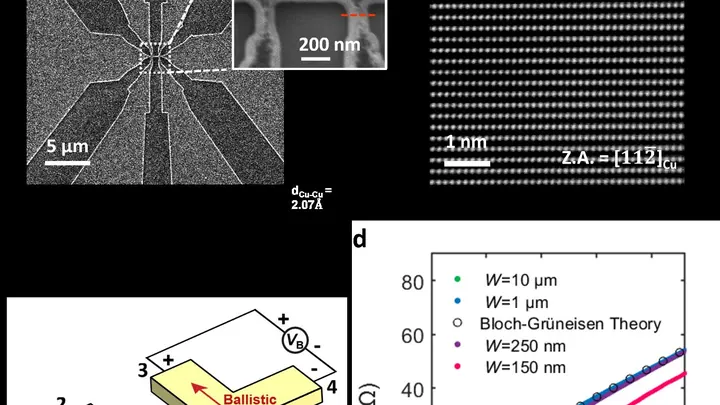
An electron in a metal is usually like a person in rush hour: it constantly bumps into others and loses its way. But if you remove the obstacles, it can fly in a straight line, like a car on an empty night highway. This kind of motion is called ballistic — from the word "ballista," an ancient catapult that hurled a stone without interference.
Light usually travels straight, like a flashlight beam. But it can be twisted, like water in a funnel, creating a vortex in the beam. Such twisted light can carry more data: different vortices don't interfere with each other, just like different radio channels. The challenge was to make a source of such light small enough for a chip.
River water flows smoothly until it hits a narrow spot. There the current speeds up, and around a bend it may swirl into a vortex. Similar funnels, but just molecule-sized, can gather particles in one place all by themselves — no pump or motor needed.
In a narrow slit between two plates, ions don't behave like free particles but like a crowd in a packed bus: pressed tightly together, they form dense clusters. This very property, the ability of ions to bunch up in extremely confined spaces, underpins a new mechanism for controlling ion transport.
Researchers studied ion behavior in two-dimensional nanochannels just a few atoms wide.
Thirty nanometers is the distance over which a phonon sprinter hasn't yet had time to accelerate. In thin aluminum nitride films, thermal resistance remains almost unchanged up to this thickness: heat transport proceeds in the ballistic regime, where phonons (quanta of crystal lattice vibrations) fly…