How a Telescope Locks Focus Without a Bright Star express
The night sky shimmers. Warm and cold air currents jiggle the star's image, and a large telescope sees a blurry blob instead of a point. To restore sharpness, astronomers ignite an artificial star in the sky — a laser beam reflected off a layer of sodium atoms about 90 kilometers up. By its twinkling, the telescope's mirror flexes hundreds of times per second, compensating for the jitter.
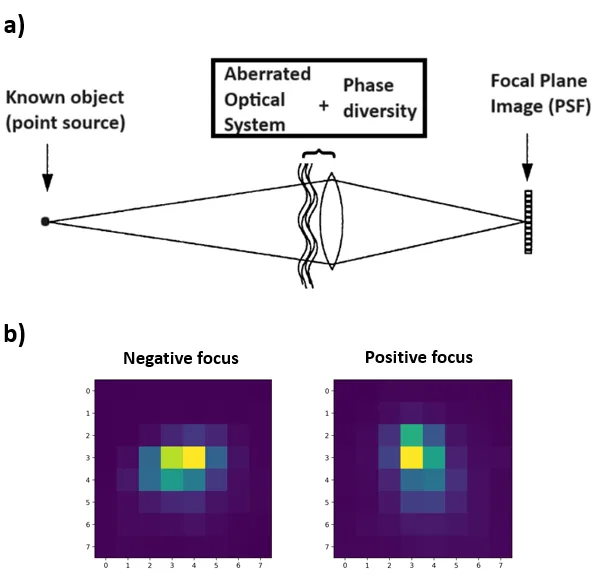
But the laser star has a quirk: the glowing sodium layer itself slowly drifts up and down, and the telescope's focus slips. Previously, a real star nearby was needed for correction, but it's not always there. Engineers at the Keck telescope in Hawaii tried a different approach: tracking focus directly from the camera image, without a second star. They compared three algorithms like chefs in a kitchen: who's more accurate, who's faster, who won't break under a weak signal. The winner was a method that reconstructs the shape of the light spot, much like we identify a coin by its glint.
Sky tests showed that even when the air was particularly turbulent, the algorithm restored sharpness.
Now Keck will have more nights when it sees distant galaxies sharply, not as if through water. The same trick will work for future giant telescopes with thirty-meter mirrors.
Original abstract
as written by the authors arXiv:2602.15746
Laser guide stars (LGSs) have been deployed for the last 20-30 years in ground-based astronomical telescopes to overcome the limited sky coverage of classical adaptive optics (AO) systems. Unfortunately, slow altitude drifts of the sodium layer compromise focus measurements, generating the so-called slow focus error, and, consequently, a natural guide star (NGS) is needed to compensate for that error. Our goal is to develop and operationalize a focal plane wavefront sensing (FPWFS) technique for slow focus tracking for the Keck I telescope, which can significantly increase sky coverage and allow slow focus tracking at higher frequencies, reducing the lag error. We develop, characterize, and compare three different FPWFS algorithms, namely Gerchberg-Saxton (GS), linearized focal plane technique (LiFT), and Gaussian fit (Gf). These algorithms were studied for the specific purpose of slow focus sensing in the NIR (H and K bands) using numerical simulations and data collected at Keck in 2025 (bench and on-sky). The three algorithms were studied and characterized against different criteria such as linearity, computational costs, and resistance to low signal-to-noise ratio and/or residuals. From the results obtained, the main candidate for an on-sky deployment was GS. On-sky tests showed promising results, with GS successfully compensating for purposely introduced focus errors, even under the presence of high turbulence conditions. This work can also be extrapolated to other existing 8-10 m class telescopes, or even future 30-40 m class telescopes, where the use of FPWFS can significantly improve sky coverage and reduce the lag error.
The sodium layer that the laser illuminates sits at about 90 km altitude — higher than meteors fly, but lower than the ISS orbit.