LISA (Laser Interferometer Space Antenna) is a planned space-based gravitational wave observatory designed to detect low-frequency gravitational waves, from about 0.1 millihertz to 0.1 hertz. These frequencies are produced by supermassive black hole mergers, compact binary systems in our galaxy, and possibly by cosmic strings or phase transitions in the early universe. Ground-based detectors like LIGO are blind to these waves because seismic noise and the curvature of the Earth limit their sensitivity at low frequencies.
History
The LISA concept was first proposed in the 1980s by scientists at NASA and ESA. The mission is currently scheduled for launch in the mid-2030s, led by the European Space Agency with NASA collaboration.
How it works
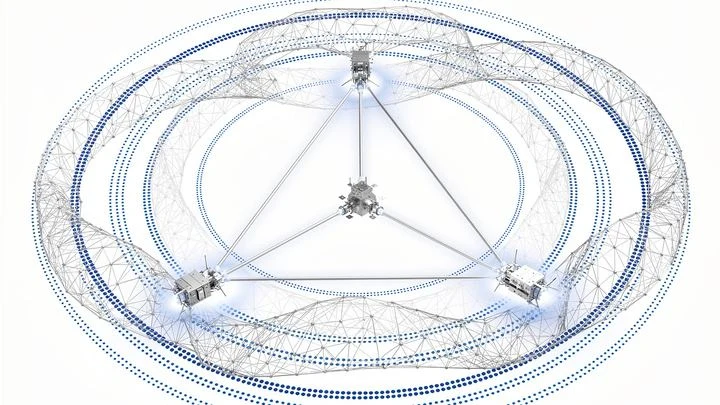
LISA will consist of three spacecraft arranged in an equilateral triangle with sides of 2.5 million kilometers, trailing Earth in its orbit around the Sun. Each spacecraft will contain a free-floating test mass, and lasers will measure the distances between them to picometer precision. A passing gravitational wave will alternately stretch and compress the arms, causing tiny changes in the laser interference pattern. The enormous arm length is necessary because low-frequency waves have very long wavelengths — a 1 millihertz wave has a wavelength of 300,000 kilometers.
In practice
LISA will open a new window on the universe, allowing astronomers to study supermassive black hole mergers, map the population of compact binaries in the Milky Way, and test general relativity in strong gravitational fields.
Fun fact
LISA will be sensitive enough to detect the gravitational wave background from the entire history of merging supermassive black holes in the universe, effectively listening to the 'hum' of cosmic structure formation.
Imagine an interpreter distracted by every rustle in the hall, turning a one-hour meeting into two. That's roughly how gravitational wave detectors behaved when analyzing long signals: each turn of the Earth added noise to the calculations, and processing a day-long neutron star merger threatened to stretch into weeks.
The night sky is full of deceptive lights. Astronomers were searching for galaxies that ignited in the first few hundred million years after the Big Bang: their light has traveled to us for nearly 13 billion years. Six faint smudges were selected from images taken by the Hubble and Spitzer space telescopes.
Gravitational-wave detectors are like extremely sensitive ears: they pick up the trembling of space when black holes or neutron stars collide somewhere in the universe. But even the most sophisticated "ears" cannot hear everything. The new LIGO A# project is like replacing the eardrum with a thinner, more sensitive membrane.
A black hole is like a spinning top that never stops on its own. But if a cloud of ultra-light particles, bosons, forms around it, the picture changes. This "fog" acts like an invisible brake: the particles drain the hole's spin, slowing it down.
Imagine a quiet room where you need to pick out a single melody among many barely audible rustles. That's roughly what it's like to search for signals from extreme systems of two black holes — one huge, the other millions of times smaller.
Somewhere in the depths of the Milky Way, radio pulses flare up from time to time — rare, steady, like the ticks of a distant metronome. These long-period radio transients were discovered only recently, and they immediately puzzled astronomers.
The orchestra plays, but the conductor hears only a general hum. Each instrument plays its own part, but you can't tell where the flute is and where the double bass is. You need a spectrum analyzer — a device that breaks down sound by frequency.
A bell rings not from the strike but from a fleeting shudder of space. A gravitational wave, like ripples on a pond, passes through a massive magnet, and it deforms ever so slightly. That deformation can be turned into an electrical signal.
A noisy café. You're trying to make out two quiet conversations: one from the table by the window (black hole mergers), the other a barely audible whisper from the far corner (echoes of the universe's birth). But the hiss of the espresso machine and street noise (detector jitter) drown everything out. New work teaches a computer to separate these sounds.
At the heart of our Galaxy lives the supermassive black hole Sagittarius A*. If an invisible companion orbits nearby, their dance can be spotted through the light of other stars. The pair's gravity works like a lens: as the black holes pass in front of a background star, its light briefly brightens and splits into two.
A huge bowl of water. Drop a stone into it — ripples spread across the surface. The fabric of spacetime works much the same way: when two massive stars merge, they create ripples — gravitational waves. These waves travel to Earth and are picked up by giant detectors like LIGO and Virgo.
Low-frequency radio waves (from 30 to 300 kilohertz) carry information through water and earth. But catching them with an ordinary antenna is hard: the wavelength reaches several kilometers, and a small receiver barely feels such a field.
A spinning top that makes a hundred turns per second suddenly starts losing speed dramatically — much faster than any known top. That's exactly what pulsar J0435+3233 is doing. It's a dead star, crushed to the size of a city, but whirling at a furious rate.
In 2034, a rocket leaves a spaceport with an unusual payload: two spheres the size of a large globe, each weighing nearly a ton. No engines, no electronics. Just a mirrored surface of hundreds of corner-cube reflectors — tiny prisms that return light exactly to where it came from. This is the future space tuning fork.
The Universe is a giant concert hall, where instead of walls and balconies, invisible clouds of dark matter float. This architectural ensemble is not static: it refracts and scatters the 'music' rushing through it — gravitational waves from merging black holes.
In the silent ocean of the Galaxy, mature civilizations have likely long chosen an unexpected strategy: instead of loud beacons, they scatter quiet fireflies — autonomous interstellar laser beacons, drifting in the void and dropping microsecond flashes. These 'seeds of contact' are not tied to their home stars and do not drown in their glow.
Gravitational waves from merging black holes sound like bass chords, pulsars tap out a rhythm, and the cosmic microwave background carries echoes of the Big Bang. But there is a silent player — dark matter, whose presence is betrayed only by gravitational effects.
The Universe is not silent: it is filled with a continuous gravitational-wave hum. In a decade, the LISA space observatory will tune its "ears" to the millihertz range, and the richest source will be our Galaxy — tens of thousands of white dwarf pairs whirling in a frantic dance.
In the centers of distant galaxies, X-ray 'beacons' sometimes light up. They don't flash randomly but on a strict schedule: every few hours or days. These bursts are called quasi-periodic eruptions (repeating at nearly regular intervals).
The space antennas LISA and Taiji each consist of three satellites flying around the Sun behind Earth, forming a triangle with sides millions of kilometers long. They measure how the distance between them changes when a gravitational wave passes, like ripples on a pond from a thrown stone.
Two dead stars circle in a final dance. Their approach creates ripples in space — gravitational waves. But there may be a third, invisible partner in this dance. Its gravity accelerates the pair, and the signal changes pitch slightly, like the siren of a passing car.
A pair of neutron stars, locked in a gravitational embrace, traces invisible circles in the void. A century ago, Albert Einstein described this dance as waves of curved geometry, but for a long time we could only catch glimpses — through the feverish flicker of radio pulses.
A tiny star spirals around a giant rotating black hole. Slowly, it moves closer in a spiral, and this dance lasts thousands of years. All the while, waves ripple through space, like ripples on water, but these are gravitational waves. They can be "heard" with special detectors.
Two dead suns circle in an eternal dance. Their orbit is a perfect metronome, keeping time with the accuracy of atomic clocks. But even dead stars can tremble.
In absolute silence, you need to hear a feather drop. But someone keeps rustling a plastic bag. For the space-based LISA observatory, that 'rustling' will come from charged particles in space.
Two sensitive microphones are listening to the Universe. One hears a low hum, the other hears almost nothing. It's not a malfunction: it's about how they are oriented.
Gravitational-wave observatories like LIGO don't just catch loud bursts from black hole mergers.
The universe is permeated by invisible mass, dark matter, whose existence was first proposed by Fritz Zwicky in the 1930s, based on his observations of galaxies moving in clusters.
The early universe cooled like a giant cauldron. And just like cracks can form on a freezing pond, cracks could appear in space — domain walls. These are folds in space itself, boundaries between regions with different properties. When such a wall vanished, it shook spacetime, producing gravitational waves.
When a piano falls into an abyss, we think about the abyss. We don't think about the piano's cover. In much the same way, astrophysicists have for decades studied extreme close encounters between small bodies and massive black holes. They focused on the black hole itself and what orbits it. But what the 'bullet'—the small object heading toward doom — is wearing, almost no one asked.
A translator records a multi-hour conversation. If they try to hold the entire dialogue in their head, they're bound to garble details by the end. That's roughly how gravitational observatories work: they listen to the 'conversation' of massive bodies spiraling together.
An ultra-sensitive microphone listens not to sound, but to the trembling of space itself. That's how gravitational wave detectors work — LIGO, Virgo, KAGRA.
A tiny coin circles a heavy bowling ball. The coin is a small black hole or a neutron star, and the ball is a supermassive black hole at the center of a galaxy.
When water freezes in a lake, the ice becomes covered with a network of cracks — boundaries between crystals. A similar process in the first moments after the Big Bang could have spawned enormous structures resembling icy fractures. Scientists call them domain walls.
The Universe is pervaded by an invisible substance — ultralight dark matter, which doesn't collide with ordinary matter but can tremble like a taut string. Its oscillations alter the world's most fundamental properties: the electron charge, the speed of light — as if the tuning of a single cosmic note slightly drifts.
It was Edwin Hubble who discovered that galaxies are rushing apart, and Georges Lemaître linked this to the expansion of space. Today, the ΛCDM model, relying on dark energy and dark matter, asserts that the Universe is flat as a perfectly stretched canvas.
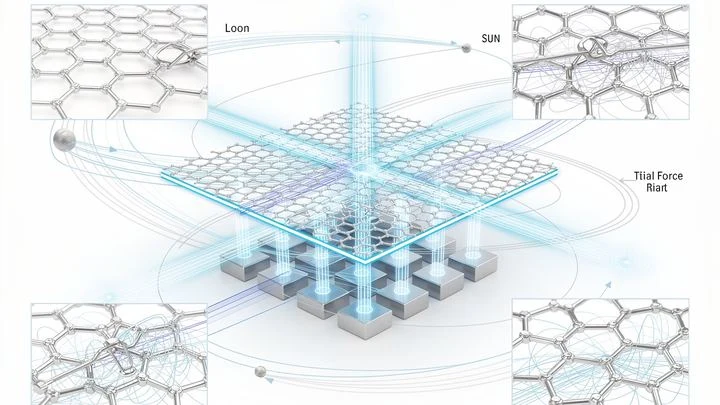
In the quiet of a laboratory, a graphite flake hovers above a magnetic grid. This is not just a demo of diamagnetism's magic — it's listening to the Universe. Like a spider casting its web to catch vibrations from an invisible world, this flake has become a gravitational web.
Astronomers listen to the cosmos like an old radio: they twist the knob not to find a particular station, but to catch any unusual noise. This approach breaks the mold: instead of hunting for gravitational waves using memorized patterns, they catch everything — without bias.
LIGO, Virgo, and KAGRA detectors act like giant microphones, listening in on gravitational waves — vibrations of space itself. The new GWTC-5.0 catalog recorded 161 black hole mergers, bringing the total count to 390 events.
The universe sometimes resembles a pot of boiling water. With enough heat, liquid turns to vapor: that's a phase transition. Something similar could have happened in the early universe: a field filling space suddenly changed its state, like water becoming gas.