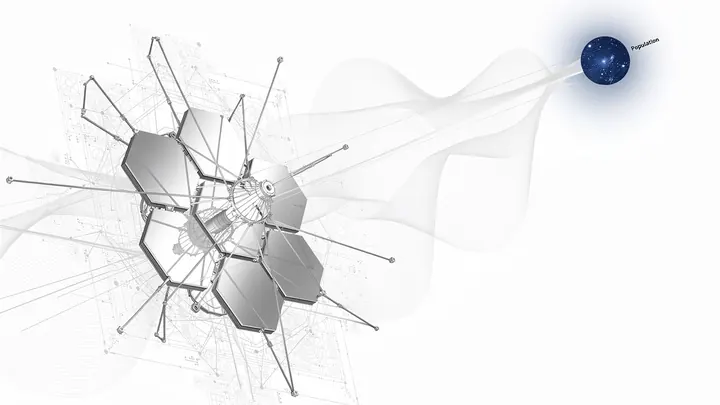
The James Webb Space Telescope (JWST) is a large infrared space observatory launched in December 2021, designed to study the universe's earliest galaxies, the formation of stars and planets, and the atmospheres of exoplanets. Its 6.5-meter primary mirror, made of 18 hexagonal beryllium segments, collects infrared light, allowing it to see through cosmic dust and observe objects that are too distant or too faint for visible-light telescopes. JWST orbits the Sun at the second Lagrange point (L2), about 1.5 million kilometers from Earth, where it remains shielded from the Sun's heat and light by a tennis-court-sized sunshield.
History
The concept for a space-based infrared telescope originated in the 1990s as the 'Next Generation Space Telescope,' later renamed in 2002 after NASA administrator James E. Webb. It was developed by NASA, ESA, and CSA, and launched on an Ariane 5 rocket on December 25, 2021.
How it works
JWST's instruments—NIRCam, NIRSpec, MIRI, and FGS/NIRISS—detect infrared radiation from 0.6 to 28.5 micrometers. The telescope's cold operating temperature (below 50 K) minimizes its own infrared emission, which would otherwise overwhelm faint signals. Its large mirror and sensitive detectors enable high-resolution imaging and spectroscopy, breaking down light into wavelengths to reveal the chemical composition, temperature, and motion of distant objects.
In practice
JWST has already provided detailed spectra of exoplanet atmospheres, such as HAT-P-12b, revealing water vapor and other molecules, and has imaged some of the earliest galaxies ever seen.
Fun fact
JWST's sunshield is about the size of a tennis court and consists of five layers of Kapton, each thinner than a human hair, to block heat from the Sun, Earth, and Moon.
Beyond Neptune's orbit lies an ocean of icy islands that has remained nearly unchanged for four billion years. These islands, known as trans-Neptunian objects, hold the recipe for planet formation. Until recently, astronomers could only see the large ones, while the small, city-sized ones stayed invisible.
A stroboscope in a dark room picks out fleeting shadows from the crowd, shadows the eye cannot catch. A primordial black hole the size of a virus, passing in front of a distant star, briefly magnifies its light for a few seconds, like a magnifying glass held over a bulb.
A lighthouse on a rocky shore shines steadily until the wind carries smoke from the keeper's fire. The light fades before your eyes, even though the flame inside remains intact.
In the dense galaxy cluster Abell 2744, where gravity bends light like a lens, the James Webb Space Telescope spotted a new point of light. It appeared in images from 2023 and then began to change brightness. It was a supernova, the explosion of a dying star, but not just any kind: a Type IIP.
In a distant galaxy, light from hot gas should reveal its composition. The James Webb Telescope split that light into a spectrum, and astronomers saw: oxygen lines too weak.
Two stars, AF Lep A and ε Indi A, have become the focus of close attention. Using the GHOST spectrograph on the Gemini telescope, astronomers split their light into colors and, from absorption lines, determined how much carbon, oxygen, sulfur, and thirteen other elements are in the stars' atmospheres.
In the southern sky, behind a dense veil of dust, hides a source of gamma rays — the most energetic light in the Universe. It shines so brightly that it can be seen even through this veil, but the object itself remains invisible. Astronomers pointed the ALMA radio telescope at the neighboring gas clouds and saw a pattern that gave the invisible object away.
The night sky is full of deceptive lights. Astronomers were searching for galaxies that ignited in the first few hundred million years after the Big Bang: their light has traveled to us for nearly 13 billion years. Six faint smudges were selected from images taken by the Hubble and Spitzer space telescopes.
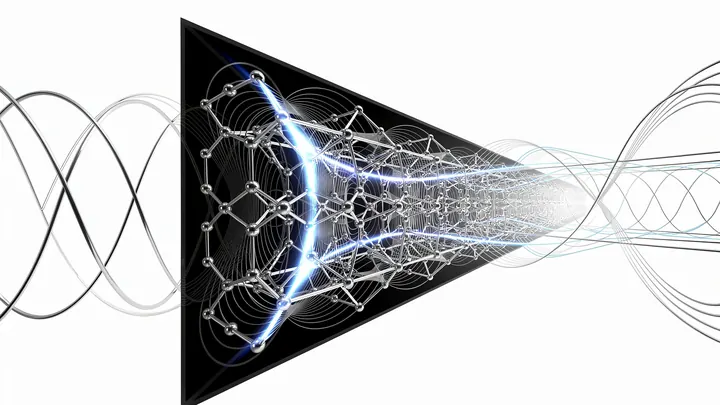
Every morning, a janitor sweeps leaves into a pile. The Sun, as it travels through the galaxy, does something similar: its gravity gathers diffuse interstellar gas into an invisible cone — a giant funnel.
In the dark kitchen of the Taurus molecular cloud, 450 light-years away, dozens of planetary systems are being prepared. Each young star is a chef, and its protoplanetary disk is a counter piled with flour-like dust and steam-like gas.
Galaxy NGC 5584 is a vast stellar city, where some neighborhoods are just being built while others are already marked by aging giants. To see both, astronomers used two very different flashlights. The ultraviolet telescope Swift lit up hot blue patches — stellar nurseries where massive stars have recently ignited.
The orchestra plays, but the musicians can't hear each other. The conductor keeps stopping the music and walking over to each player to tune the instrument. That's roughly how space telescopes with segmented mirrors work.
A distant light in the fog looks tiny and reddish: you'd think it's miles away. But then the light shifts sideways, and it becomes clear: it's a cyclist twenty steps away, just with a nearly dead rear light. That's how, in 2025, astronomers stumbled upon 'Capotauro'—a compact red source in images from the James Webb Space Telescope.
A lamp is hidden behind a large aquarium filled with water. You see not one light source but several reflections and refractions — the water bends the path of the rays.
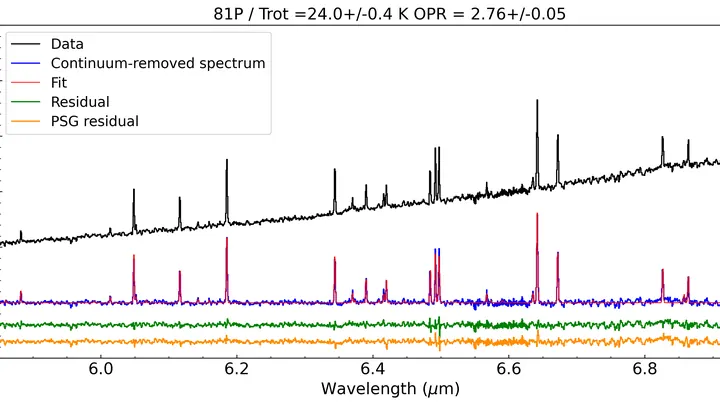
In March 2023, the James Webb Space Telescope pointed its instruments at the short-period comet 81P/Wild 2. This celestial body, about the size of a small town (nucleus radius around 1.77 km), is already familiar to scientists: in 2006, the Stardust probe flew through its tail and collected dust samples that were later studied in Earth laboratories.
The night sky is like an ocean: the longer you stare, the more faint lights you notice in the depths. That's how astronomers, peering into the outskirts of the Milky Way, found Aquarius IV — a tiny stellar system that had been hiding in the dark until now.
The system was spotted in images from an early survey by the future Vera Rubin Observatory.
Betelgeuse, the red supergiant familiar from Orion's shoulder, keeps surprising us. After the mysterious Great Dimming of 2019–2020, when the star suddenly dimmed, it didn't just recover; it changed its ways.
When an orchestra of thousands of musicians plays in harmony, the credit goes not only to each player's talent but also to the invisible work of the conductor.
A star wrapped in an invisible blanket warms up more than it should. That's exactly how ten red dwarfs look, which astronomers from the Hephaistos project have been monitoring. These stars lie within 300 parsecs (about 1000 light-years) of us and emit far more infrared energy than their modest sizes can explain.
2,41 hours. That's exactly how long a day lasts on SIMP 0136 — a lonely planet-like object 6,1 parsecs away. That's twice as far as Proxima Centauri. Its mass ranges from 12,7 to 17,8 Jupiter masses, placing it on the boundary between planet and star.
Edge of the spotlight. Remove the dazzling light of the central star, and a theater of shadows emerges. The James Webb coronagraph, like a dense curtain, hid the star TW Hydrae — and on a stage 120 astronomical units long (four times the distance to Neptune), its protoplanetary disk came alive.
The JWST spectrograph caught a barely perceptible dip in the spectrum of a distant galaxy — two lines, like shadows cast by cold gas. These are the sodium lines, the very yellow light of streetlamps. Here, at the edge of the visible Universe, they betray the slow exhalation of a galaxy returning matter to space.
In the early universe, just a few hundred million years after the Big Bang, astronomers see strange objects — little red dots. They are compact, red, and in their spectra, broad Balmer lines scream the presence of supermassive black holes. But how did the hole manage to accumulate millions of solar masses in such a short time?
The hunter of ancient light, the James Webb Telescope, aimed its mirrors at a tiny patch of sky and caught a strange beacon. The object, with the working name beacon_1420-$$5253_{4770}$$, flashed and faded. At first, it was logged as a candidate for the most distant galaxy, as if we were seeing it just 300 million years after the big bang.
In 2034, a rocket leaves a spaceport with an unusual payload: two spheres the size of a large globe, each weighing nearly a ton. No engines, no electronics. Just a mirrored surface of hundreds of corner-cube reflectors — tiny prisms that return light exactly to where it came from. This is the future space tuning fork.
For thirteen billion years, light battled through cosmic emptiness. It bent around massive galaxy clusters that, as Einstein predicted, acted as giant lenses — amplifying and distorting the distant glow. In 2023, the NIRSpec instrument on the James Webb Space Telescope captured this light and spread it into spectra.
The Universe is humming, but our ears catch only the bass. LIGO hears the rumble of black hole mergers — the infrasound of space. Higher up, in the gigahertz range, the flutes and violins of primordial gravity ring out.
In 2024, the Hephaestus project sifted through millions of stars and flagged a few dozen suspicious ones: they shone brighter in the mid-infrared than a normal red dwarf should. Two of these candidates, labeled D and E, looked especially tantalizing, as if an invisible heater were working next to the star.
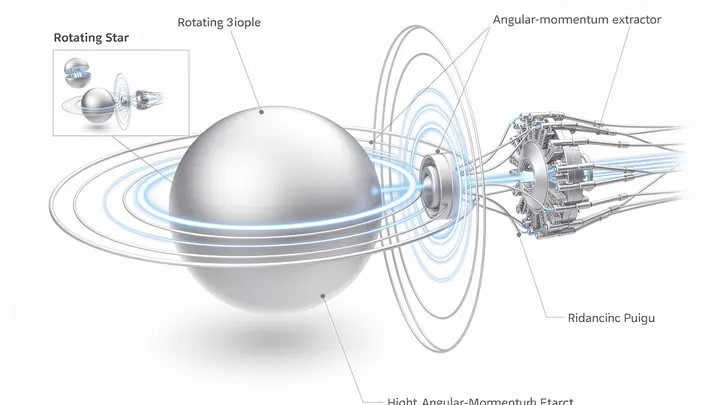
For decades, SETI has hunted for Dyson spheres — hypothetical shells that capture a star's light stars and re-radiate it in the infrared. But the cosmos remains silent. Perhaps an alien intelligence operates more elegantly: instead of collecting light, it tames the rotation of a sun, like a giant flywheel.
In the Galactic bulge, where the light of billions of stars merges into a continuous glow, four cold giants passed unnoticed. You can't see them through a telescope — too far, too dim.
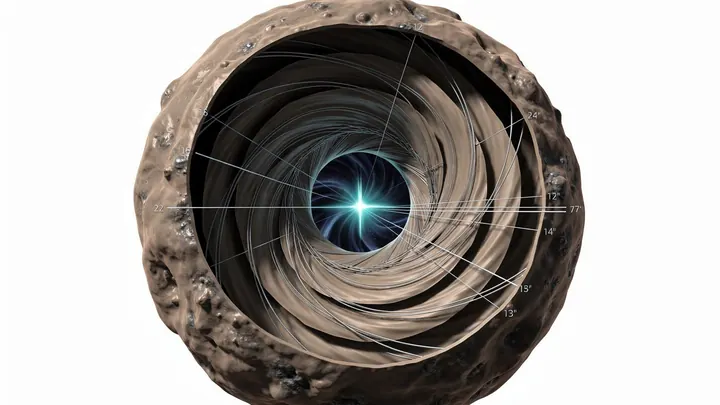
The Universe is less than a billion years old, yet at its centers already sit black holes with masses of a billion suns. According to the conventional picture, they grew by voraciously devouring matter, but calculations show that 'feeding' must have been almost continuous, while visible quasar flares last only a few million years. So where does all the accreting fuel go?
Within a field of view the size of a grain of sand held up to the eye, hundreds of galaxies lie hidden, smeared into arcs by the massive cluster Abell S1063.
The James Webb Space Telescope has peered into a strange binary world. Here, a dead star, a white dwarf, slowly roasts its companion, a brown dwarf. The object, named ZTFJ0038+2030, completes a full orbit in just a few hours. One side of the brown dwarf always faces the white dwarf, much like the Moon faces Earth.
Right after the Big Bang, the Universe was a chemical desert — only hydrogen and helium, not a hint of metals. But moments passed (by cosmic standards), and the birth of the first stars — Population III — began.
A pebble drops into a night lake, and ripples spread across the water. You can't see the pebble itself, but the ripples give it away. Astronomers use a similar trick when hunting for dark bodies in space: these objects betray themselves by the way they warp the light of distant stars.
The giant galaxy cluster Abell S1063, lying 4 billion light-years away, works not just as a lens but as a gravitational well of time. Its mass bends space so sharply that photons from an era when the Universe was just 500 million years old slide along curved paths, like rays in slow motion, and converge on us magnified forty-three times.
WASP-121 b is not just a hot ball. It's a world where iron vaporizes and the sky glows with its own heat. A fresh look at it has revealed what 'ingredients' went into making it.
The James Webb Space Telescope has for the first time clearly detected vaporized silicon monoxide in its atmosphere — a refractory substance usually locked inside dust grains.
The planet WASP-121 b is a gas giant, heated to 2500°C. It always faces its star with one side, like a globe frozen under a lamp. But as it passes in front of the star's disk, its rotation reveals different facets to us — as if that globe were slowly turned, letting us peer into every corner.
A planet glides across a star's disk, and for a moment becomes a flashlight. It blocks a tiny patch of surface, revealing details that otherwise escape our view. That's exactly how astronomers peered into the dark spots on V1298 Tauri, a young twin of our Sun. They were aided by the James Webb Space Telescope JWST and three giant planets in orbit.