How Rods Turn Liquid into Gel express
In a glass of water with charged cellulose rods (the kind you get from wood), a curious transformation takes place. As long as the rods repel each other, the mixture flows like a liquid. But add a pinch of salt, and the repulsion weakens, the rods start to stick together and form a three-dimensional network: the liquid sets into a gel.
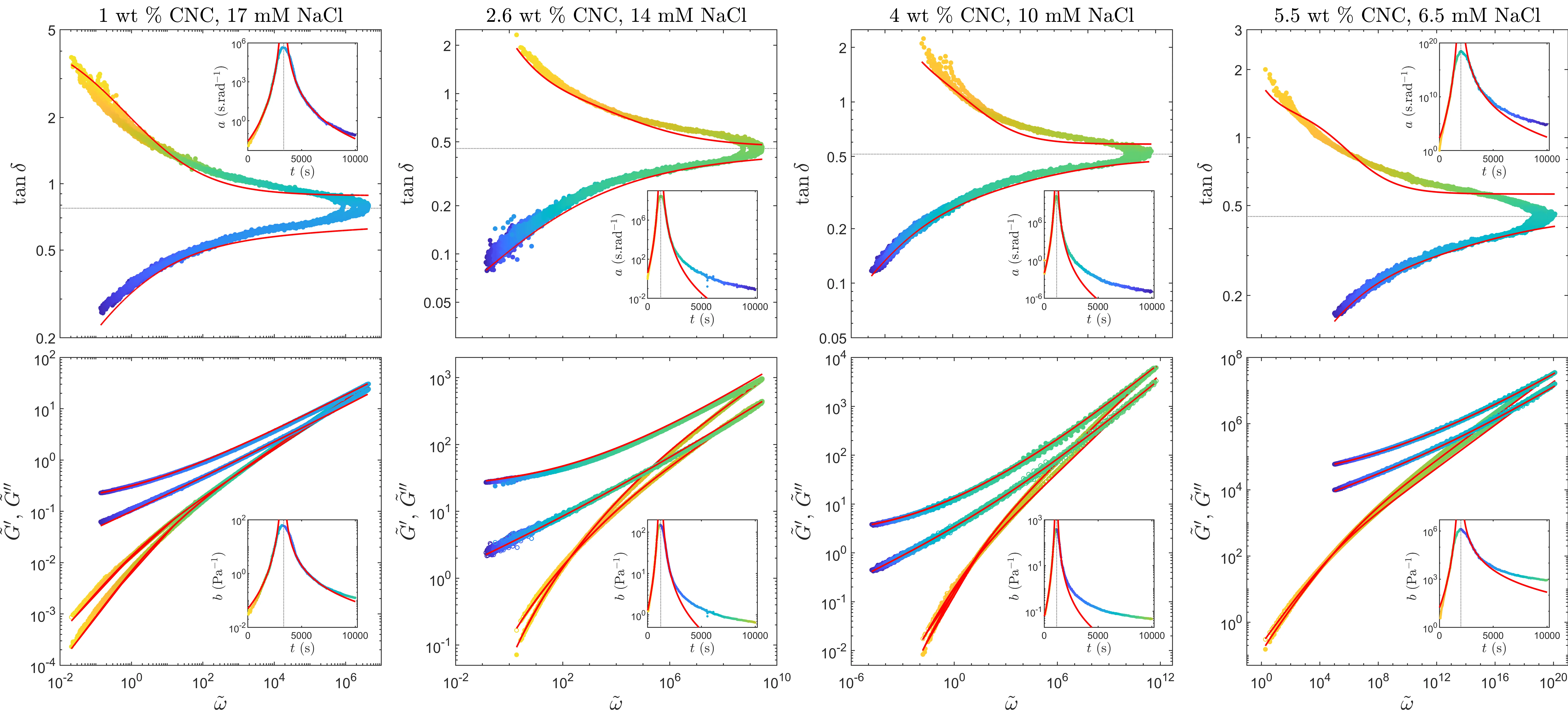
After vigorous mixing, the gel breaks apart, but over time it recovers. The researchers tracked this recovery by measuring how the material responds to gentle oscillations. They found that at a certain moment, called the critical gelation point, the properties change abruptly: before this point, the mixture behaves like a liquid; after it, like an elastic solid. Moreover, all the curves taken at different times can be superimposed if you stretch the axes properly. This points to self-similarity in the process: the network grows the same way at all scales, like a snowflake repeating its pattern.
The scientists varied the amounts of rods and salt and found a boundary between two states: a gel and an 'attractive glass'—a dense but disordered packing. Near the boundary, the material's behavior changes sharply. Interestingly, the dynamics before and after the gelation point are asymmetric: breakdown and recovery proceed differently. This distinguishes rods from spherical particles, where the transition is more symmetric.
Such insights will help create biodegradable gels from nanocellulose — for thickeners, coatings, or even medical dressings.
Original abstract
as written by the authors arXiv:2603.11366
Charged colloidal particles can self-assemble into gel networks upon screening of electrostatic repulsion by added salt. While gelation of spherical colloids has been extensively studied, much less is known about the gelation dynamics of anisotropic colloids. Here, we focus on cellulose nanocrystals (CNCs) as prototypical rigid, highly charged rod-like colloids. In aqueous solution with salt, CNCs display a rich phase diagram ranging from gel at low solid content to glassy phases at higher concentrations. Building on our previous work [Morlet-Decarnin et al., ACS Macro Lett., 2023, 12, 1733], we present an extensive study of the mechanical recovery dynamics of CNC suspensions following a strong shear. Time-resolved mechanical spectroscopy reveals a liquid-to-solid transition characterized by a well-defined critical gel point. The evolving viscoelastic spectra can be rescaled onto master curves, demonstrating a time-connectivity superposition principle and critical dynamics on both sides of the gel point. By varying the CNC weight fraction and salt concentration, we identify a boundary between gel and attractive glass states marked by clear changes in rheological observables, including the elastic and viscous moduli at the gel point and their high-frequency power-law exponents. Analysis of dynamic critical exponents and hyperscaling reveals pronounced asymmetry between pre-gel and post-gel dynamics and non-universal values of the dynamic exponent. These findings highlight gelation mechanisms specific to highly charged rod-like colloids and call for complementary microstructural characterization and theoretical modeling.
Cellulose rods in water can form a gel even at a concentration of just 1% by mass, the rest is water.