Crystallization is the process by which a solid forms from a solution, melt, or vapor, with atoms or molecules arranging into a highly ordered, repeating lattice structure. In the context of supercooled water, crystallization can be triggered by vibration, which provides the energy needed to overcome the kinetic barrier and nucleate ice crystals. This phenomenon is not just a laboratory curiosity; it is fundamental to many natural and industrial processes, from the formation of snowflakes and geological minerals to the production of pharmaceuticals and semiconductors.
History
The scientific study of crystallization dates back to the 17th century, with early observations by Robert Boyle and others. The modern understanding of nucleation and growth was developed in the 20th century, with key contributions from scientists like Wilhelm Ostwald and later, in the 1930s, by the theory of nucleation formulated by Volmer and Weber.
How it works
Crystallization begins with nucleation, where a small cluster of particles forms a stable seed that can grow. In a supercooled liquid, the system is in a metastable state — it is below its freezing point but lacks the energy to spontaneously form a nucleus. Vibration or agitation introduces localized fluctuations in density and energy, allowing clusters to reach a critical size. Once a stable nucleus exists, additional particles attach to its surface, and the crystal grows rapidly. The rate of nucleation and growth depends on factors like temperature, pressure, and the presence of impurities, which can either promote or inhibit crystallization.
In practice
Crystallization is used extensively in industry to purify substances, create materials with specific properties, and control the structure of products like metals, ceramics, and pharmaceuticals. It is also critical in the production of semiconductors and in the study of protein structures through X-ray crystallography.
Fun fact
The vibration-triggered crystallization of supercooled water is the principle behind 'instant ice' tricks, where a bottle of supercooled water freezes instantly when tapped or shaken.
A droplet the size of a pea hangs in the air, held up by inaudible sound. Inside it, the protein ferritin, the very one that stores iron in our bodies, begins its dance. The water leaves, the dancers get crowded, and they line up in neat rows: that is how a crystal is born. But this dance has a conductor: polyethylene glycol, a long chain of repeating units.
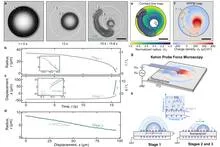
A water droplet on a fluoropolymer film initially behaves as expected: it sits and evaporates. But once it shrinks to a quarter of its initial size, it suddenly takes off and, within fractions of a second, covers a distance several times its own radius. Then it crawls slowly but persistently, leaving behind an invisible trail of electric charges. That trail is what drives the motion.
Two mica plates, smooth as mirrors, slowly approach each other in a calcium solution. At a distance of fifty nanometers, an invisible barrier suddenly appears between them: as if someone had stretched a web of molecules between the walls. This web prevents the plates from touching, even though by all calculations they should glide freely toward each other.
A lake in a drought doesn't dry up all at once. First, islands of dry land appear on the water's surface, they expand and merge, and only then does the water recede from the exposed bed. A mirabilite crystal behaves similarly when it loses water: round patches of anhydrous salt appear on its surface, growing outward and then beginning to deepen.
In a thin layer of liquid crystal, molecules usually lie like matches in a box — aligned in one direction but randomly oriented: some point up, others down. To make all the matches point the same way, you need a special molecular architecture. Scientists have found a chemical trick that does this almost automatically.
A drop of saltwater dries on a table. The salt doesn't settle just anywhere: crystals first appear at the rim, forming a ring, like coffee grounds at the bottom of a cup. Everyone who has seen the stain left by a dried droplet knows this behavior. But what if the droplet contains swimming bacteria?
In a world where Reynolds numbers are minuscule, water turns into thick syrup, and the swimming tricks we know stop working. Here reigns the insidious scallop theorem: reciprocal motions produce no net displacement. Microorganisms found a way out: they grow polymer tails.
In water cooled to –40°C, a paradoxical pause sets in: perfect hexagonal ice is in no hurry to form. Instead, a disordered structure with interspersed cubic layers emerges — a real cradle for future symmetry, brimming with disorder yet already charged with hidden architecture.
Diamond is a symbol of perfection, but its true magic is revealed through flaws. Perfect lattice purity gives transparency and hardness, while defects, such as color centers, open a portal to the quantum world, becoming the foundation for quantum computers and quantum sensors.
The pendulum of an old clock swings because a spring mechanism gives it a regular nudge. Now imagine a pendulum that decides on its own when to swing, and does so with a steady rhythm, just because the room is warm and there's a slight draft. That's exactly how time crystals behave, born in clumps of light and matter inside a semiconductor chip.
A chef pours hot sugar syrup onto a cold table, and it sets into crystals. That's roughly how engineers pictured metal solidification: the liquid instantly becomes a scatter of crystalline grains. But close-up imaging revealed an extra stage wedged between liquid and solid.
A cell about to divide first marks its waist. Beneath its membrane, in a thin gel of protein filaments, movement begins. The filaments flow like a slow river, and a belt forms in the middle of the cell. This belt tightens more and more until the cell is pinched in half.
Scientists built a computer model of this process.
In a solid piece of tin-lead alloy, the layers of the two metals lie like pages in a book. When heated from one side, the layers don't melt uniformly but in whimsical tongues and fingers. Scientists studied this process using a transparent alloy that can be seen through under a microscope and compared it with a computer model.
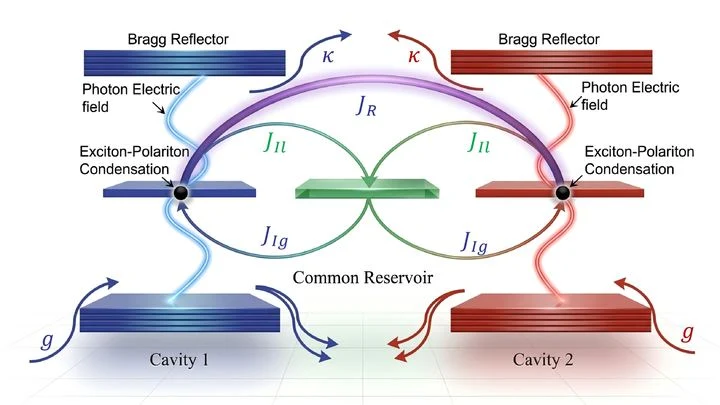
Two tiny dust grains hover at the crossing of laser beams. Each is held by its own 'tweezer'—a focused beam that keeps the particle from falling. Inside a mirrored cavity, light bounces between the walls, and its oscillations are coupled to the trembling of the grains.
Molecules in a solution behave like a crowd in a square: they can jostle randomly or line up in neat rows. An aqueous solution of disodium cromoglycate is a well-known model for chromonic liquid crystals, where such 'rows' form spontaneously. But if you shine ultraviolet light on the solution, order collapses: molecules start breaking apart.
A crystal of calcium ions in a trap, illuminated by a laser, is a tiny model of the matter inside a white dwarf. There, in the depths of a dying star, atomic nuclei arrange into a rigid lattice as the temperature drops.
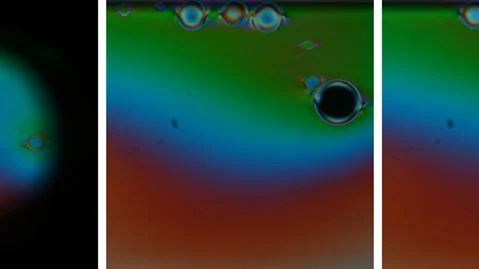
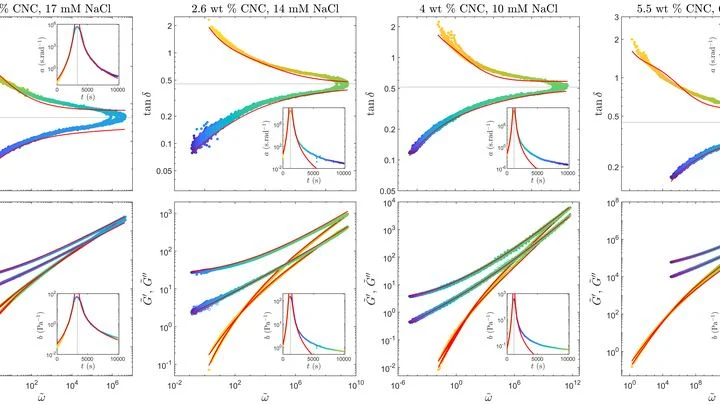
In a glass of water with charged cellulose rods (the kind you get from wood), a curious transformation takes place. As long as the rods repel each other, the mixture flows like a liquid. But add a pinch of salt, and the repulsion weakens, the rods start to stick together and form a three-dimensional network: the liquid sets into a gel.
Water in a pot, when heated, doesn't boil: it turns into ice. That's roughly how ultracold atoms behave in an optical lattice — a light-based crystalline grid that holds atoms in place. Scientists simulated this system on a computer to understand how order changes as temperature rises.
A drop of water with tiny particles dries on a table. The water evaporates, leaving the particles behind, and they arrange into a pattern, like sand after the tide. But if the particles are soft, the pattern turns out quite different. Researchers studied this process under a microscope, varying only one property of the particles: their elasticity.
Molten metal is like an overcrowded hall where everyone is waiting for a signal to start dancing. Crystallization is that very moment when chaos turns into order. But to start the dance, you need a first step: the appearance of tiny crystal nuclei. Usually, this requires the metal to be cooled a lot. It turns out that a simple shake can replace some of that cooling.
In a container the size of a coin, light behaves like water: it gathers into a single quantum fluid. When energy is added, whirlpools, quantum vortices, spin up on their own. Each vortex is like a tiny whirlpool that cannot simply disappear.
Physicists illuminated this fluid with a laser and took snapshots.
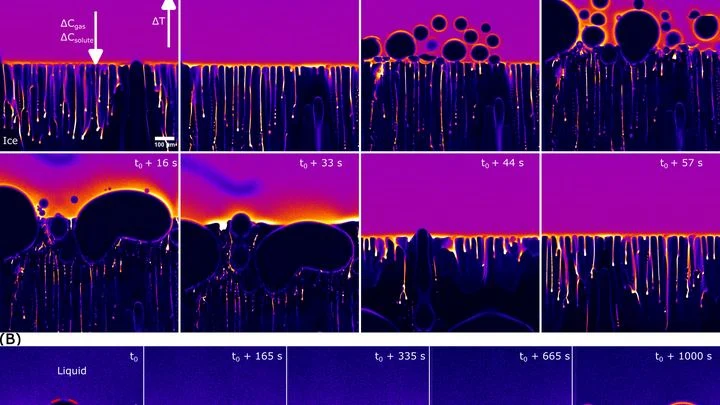
In a glass of soda, bubbles merrily rise to the top. But if you freeze the water, some bubbles end up trapped in the ice. How do they get there? After all, ice grows, pushing gas aside, but it doesn't always manage to.
Electrons in a conductor usually behave like a gas: they dart around chaotically, collide, and don't hold formation. But if you spread them far apart and cool them down, their mutual repulsion can force them into place, like attendees in an overcrowded hall who settle into every other seat.
The usual way to freeze a living cell is like trying to put a spacesuit on it: you first need to get a protective substance inside, but while it's crossing the membrane, the cell can burst from salt imbalances or get poisoned by the chemicals.
A thin stream of water flows down a cold inclined board and, before your eyes, turns into an ice ridge. At first, the water paves itself a straight icy path, as if reinforcing its own banks. Then the trickle starts to meander, and the ice quickly spreads sideways. Finally, the ridge stops growing outward and begins to thicken, smoothing out irregularities.
Heat flow usually evens everything out: hot things cool down, cold things warm up, and in the end you are left with a uniform warm swamp. The same holds in the quantum world: the environment, whether a crystal lattice or a gas of photons, tends to destroy the fragile entanglement between particles.
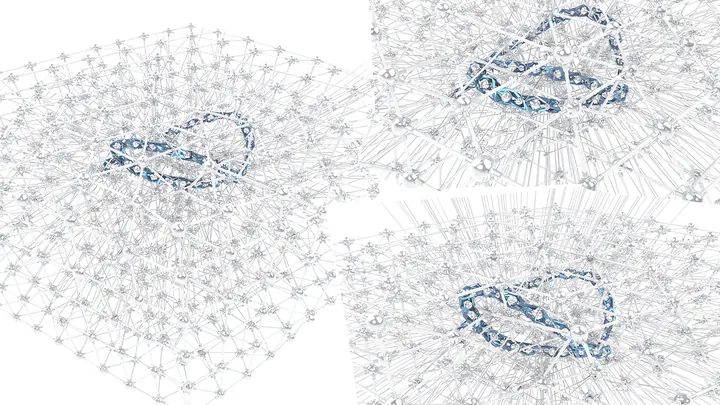
Six barium ions lined up in a flat hexagon inside a Paul trap, a device that holds charged particles with oscillating electric fields. But a slight change in the shape of the trapping potential made the crystal rearrange: one ion moved to the center, and the other five formed a ring around it.