process

critical collapse

A mechanism for black hole formation where the mass depends sensitively on initial conditions near a threshold.
84 related articles

Description

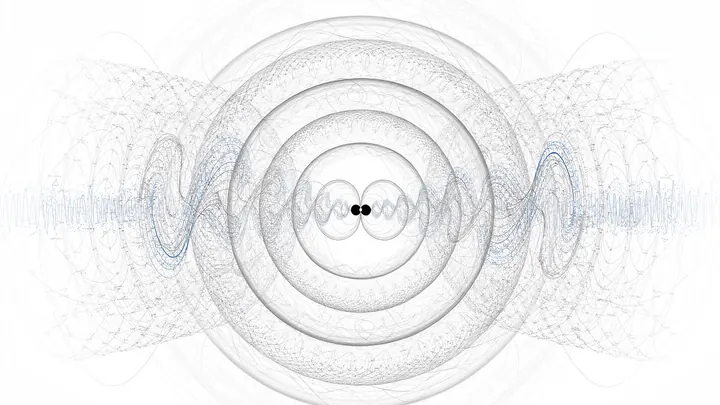
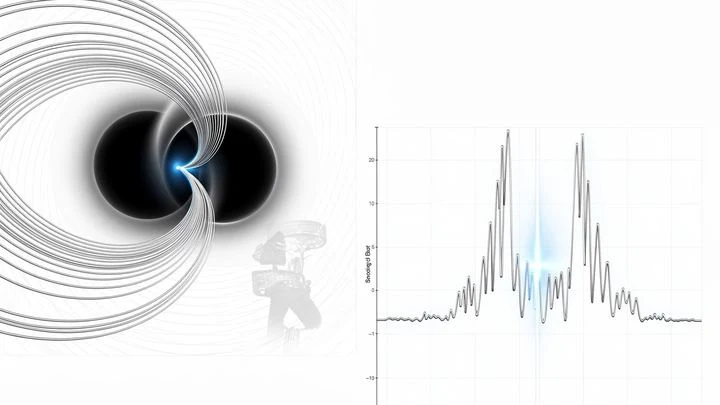
Critical collapse is a mechanism for black hole formation that occurs when a collapsing wave of matter (such as a scalar field or gravitational waves) is tuned precisely to a threshold. At this critical point, the mass of the resulting black hole depends sensitively on the initial conditions, following a power-law scaling: the mass is proportional to (p - p*)^γ, where p is a parameter like the amplitude of the initial pulse, p* is the critical value, and γ is a universal exponent. This behavior is analogous to phase transitions in statistical mechanics, where systems exhibit critical phenomena near a phase boundary.

History

Critical collapse was discovered in 1993 by Matthew Choptuik, who found it through numerical simulations of a massless scalar field collapsing in general relativity. His work revealed the universal scaling and self-similarity, which was a surprise and sparked extensive theoretical and numerical research.

How it works

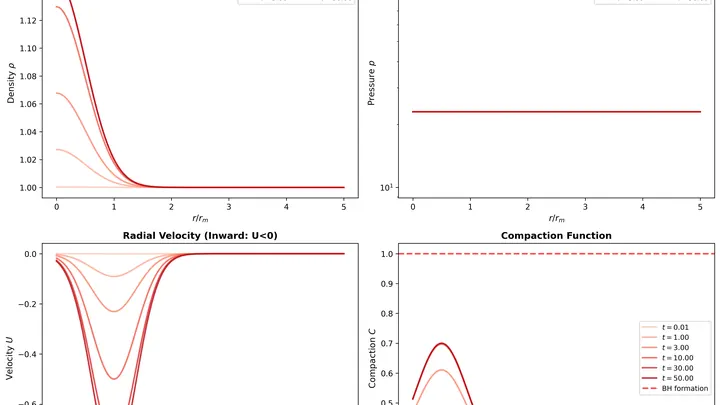
When a collapsing configuration is slightly above the critical threshold, it forms a black hole with a tiny mass, while slightly below, it disperses entirely. Near the threshold, the dynamics become self-similar: the collapsing matter repeats a pattern on ever-smaller scales, leading to a 'critical solution' that is universal—independent of the initial shape of the wave. The black hole mass scales as a power law with the distance from criticality, and the exponent γ depends on the type of matter but is the same for all initial conditions of that type. This arises from the nonlinearity of Einstein's equations, which amplify tiny differences in initial data near the threshold.

In practice

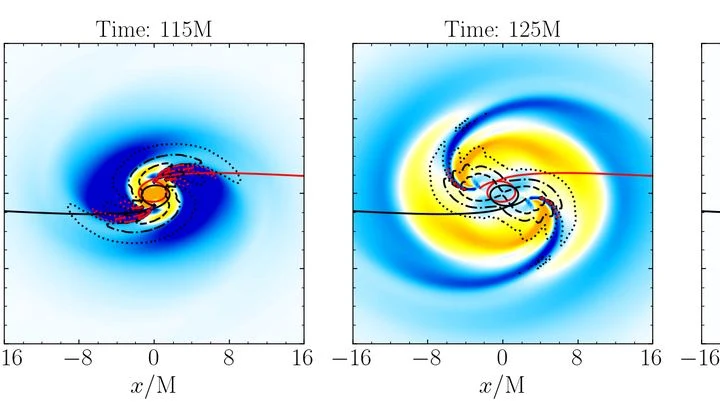
Critical collapse is primarily a theoretical tool for understanding black hole formation and the nonlinear dynamics of general relativity, but it also informs numerical relativity codes used to simulate gravitational wave sources like binary black hole mergers.

Fun fact

The critical exponent γ for a massless scalar field is approximately 0.37, and it is the same for any initial shape of the wave, a universality that mirrors critical exponents in condensed matter physics.

Concept graph →

Related articles · 84

General Relativity2026-08-072 minarXiv:2608.06798express
A Black Hole Under the Microscope of Ripples
When two heavy balls merge into one, ripples spread across the water's surface for a long time. A black hole behaves similarly: after a merger, it 'rings' for a while, emitting special gravitational oscillations — quasinormal modes. Usually, this ring fades quickly, like an echo dying out in an empty hall.
General Relativity2026-08-061 minarXiv:2608.05818express
Black Hole Without a Singularity Emerges from a Dust Cloud
A homogeneous, spherical cloud of cosmic dust begins to contract under its own gravity. At some point, by classical laws, it should collapse into a point of infinite density — a singularity.
General Relativity2026-08-062 minarXiv:2608.05861express
Black hole in a dark matter cocoon
Somewhere in the center of a galaxy, a black hole is spinning. It doesn't hang in a void — around it swirls an invisible swarm of dark matter particles. Until now, this swarm was described for non-rotating holes, but in reality, holes always rotate.
General Relativity2026-08-042 minarXiv:2608.03538express
Black Hole Turns Inside Out into a White Fountain
A black hole that swallows matter might not just evaporate over billions of years: it could pop like a soap bubble and turn into its opposite: a white hole. This scenario emerged from numerical experiments in semiclassical gravity.
HEP Theory2026-08-011 minarXiv:2608.00590express
Black Holes as Bridges to the Dawn of the Universe
A black hole is not just an abyss. It is a seething cauldron whose temperature rises as it evaporates. The authors of the study found that when the heat reaches a critical threshold, the hole seems to boil. It emits superheavy particles — the very ones that exist on a scale where any theory of gravity collapses.
General Relativity2026-07-291 minarXiv:2607.27129express
Chaos in the Shadow of a Black Hole
A star circles a rotating black hole like a figure skater at the center of a rink. While it is far away and can be treated as a point, the dance remains predictable: the orbit follows clear laws, like music that is easy to glide to. But as it approaches, gravity begins to act unevenly.
General Relativity2026-07-292 minarXiv:2607.27343express
Gravity Overflows Its Banks
A cloud of waves collapses under its own gravity. While it's loose, everything goes by the book: the field oscillates gently in nearly flat space, and approximate formulas work perfectly. But add just a bit more energy, and the picture changes. Physicists used a numerical model to catch the moment when simple calculations stop describing reality.
The Black Hole's Thermodynamic Compass
In 1973, Jacob Bekenstein proposed that black hole possess entropy — a measure of hidden disorder. Stephen Hawking later confirmed this by adding radiation, but the microscopic origin of entropy remained obscure.
HEP Theory2026-07-262 minarXiv:2607.23747express
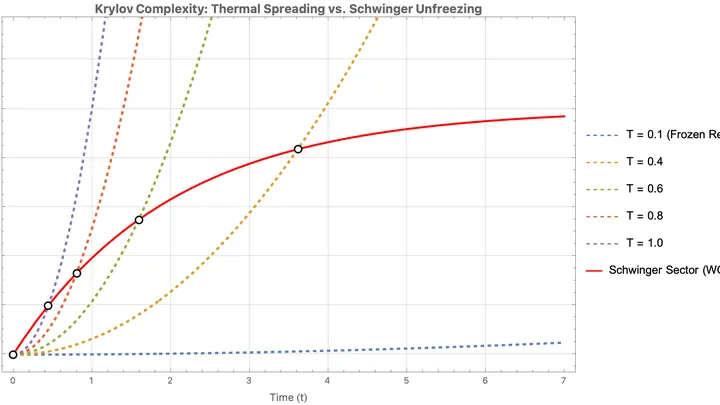
Frozen Complexity of a Black Hole
Hot tea cools down, a pendulum comes to rest — nature loves equilibrium. But a charged black hole can reach a special, extreme state: the mass becomes minimal, and the temperature drops to zero.
HEP Theory2026-07-242 minarXiv:2607.22382express
Quantum Whisper Wakes a Black Hole
A black hole sitting on a thin cosmic membrane (brane) resembles a heavy ball stretching an elastic sheet. In classical physics, it is bald — only mass, charge, and rotation. But add a scalar field (an invisible substance like temperature), and the hole can spontaneously grow 'fur' from this field.
Polarization Trio: Why Black Holes Sing in Three Voices
The event horizon's edge is never calm. Quantum vacuum boils there, and particles sometimes burst out of this foam: that is how Stephen Hawking in 1974 discovered black hole radiation, forever linking gravity with quantum field theory.
General Relativity2026-07-192 minarXiv:2607.17367express
Dark Matter Tunes Black Holes Like Quantum Instruments
At the center of many galaxies lurks a black hole, wrapped in an invisible cloud — the halo of dark matter. This is not just a featureless mass: its density changes from the edge to the center, and the degree of this "compression" is called compactness.
General Relativity2026-07-181 minarXiv:2607.16590express
How a Black Hole Is Born Without a Singularity
A star runs out of fuel and rapidly collapses under its own gravity. According to classical ideas, it collapses into a point of infinite density — a singularity. But what if nature abhors infinities? In models of regular black holes, instead of a singularity, a dense core of unknown matter forms at the center.
High Energy2026-07-111 minarXiv:2607.10396express
A Supernova Explosion with a Quark Switch
An old factory where instead of machines there are atomic nuclei, and neutrino radiation seethes all around. When a massive star exhausts its fuel, its core compresses a hundredfold, and the temperature skyrockets to billions of degrees.
The Smoking Gun of Hierarchy: Black Holes Betray Their Ancestors
A detective story unfolded in the GWTC-5 catalog. Hundreds of signals from merging black holes, captured by the detectors of Rainer Weiss and his colleagues, held the secret to the origin of the most massive and rapidly spinning stellar-scale objects.
Cosmology2026-06-293 minarXiv:2606.30087
Branching Inflation: How Stochastic Trees Revealed Exotic Black Holes
After the Big Bang, the universe underwent a rapid expansion — inflation, smoothing out the cosmic microwave background and sowing the seeds of galaxies. But at the quantum level, chaotic fluctuations brewed in the inflaton field.
Cosmology2026-06-291 minarXiv:2606.30641express
General Relativity2026-06-291 minarXiv:2606.30865express
Black Holes Grow a Fur Coat on the Fly
Two black holes race past each other like Formula 1 cars on opposite lanes. In standard general relativity, they remain 'bald'—no extra fields appear around them. But if you add a scalar field to the equations (something like an invisible fog permeating space), the rules change.
General Relativity2026-06-282 minarXiv:2606.29418express
A Cosmic Lens at the Very Edge of a Black Hole
A cosmic ray approaches a black hole almost tangentially. Instead of falling straight in, it lingers on an unstable orbit, like an acrobat balancing on a tightrope over an abyss. After a few loops, the light finally escapes toward a distant observer. Such rays produce multiple images of the same source, known as higher-order images.
General Relativity2026-06-282 minarXiv:2606.29590express
How Pressure Stops Black Holes from Being Born
In the first moments after the Big Bang, the universe was filled with a hot, nearly uniform plasma. But in some places, the density could randomly be slightly higher. If such a clump gained critical mass, it collapsed into a black hole: this is how primordial black holes were born.
Cosmic Fountain: How Shock Waves Control the Growth of Black Holes
Observations by James Webb showed: already 500 million years after the Big Bang (at redshifts z~10), the Universe was aglow with black holes with masses of billions of solar masses. This baffles theories of gradual growth: matter would not have time to 'feed' the seeds at the required rate.
High Energy2026-06-261 minarXiv:2606.27661express
X-ray Beacons in Galactic Centers
In the centers of distant galaxies, X-ray 'beacons' sometimes light up. They don't flash randomly but on a strict schedule: every few hours or days. These bursts are called quasi-periodic eruptions (repeating at nearly regular intervals).
General Relativity2026-06-261 minarXiv:2606.27958express
Black Hole Grows a Cloud Without Outflow
A black hole with a magnetic field resembles a whirlpool in a river, where water doesn't flow into the vortex but swirls in place. Usually, the hole's rotation picks up waves and amplifies them: this is called superradiance. But add a magnetic field, and everything changes.
Cosmic Molasses: How Viscosity Changes the Rules of Primordial Black Hole Birth
In the search for the nature of dark matter, one of the most intriguing hypotheses traces back to the first moments after the Big Bang. Back then, quantum fluctuations of the inflation field gave rise to clumps of matter that could collapse into primordial black holes.
HEP Theory2026-06-242 minarXiv:2606.28408express
Quantum Black Hole Untangles Color and Volume
A classical black hole has a temperature and other thermodynamic properties. When physicists began accounting for changes in the cosmological constant, the energy of empty space, a strange coupling emerged in the equations.
General Relativity2026-06-231 minarXiv:2606.24642express
When a Black Hole Can Split Apart
A black hole is like a spinning drop of viscous liquid. Normally, such a drop tends to stay whole: splitting would reduce its surface area, which contradicts the law of non-decrease of entropy (a measure of disorder, like a broken cup doesn't glue itself back together).
General Relativity2026-06-152 minarXiv:2606.16757express
A Black Hole Grows, and Entropy Keeps Track of Order
A black hole is like a perfect vacuum cleaner: anything that crosses its horizon vanishes without a trace. But this vacuum cleaner has a strange feature: its "dust bag" grows, and by the size of the bag you can tell how much has been sucked in. In black hole physics, this size is linked to entropy entropy — a measure of hidden information about what fell inside.
General Relativity2026-06-152 minarXiv:2606.17135express
A Quantum Cloak for the Naked Singularity
A star contracts under its own gravity, and at some point its fate hangs on a razor-thin balance. Classical physics paints a grim picture: if the mass and the force of compression are tuned with terrifying precision, what emerges is not a black hole but a 'naked' singularity.
General Relativity2026-06-131 minarXiv:2606.15423express
There Is No Singularity in Black Holes
Space is like a sheet of paper: gravity bends it, making lines converge toward the center. But if you bend too hard, the paper tears, just as space, under monstrous curvature, doesn't collapse into a point but forms a torn edge. That edge is the quantum boundary.
HEP Phenomenology2026-06-112 minarXiv:2606.12775express
Dark Matter from Black Hole Mites
In the kitchen cupboard sits a jar of sugar. If you shake it, the grains will spread almost evenly — no need to place each one with tweezers. In much the same way, tiny black holes could have appeared in the first moments after the Big Bang. Their mass is like that of an asteroid, their size smaller than an atom.
HEP Phenomenology2026-06-112 minarXiv:2606.13788express
Invisible Black Holes Leave a Mark in Gamma-Ray Light
A swarm of tiny ice balls is scattered across a warm room. Some melt faster, others slower, but when only wet spots remain, they all vanish in the same way: the last drop evaporates according to the same law. This is roughly how primordial black holes behave — hypothetical objects born in the first moments after the big bang.
General Relativity2026-06-091 minarXiv:2606.10792express
A Black Hole from Nothing
Emptiness can surprise you. In general relativity, there is a solution where space itself gives birth to a black hole — literally from a point. It all starts at the moment when the event horizon (the surface from which not even light can escape) appears with zero radius and immediately begins to grow.
Cosmology2026-06-082 minarXiv:2606.09804express
Black Holes Evaporate, but Gravitational Waves Remember
A black hole is not an eternal vacuum cleaner. Left alone in the void, it slowly disappears, radiating energy like a puddle drying on asphalt. This process, predicted by Stephen Hawking, is called evaporation.
General Relativity2026-05-291 minarXiv:2606.00166express
How a Black Hole Amplifies Gravitational Waves
In the usual picture, a black hole is a featureless pit in spacetime. But if a shell of matter vibrates around it, the gap between the edge of the abyss and this shell becomes a resonant cavity.
General Relativity2026-05-281 minarXiv:2605.30145express
Dark Matter Sculpts Black Holes
Just a few hundred million years after the Big Bang, in the ocean of invisible dark matter, giant black holes were already taking shape. They were born from the matter itself — without any help from stars. This mechanism, based on the equations of Lemaître, explains their early appearance.
General Relativity2026-05-282 minarXiv:2605.30340express
Why Tiny Black Holes Didn't Form in the Early Universe
If you squeeze a handful of sand, it gets denser, but at some point the grains press against each other: there's no more room to compress. Some theorists think space behaves similarly at ultra-small distances: it has a limit to divisibility, a kind of 'grain.' In this new study, that principle was applied to the birth of black holes in the early universe — the very ones that…
HEP Theory2026-05-281 minarXiv:2605.30411express
Invisible particles turn black holes into cosmic meat grinders
A black hole is like a whirlpool in the ocean: anything that falls in disappears forever. But if the whirlpool spins and carries a slight electric charge, and invisible axion particles (dark matter candidates) are buzzing around it, its surface stops being smooth.