X-ray captures metal melting at 25,000 frames per second express
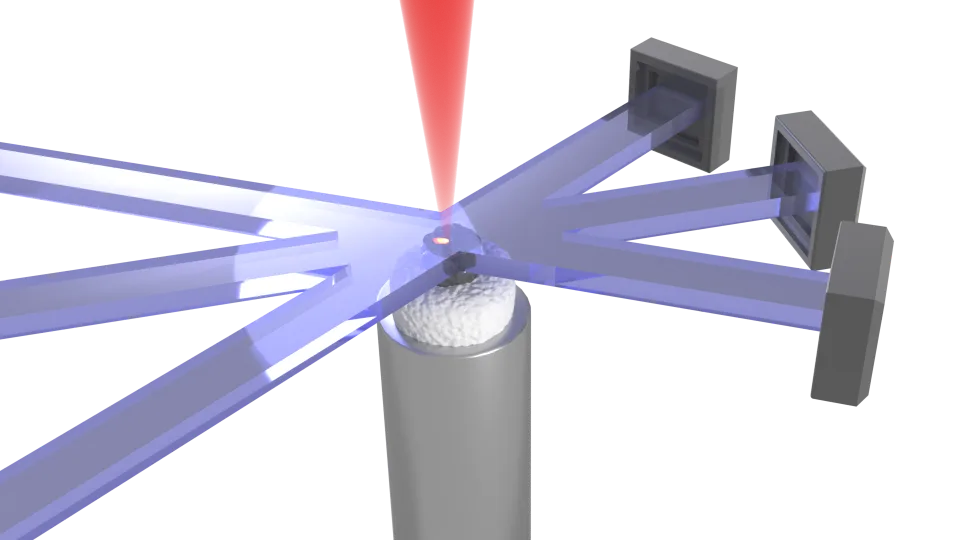
A laser melts metal powder layer by layer, and inside the boiling pool, vapor bubbles appear and collapse within milliseconds. Seeing this kitchen in action was previously impossible: the X-ray tomograph that takes 3D images is too slow. The sample has to rotate, and by the time it does, the melt has already changed a hundred times.
Engineers from Sweden found a way out. Instead of a single X-ray beam, they aimed three beams at the sample, spreading out like a fan. By rotating the sample at 25 revolutions per second, they capture three angles at once. A special program based on neural networks assembles a 3D image from these three flat pictures, just as the brain builds depth from two eyes.
The method was tested on melting alumina ceramics. The footage shows the melt pool stretching, with a vapor cavity pulsing inside it — the main culprit behind porosity in printed parts. Previously, these movements were smeared into a blur; now they're as sharp as in slow motion.
This X-ray "eye" could help tune lasers so that bubbles don't get trapped in the metal. That means parts for airplanes and implants will become stronger and more reliable.
Original abstract
as written by the authors arXiv:2603.14391
Advancing additive manufacturing, e.g., laser powder-bed fusion (LPBF), requires resolving rapid processes such as melt-pool dynamics and keyhole evolution in 4D (3D + time). Operando X-ray tomography is a state-of-the-art approach for 4D characterization, but its temporal resolution is fundamentally constrained by the sample rotation speed, limiting achievable 4D imaging rates and preventing the resolution of these fast phenomena. Here we present rotation-enabled X-ray Multi-Projection Imaging (rotation-XMPI), which captures three angularly resolved projections per time step and thereby decouples temporal resolution from the sample rotation speed. Combined with a self-supervised deep-learning reconstruction framework for multi-angle inputs, rotation-XMPI enables high-fidelity 4D imaging at unprecedented speed. We demonstrate the approach in an operando alumina laser-remelting experiment at MAX IV using three beamlets combined with 25 Hz sample rotation. Rotation-XMPI resolves melt-pool morphology and keyhole evolution; in contrast, conventional and limited-angle tomography remain rotation-limited, and motion blur prevents resolving these dynamics. Overall, rotation-XMPI delivers a 250-fold increase relative to state-of-the-art melt-pool imaging, effectively achieving 25,000 reconstructed volumes per second. This method establishes a practical route to scalable ultrafast 4D imaging for additive manufacturing and other materials processes.
In one second, the new method captures as many volumetric images as a conventional tomograph does in four minutes.