A Cosmic Beacon in the Galaxy's Spiral Arm express
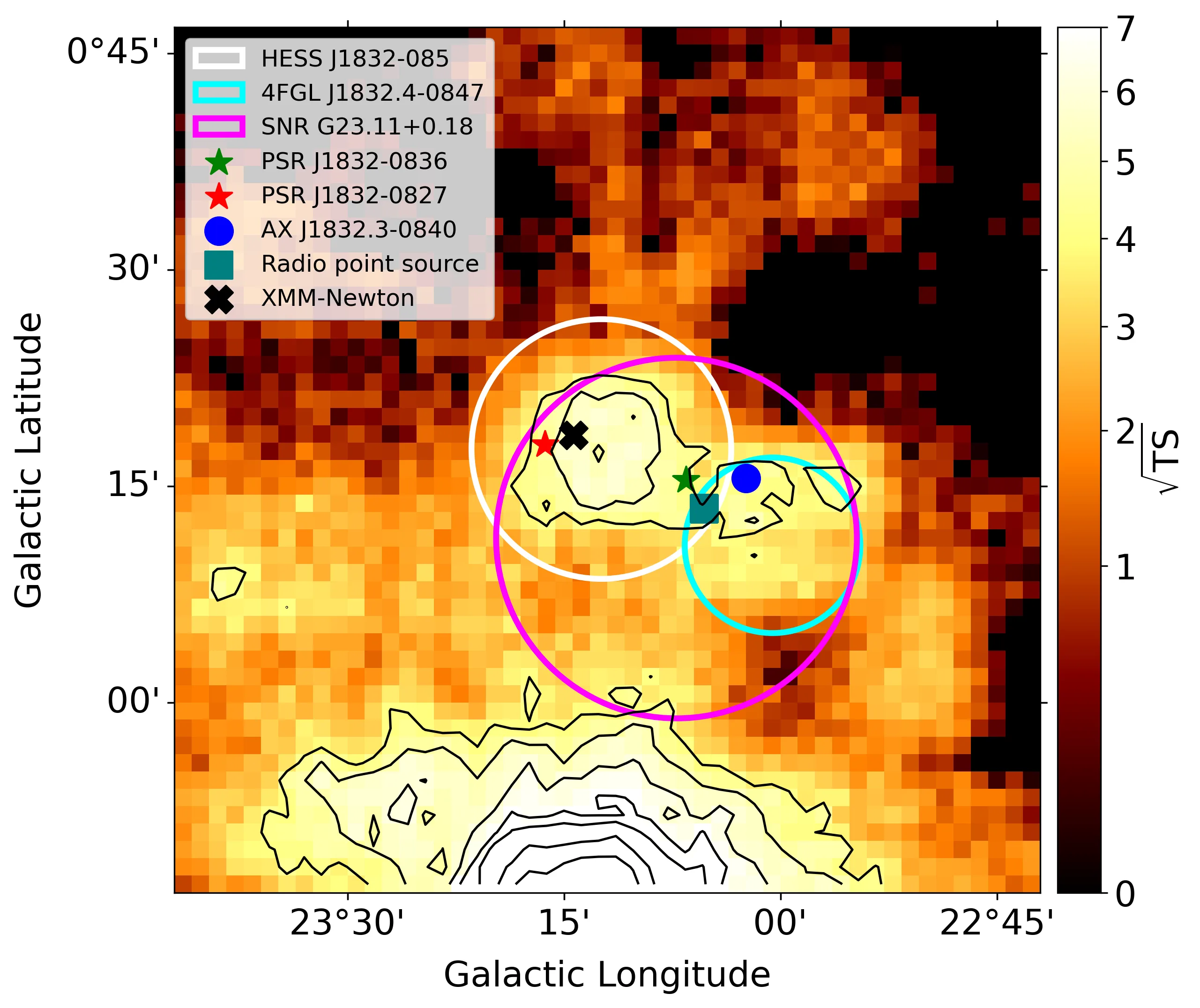
In the dense stellar arm of our Galaxy, telescopes have spotted a point that emits gamma rays — the most energetic radiation in the Universe. For a long time, no one could say what this object was. It didn't blink, didn't move, and no star or gas cloud was visible nearby. Such 'silent' sources are a real headache: there are hundreds of them in catalogs, but only a few have known natures.
Now, the mysterious point named HESS J1832-085 has a possible explanation. Scientists took 17 years of data from the Fermi space observatory and found a faint but confident gamma-ray signal at the same location, at slightly lower energies. In old X-ray images, they also found a dim source, like a smoldering ember next to a bright fire. Together, it all fits a picture familiar to astronomers: this is how a gamma-ray binary shines.
A gamma-ray binary is a pair of stars, one of which is dead. What remains is a pulsar — an ultra-dense sphere the size of a city, spinning dozens of times per second and emitting streams of particles like a garden sprinkler. These particles slam into the companion star or its wind, and the impact produces gamma-ray emission. It brightens and fades as the pulsar's orbit takes it in and out of the dense stellar wind.
So far, no periodicity has been caught for HESS J1832-085: the orbit might be highly elongated, or we might be viewing it from an unfavorable angle. But all other signs are in place. If future observations confirm the hypothesis, the list of rare gamma-ray binaries will gain another member, and that will help us understand how the most powerful particle accelerators in the Galaxy work.
Original abstract
as written by the authors arXiv:2603.16150
The Galactic plane survey conducted by the High Energy Stereoscopic System (H.E.S.S.) has revealed numerous teraelectronvolt (TeV) sources, many of which remain unidentified. HESS~J1832$$-$$085 is a point-like TeV source lacking a confirmed multiwavelength (MWL) counterpart. In this paper, we present evidence that HESS~J1832$$-$$085 is likely a gamma-ray binary. We aim to investigate the nature of HESS~J1832$$-$$085 using {\it Fermi}-LAT and X-ray data, complemented by broadband radiative modeling, to assess its classification as a potential gamma-ray binary. We analyzed $$\sim$$17.3~yr of {\it Fermi}-LAT data between 0.1 and 500~GeV to establish the gigaelectronvolt (GeV) counterpart of HESS~J1832$$-$$085, including performing spectral, spatial, and periodicity analyses. Archival X-ray observations were examined to search for a counterpart and to characterize its spectrum and potential variability. The broadband emission was interpreted using models commonly applied to gamma-ray binaries. We detect a point-like GeV gamma-ray source spatially consistent with HESS~J1832$$-$$085, with spectral properties compatible with known gamma-ray binaries. No significant GeV periodic modulation is detected. A potential X-ray counterpart is identified in archival X-ray data, exhibiting a hard, absorbed spectrum and moderate variability. The broadband spectral energy distribution is reproduced by the adopted binary radiative model. Our results indicate that HESS~J1832$$-$$085 is likely a gamma-ray binary candidate, motivating dedicated MWL follow-up observations to confirm the source nature.
A pulsar in such a system can spin up to 700 times per second — faster than a kitchen blender.