An observatory is a facility or instrument designed for observing astronomical objects and phenomena. It can range from a simple optical telescope in a dome to a space-based satellitedetecting X-rays, gamma rays, or gravitational waves. The key purpose is to collect data from celestial sources, often requiring specialized equipment to detect radiation outside the visible spectrum.
How it works
Observatories work by gathering electromagnetic radiation or other signals (like gravitational waves) using large collectors—mirrors, antennas, or detectors—and focusing them onto sensitive instruments. These instruments record the signal, which is then analyzed to infer properties like position, brightness, spectrum, or polarization. Many modern observatories are automated and operate remotely, with data processed by computers.
In practice
Observatories are used in astronomy for discovering planets, studying stars and galaxies, and monitoring cosmic events; they also support space missions and fundamental physics tests.
Fun fact
The first optical observatories were built in the Islamic world over a thousand years ago, such as the Maragheh observatory in Persia.
Gamma rays are the most energetic light in the Universe. But one part of them, the medium-energy range, long remained invisible: instruments couldn't catch them, leaving a gaping hole in the sky. Scientists call it the "MeV gap," named after the unit of energy these rays carry.
The new camera works like a three-layer detective.
Gravitational-wave detectors are like extremely sensitive ears: they pick up the trembling of space when black holes or neutron stars collide somewhere in the universe. But even the most sophisticated "ears" cannot hear everything. The new LIGO A# project is like replacing the eardrum with a thinner, more sensitive membrane.
The orchestra plays, but the musicians can't hear each other. The conductor keeps stopping the music and walking over to each player to tune the instrument. That's roughly how space telescopes with segmented mirrors work.
When an orchestra of thousands of musicians plays in harmony, the credit goes not only to each player's talent but also to the invisible work of the conductor.
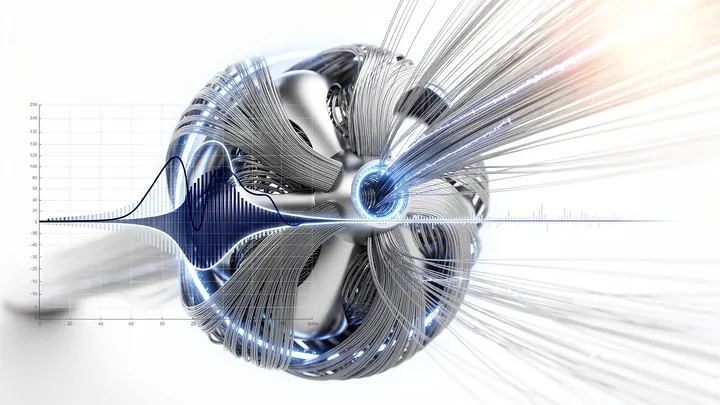
Gravitational waves are ripples in space from the mergers of black holes and neutron stars. Existing detectors, built with contributions from Kip Thorne and Rainer Weiss, work like highly sensitive microphones but only hear the highest 'notes'.
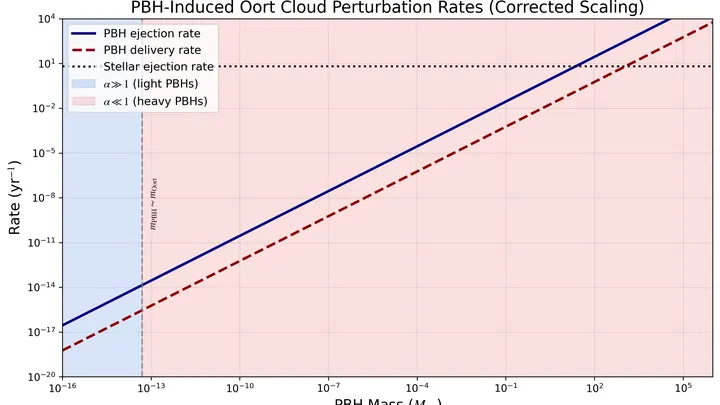
The Oort Cloud is a spherical swarm of trillions of icy bodies at the very edge of the Solar System, about a light-year from the Sun. These objects are almost motionless relative to one another until some gravitational disturbance breaks their calm.
By day in Chile's Atacama Desert, the air shimmers with heat like the haze above a hot skillet. Sunlight passing through this shimmer begins to dance and flicker. Astronomers call this airy trembling "seeing" — and it keeps telescopes from getting a sharp view of the stars.
To fight this nuisance, engineers have built a special instrument — a solar seeing monitor.
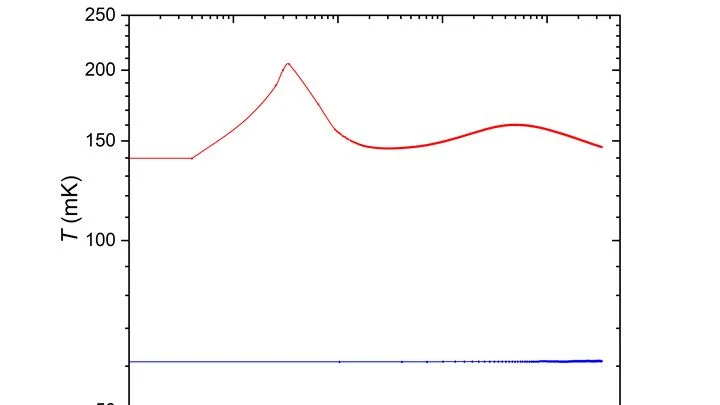
At 0.1 K, just three-tenths of a degree above absolute zero, matter stops following the usual rules. Helium becomes superfluid: it flows without friction, seeps through cracks, and behaves like one giant quantum liquid. Seeing what happens inside such cold is a challenge at the edge of possibility.
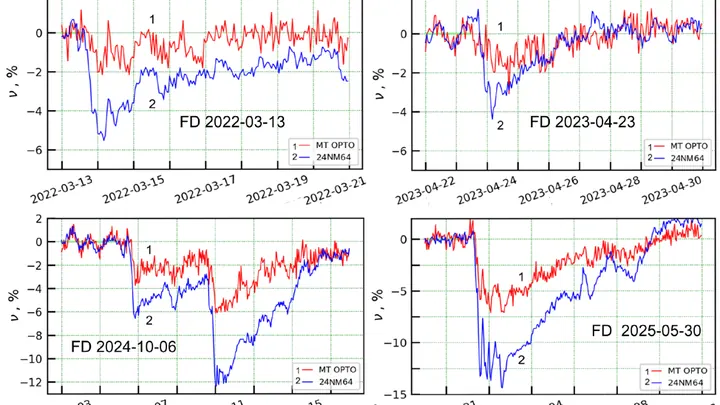
A storm is brewing somewhere far away, and the Geiger counter is already clicking more often. That's how cosmic rays, a stream of charged particles from deep space, make themselves known. When they slam into the atmosphere, they create showers of secondary particles, including muons: heavy cousins of electrons that can reach the ground.
Since Vera Rubin first convincingly showed that galaxies are surrounded by invisible matter, the quest to understand the nature of dark matter has remained one of physics' greatest challenges.
Throw pebbles along a tight row of posts: they ricochet into a dense spray. Throw at an angle, and they scatter. Gamma rays in a crystal do the same: they spawn particle cascades that spread out unless the crystal’s atomic rows are perfectly aligned. Align them within a hair’s width, and the cascade sharpens into a tight beam. A small crystal then outperforms a large one.
The Comet Interceptor mission launches without a target. The spacecraft freezes at a point of space equilibrium, like a fighter jet on combat standby: engine warmed up, but takeoff only on alert.
Every second, dozens of particles from space fly through each of us. Most are light protons, but there are also heavier atomic nuclei: carbon, oxygen, iron. They are born in stellar explosions and travel to Earth for millions of years. Their energy can be staggering: a single particle can carry as much as a tennis ball on a serve.