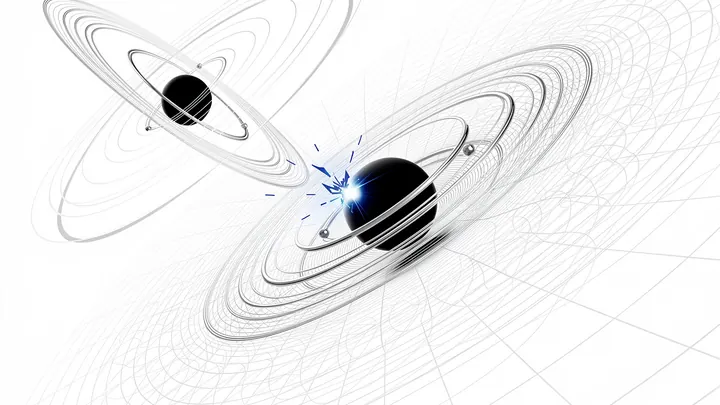
A binary star is a system of two stars orbiting a common center of mass. Periods can range from hours to millions of years. Such pairs are often born together from a single gas cloud, becoming true twins. Their dance allows direct determination of stellar masses—a fundamental characteristic governing stellar evolution. Binaries come in visual (seen separately), spectroscopic (detected by Doppler shift—the change in light frequency due to motion), eclipsing (when one star periodically blocks the other), and astrometric (an invisible companion revealed by wobbles of the visible star).
History
The duality of Mizar was first recorded by Riccioli in 1650. In the late 18th century, William Herschel began systematic searches for binaries and proved their orbital motion. The 19th century brought computations of the first orbits. In the 20th century, spectroscopy unveiled invisible duets, and space telescopes allowed us to discern pairs in other galaxies. Today, the Gaia mission is building a three-dimensional map of billions of stars, revealing the architecture of binary systems in the Milky Way.
How it works
Motion follows Newtonian mechanics (or general relativity for compact objects). Period and distance yield total mass. If the orbital plane lies along the line of sight, eclipses are observed with characteristic light curves. When the Roche lobe is filled, matter streams onto the accretor, forming a disk and a hot spot. This process explains cataclysmic variables, X-ray pulsars, and Type Ia supernovae. Mergers of neutron stars and black holes are detected by LIGO and Virgo detectors via gravitational-wave bursts. Kepler's third law plus spectroscopy unveil the masses of exoplanets in binary systems.
In practice
Binary stars serve as cosmic scales, allowing measurement of stellar masses and discovery of invisible objects like black holes. Their mergers generate gravitational waves and supernovae—forges of heavy elements.
Fun fact
The North Star, famously a guiding beacon, is itself a triple system: the bright supergiant is accompanied by two small companions.
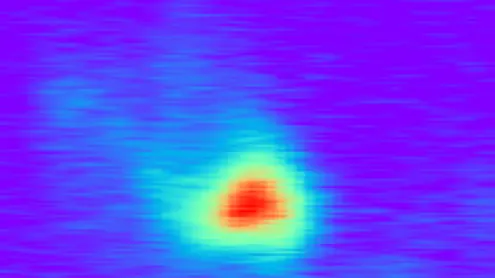
In a dense cloud of gas and dust where massive stars are born, two young stars recently passed very close to each other. Their dance has lasted only about sixty years, and astronomers have now seen it in detail for the first time.
An octopus waits with tentacles spread wide. No central controller directs its arms, but the moment prey touches one, all eight wrap around it. Physicists have recreated a similar trick in the lab with a body that has neither neurons nor muscles: a star polymer with self-propelled arms.
The polymer was assembled from small cylindrical vibrobots on a vibrating plate.
The family album of this stellar pair has been filling up for 45 years, but the pictures were blurry and the captions contradictory. Now astronomers have pulled out the old photographs, taken new sharp shots, and put everyone back in their proper places. Gamma Cephei is a bright star visible to the naked eye, and it has an invisible companion that orbits it every 70 years.
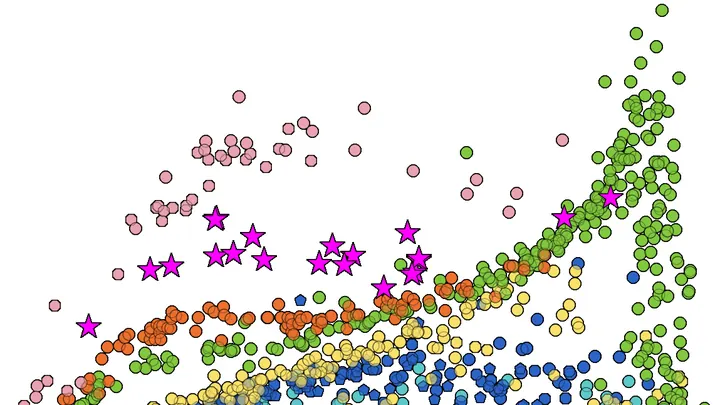
In the dense star cluster NGC 6791, which is older than the Sun and rich in heavy elements, the light from many stars blends into a common glow. Astronomers set out to disentangle this light into individual stars using data from the Gaia space telescope.
Two stars circle each other like dancers who come together and drift apart. Over time, one swells, and its outer layers spill onto its neighbor. The star that receives foreign matter looks no different from a single star, but its surface remembers everything.
Two spinning tops whirl so close they nearly touch. One is scorching blue, the other dim white. Together they complete a full orbit in twenty hours. This is the pair Feige 64: a blue star with a mass of just a third of the Sun's, and a white dwarf, the cooled core of a former star, one and a half times heavier than our Sun.
The blue star seems too hot for its mass.
Two stars circle each other like dancers who come together and drift apart. Over time, one swells, and its outer layers spill onto its neighbor. The star that receives foreign matter looks no different from a single star, but its surface remembers everything.
Two glowing embers left over from a fire whirl in the darkness, gradually drawing closer. With each turn, they lose tiny bits of energy that seep into the invisible ripple of space. That is exactly what the system eRASSU J060839.5−704014 looks like — a pair of white dwarfs (superdense stellar remnants) separated by a distance comparable to Earth's diameter.
Stars are like spinning tops: they start fast and gradually slow down. This process acts like an hourglass — the slower a star spins, the older it is. Astronomers use this relationship to estimate stellar ages, but they need reference groups of stars with known ages.
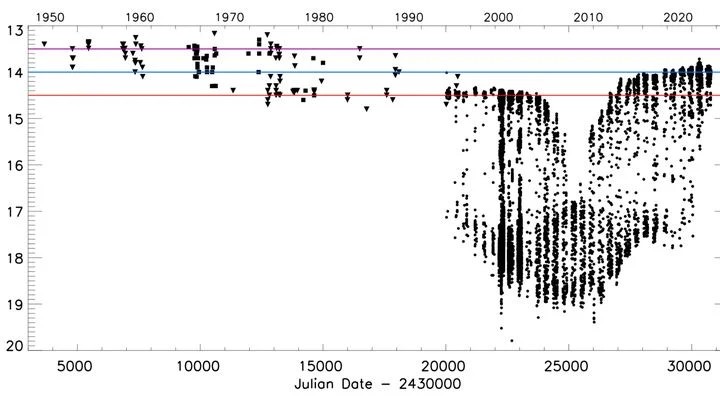
In the KH 15D system, two young stars orbit a common center, and between them and us lies a huge dust disk, like a curtain that sometimes hides the stars and sometimes reveals them. For seventy-five years, astronomers have watched this "theater of shadows": sometimes the light nearly went out, sometimes it flared up with renewed vigor.
A balloon that lets out air in bursts zips around the room — the jet blasts first one way, then another. A dying star behaves the same way as it sheds its bloated shell. Only instead of air, it's superheated gas, and instead of a balloon, it's a future white dwarf (the dense stellar remnant about the size of Earth).
At a distance of 1900 parsecs, in the constellation Vulpecula, the star V420 Vul pulsates — a Mira-type variable. Such stars, nearing the end of their lives, swell and shed their outer layers. But around V420 Vul, astronomers spotted not just a shed envelope, but something trickier.
Somewhere in the depths of the Milky Way, radio pulses flare up from time to time — rare, steady, like the ticks of a distant metronome. These long-period radio transients were discovered only recently, and they immediately puzzled astronomers.
In a binary star system, one star pulls matter from its companion. Over centuries, this material settles onto the surface of a neutron star — the ultra-dense remnant of a dead star. This process, called accretion, usually proceeds smoothly. Gravity behaves as general relativity predicts, without surprises.
Two stars circle each other, gradually drawing closer. Their dance loses energy, and that energy escapes into space — in the form of gravitational waves, and sometimes other fields.
When a star many times heavier than the Sun dies, it collapses and explodes as a supernova. This is not just a flash of light — the entire process, from core collapse to the ejection of the outer layers, makes space itself tremble. These ripples are called gravitational waves.
At the heart of our Galaxy lives the supermassive black hole Sagittarius A*. If an invisible companion orbits nearby, their dance can be spotted through the light of other stars. The pair's gravity works like a lens: as the black holes pass in front of a background star, its light briefly brightens and splits into two.
A galaxy collision is like a slow dance in which two partners gradually draw closer. Hidden at the center of each is a supermassive black hole — an invisible flywheel with a mass of millions or billions of suns.
A gas disk with a mass of four hundred thousand suns encircles the black hole at the center of the Milky Way. Its gravity works like a gravitational rudder: slowly but inexorably turning the orbits of binary stars, driving them into the region where tidal forces tear the pair apart.
In the galaxy NGC 1052 DF2, stars move at only 8 kilometers per second, as if there were no invisible mass around. For comparison: in our Milky Way, outlying stars accelerate to 200 kilometers per second, held by a massive dark matter halo.
1799 kilometers per second — that's the speed at which star S5-HVS1 is permanently leaving the galaxy. 4.8 million years ago, it was ejected from the center of the Milky Way during a close encounter with the supermassive black hole Sgr A*.
A young star cluster resembles an orchestra before a concert: each instrument tunes up in its own way, and the overall hum seems like chaos. But if you listen closely, you can pick out individual notes.
Two galaxies (our Milky Way and its satellite, the Large Magellanic Cloud) slowly circle each other. Their gravitational pull stirs the distant outskirts of the Milky Way, like a pebble thrown into a pond makes the water ripple.
A thousand years ago, Vikings took Iceland spar to sea. The translucent crystal split light into two rays. By their brightness, they could find the sun even in fog. Birefringence — the physical term for this phenomenon — now helps hunt for the most elusive force in the cosmos.
In the first moments after the Big Bang, the Universe was a hot soup of particles. Among them floated superheavy neutrinos — thousands of times more massive than their light counterparts that permeate us today. Their masses were almost identical, like triplets rather than random passersby.
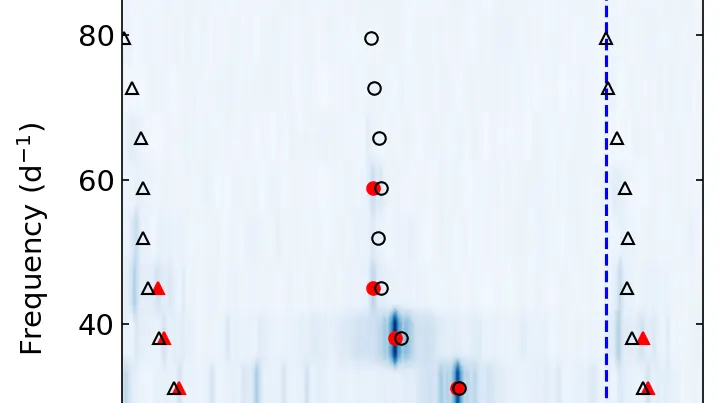
It takes the stellar pair J05+50 nearly two months to complete one orbit around their common center. From Earth, it appears as a faint point in the constellation Hercules — 4625 parsecs away. Photometry of the binary star only captures a steady flicker of brightness, like the pulse of a giant heart.
It takes the stellar pair J05+50 nearly two months to complete one orbit around their common center. From Earth, it appears as a faint point in the constellation Hercules — 4625 parsecs away. Photometry of the binary star only captures a steady flicker of brightness, like the pulse of a giant heart.
A neutron star is the collapsed core of a massive star, squeezed to the size of a city. A teaspoon of its material weighs as much as a mountain. But inside this superdense sphere, a surprise may lurk: under unimaginable pressure, neutrons break apart into quarks, giving the star a new, more compact core.
In May 2020, the LIGO and Virgo detectors picked up a gravitational-wave burst known as GW200105. Among the many similar gravitational waves recorded, this one stood out for an oddity: the orbit of the colliding neutron star and black hole was not a perfect circle, but a stretched ellipse.
Two figure skaters on a lake frozen to the horizon. They are so far apart that their silhouettes turn into dots, and their mutual attraction becomes almost an article of faith. By Newton's law, they should circle in an unimaginably slow waltz. But telescopes see otherwise.
Seventeen minutes: that’s the heartbeat frequency of AM Canum Venaticorum, setting the rhythm for the entire class of ultracompact binaries. In these systems, two white dwarfs whirl in a death dance, tightening their orbit to the still-inaudible whisper of gravitational waves.
At the center of the Milky Way, shrouded in dust and glare, lurks a supermassive black hole — Sagittarius A*. Around it, like moths around a flame, swarm dozens of guide stars. Two of them, S2 and S38, with eccentric orbits and periods of just a few years, have become the protagonists in testing the fundamental laws of the cosmos.
In the centers of many galaxies slumber supermassive black holes, surrounded by accretion disks and the activity of active galactic nuclei. When a compact object — such as a stellar-mass black hole — orbits them, a gravitational duet is born.
Gravitational waves from merging black holes sound like bass chords, pulsars tap out a rhythm, and the cosmic microwave background carries echoes of the Big Bang. But there is a silent player — dark matter, whose presence is betrayed only by gravitational effects.
Two ultradense spheres, each the size of a city, whirl in a dance. Their masses are less than the Sun's, but inside them is matter compressed to unimaginable limits. One sphere is a neutron star; the other is a strange star, made entirely of quarks — the elementary particles that build up protons and neutrons.
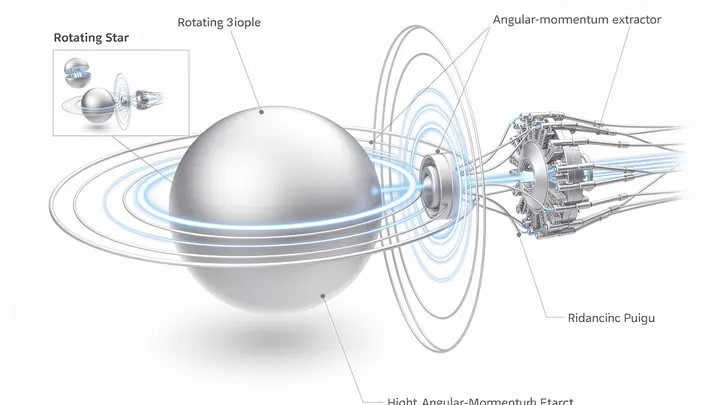
For decades, SETI has hunted for Dyson spheres — hypothetical shells that capture a star's light stars and re-radiate it in the infrared. But the cosmos remains silent. Perhaps an alien intelligence operates more elegantly: instead of collecting light, it tames the rotation of a sun, like a giant flywheel.
The universe rewrites its history again and again. Where ordinary astronomy sees only a point, a black hole, gravitational waves peel back thin layers of the past, like an ancient palimpsest. The idea that black holes can grow by devouring each other, and their offspring can enter new unions, has been discussed by astrophysicists for half a century.
The gravitational dances of celestial bodies long remained silent to astronomers. We learned to catch the shadows of planets against stars with the transit method — a breakthrough that delivered thousands of worlds thanks to William Borucki and his Kepler telescope.
In the heart of a dense star cluster, a true forge reigns: here stars, like glowing blanks, collide and merge under gravity, and these mergers are not a catastrophe but an opportunity. Each strike of the stellar hammer transfers spin to the future black hole.
At the heart of almost every galaxy slumbers a supermassive black hole — the invisible conductor of a stellar orchestra. When galaxies collide, their central monsters draw closer, entwining in a gravitational dance. Sometimes a third partner joins the duo, and then a triple waltz begins, its outcome unpredictable.