Molecular Lego for Batteries express
Inside every battery sloshes a liquid electrolyte, and how ions jostle within it determines how much energy the battery delivers and how long it lasts. Previously, peeking into that crowd meant either running long experiments or launching ultra-precise calculations that devour weeks of computer time. Now there's a third path: a model that learns from millions of examples and produces the picture almost instantly.
The authors took two such models. One was trained on inorganic crystals: it knows the world of solids. The other was trained on the OMol25 set, which contains tens of millions of molecular configurations, including those found in electrolytes. It turned out that the 'molecular' model predicts density and X-ray structure factors noticeably more accurately than the 'crystal' one.
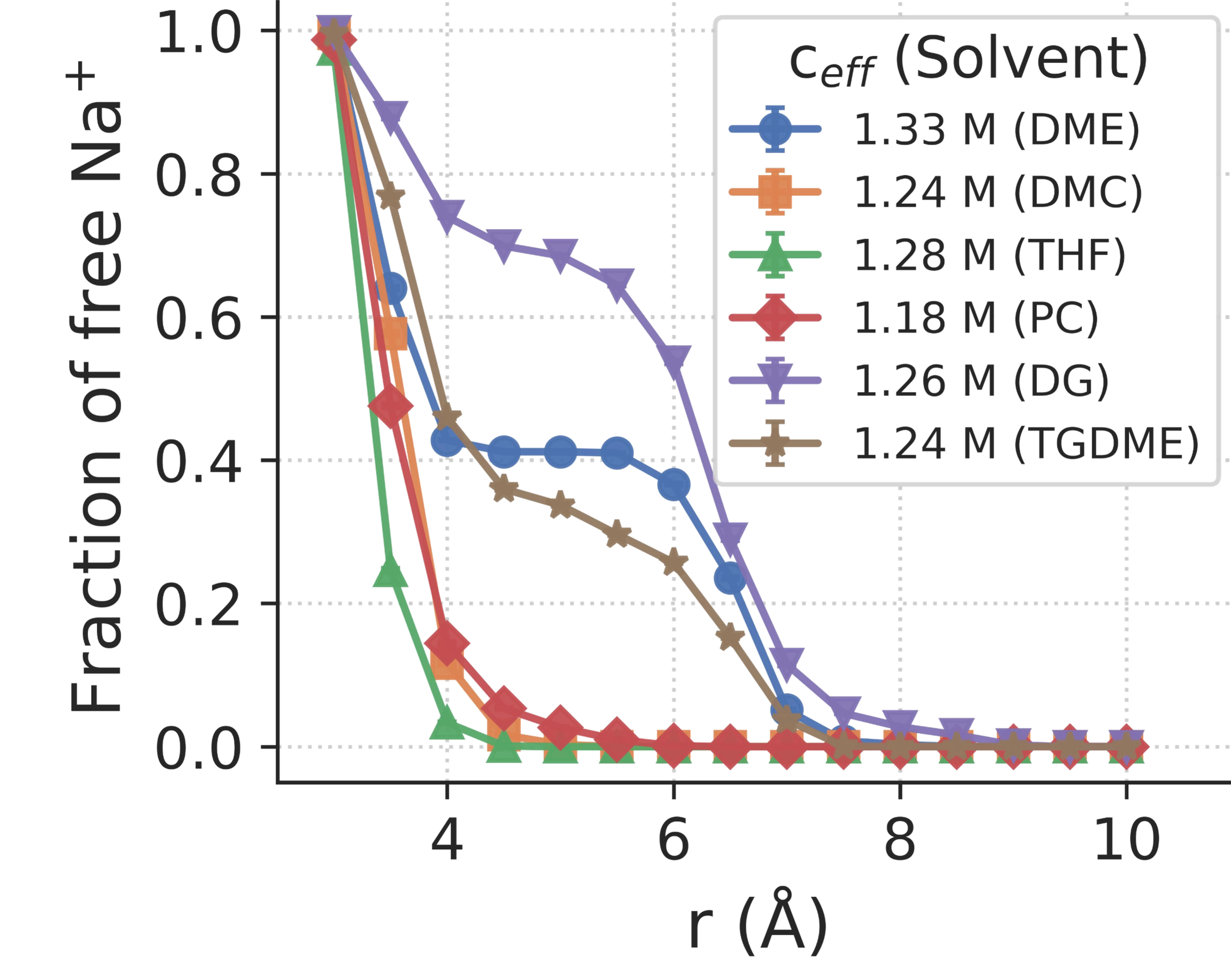
The model then showed how solvation changes with composition: which cation, which anion, how much salt, and the shape of the solvent molecule. For example, in glyme electrolytes, even a slight change in solvent topology noticeably rearranges ionic correlations. Such sensitivity to details previously eluded coarse models.
Now engineers can sift through electrolyte compositions on a computer like assembling Lego pieces, and only the best candidates need to be tested in the lab. This speeds up the search for safe, high-capacity sodium batteries, and sodium is far more abundant than lithium.
Original abstract
as written by the authors arXiv:2603.20183
Machine learning interatomic potentials (MLIPs) trained on large, chemically diverse datasets are revolutionizing computational chemistry, enabling molecular dynamics simulations of battery electrolytes with near-DFT accuracy over 10,000 times faster than DFT. While previous MLIP training datasets with suitable elemental coverage for electrolytes have been based on inorganic materials, the Open Molecules 2025 (OMol25) dataset provides large-scale molecular DFT MLIP training data with broad elemental coverage and specifically samples tens of millions of electrolyte configurations. Here, we integrate computational modeling with experimental validation to systematically assess the ability of large-scale MLIPs pre-trained on materials data or on OMol25 to accurately resolve nanoscale structural organization and ion-solvation characteristics in Na-ion battery electrolytes across diverse physicochemical conditions and compositional regimes. We find that the OMol25-trained Universal Model of Atoms (UMA-OMol) predicts experimentally measured densities and X-ray structure factors in substantially better agreement compared to state-of-the-art models trained only on inorganic materials data. Using UMA-OMol, we further analyze systematic trends in solvation structure as a function of cation identity, anion chemistry, salt concentration, and solvent topology. We observe that increasing system temperature amplifies the heterogeneity within the solvation environment, perturbing cation-solvent interactions and promoting the formation of contact ion pairs (CIPs). Moreover, subtle variations in the solvent topology of glyme-based electrolytes cause pronounced changes in ion-correlations and solvation structure. The experimental agreement and microscopic insights shown here position OMol25-trained MLIPs as a practical route to predictive, high-throughput electrolyte simulations.
Sodium is the sixth most abundant element in Earth's crust and can be extracted from ordinary table salt, making sodium batteries potentially cheaper than lithium ones.