Electrolyte transport is the study of how ions move through liquids, gels, and porous materials under electric fields, concentration gradients, and fluid flow. It sits at the intersection of electrochemistry, fluid dynamics, and materials science, governing the performance of batteries, fuel cells, electrolyzers, and even biological membranes. The behavior of electrolytes determines how efficiently hydrogen can be produced from water, how quickly a battery charges, and how ions distribute in geological formations deep underground.
History
The quantitative foundations were laid in the late 19th century by Walther Nernst and Max Planck, who derived the equations for ion migration and diffusion. The coupling with fluid flow in porous media was developed later, notably by M. Muskat in the 1930s for oil reservoir engineering.
How it works
Ions in an electrolyte move by two coupled mechanisms: migration (drift in an electric field) and diffusion (spreading from high to low concentration). When the electrolyte flows, convection carries ions along as well. The coupling between these processes is described by the Nernst-Planck equations, often combined with Navier-Stokes for fluid motion. In porous media, the geometry of pores creates complex flow patterns, and the interaction between ions and pore surfaces (electrostatic double layers) can dramatically alter transport rates.
In practice
Electrolyte transport is central to water electrolyzers for green hydrogen production, flow batteries for grid storage, and desalination membranes. It also underpins the design of fuel cells and the understanding of ion transport in soil and aquifers.
Fun fact
In some porous media, the flow of ions can create self-sustaining oscillations in electric potential, similar to the rhythmic beating of a heart.
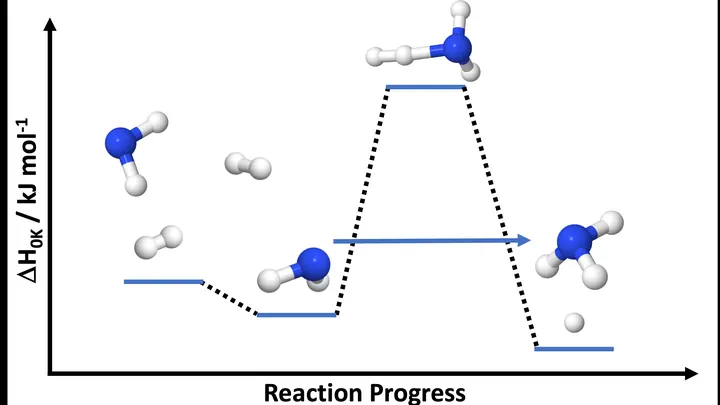
Inside the steel of a future fusion reactor, tiny helium bubbles form, and on their walls a chemical drama unfolds. Chromium and tantalum atoms, like sentinels, take positions at the cavity boundary and change the rules of the game for hydrogen.
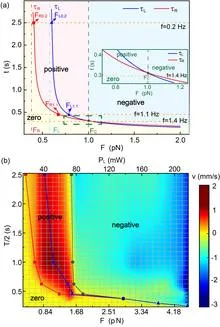
A swing that rocks on a sawtooth hill behaves strangely: without kicks, it gets stuck in the first dip, but with rhythmic pushes it can move uphill, downhill, or stay frozen in place. That is exactly what physicists saw when they placed a single dust grain in a trap with a sawtooth bottom and started pushing it alternately with laser beams.
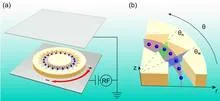
In a ring-shaped channel between two toothed rings, microspheres are suspended: some with a radius of 8 micrometers, others 14. The discharge is switched on, and the particles start moving. The small ones go one way, the large ones the other. It is like a shopping mall where escalators for people of different heights run in opposite directions.
In the dark chamber of the trap, thousands of charged particles dance under electric fields. At first they move freely, like a crowd in a square, but cool the cloud and the dance slows: ions begin to sense each other, their steps become constrained.
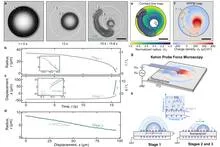
A water droplet on a fluoropolymer film initially behaves as expected: it sits and evaporates. But once it shrinks to a quarter of its initial size, it suddenly takes off and, within fractions of a second, covers a distance several times its own radius. Then it crawls slowly but persistently, leaving behind an invisible trail of electric charges. That trail is what drives the motion.
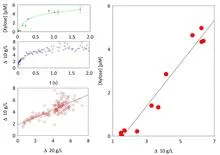
A courier carrying a package enters a dense forest of intertwined ropes. He needs to deliver the cargo deep inside, but along the way he loses strength, and each step becomes harder. This is what an enzyme looks like as it degrades a dense gel of biological molecules. Until recently, no one could simultaneously see how the courier moves and how the forest thins out.
A lake in a drought doesn't dry up all at once. First, islands of dry land appear on the water's surface, they expand and merge, and only then does the water recede from the exposed bed. A mirabilite crystal behaves similarly when it loses water: round patches of anhydrous salt appear on its surface, growing outward and then beginning to deepen.
Picture a long thread trapped inside a sphere with charged walls. The thread is the virus's RNA; the sphere is its protein shell. The thread tries to settle so that its charges sit as close as possible to opposite charges on the wall.
In dark interstellar clouds where new stars are born, chemistry starts with a tiny particle — the trihydrogen ion (H₃⁺). It collides with other atoms and sets off a cascade of reactions that build ever more complex molecules. For a long time, it was thought that the main reaction producing it, H₂⁺ colliding with H₂, only happens in the gas phase.
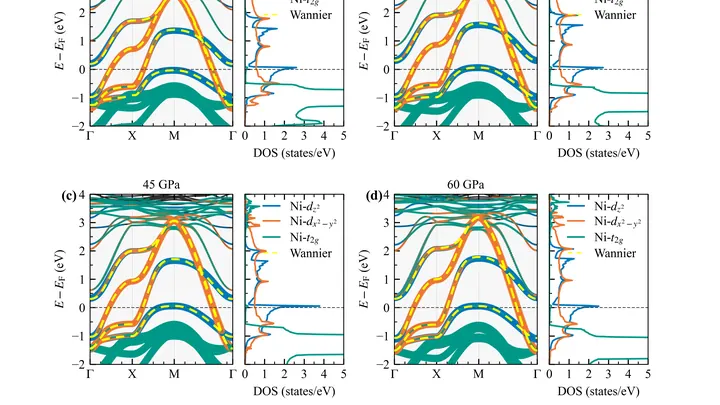
Under pressure, the layered crystal La₃Ni₂O₇ behaves like an orchestra where the conductor adjusts the volume of different instrument sections. Compression increases electron hopping between layers — which, one might think, should boost superconductivity. But at the same time, some electrons become too mobile.
A layered cake where each tier conducts electricity differently: that's the structure of the crystal La3Ni2O7, a compound of nickel, lanthanum, and oxygen. Current flows differently along the layers than across them.
In the vast clouds of rarefied gas that fill the space between stars, something is always churning. Supernova explosions, colliding streams — all of it shakes the plasma. And in this rippling, as it turns out, hides the mechanism that gives birth to magnetic fields.
Plasma is a gas in which electrons are stripped from atoms.
Membraneless organelles, tiny factories inside the cell, defy conventional rules. Take the nucleolus: here ribosomal RNA is synthesized — long chains woven from carbon sugars, rich in oxygen phosphate groups, and stitched with hydrogen bonds, suspended in the watery environment of the nucleus.
When physicists drive electrons through an ultrapure gallium arsenide channel at helium temperatures, they expect to see a well-behaved, almost ideal fluid.
A solid electrolyte is not just a crystal lattice: it’s a bustling metropolis for ions. Each act of conduction resembles a trip through the city: there are wide highways with low energy barriers, gridlocks in bottlenecks, and tricky detours where an ion can get stuck.
An ionic conductor resembles a crowded bus where passengers (ions) try to squeeze toward the exit. Previously, it was thought that fast exit could be achieved either by a gently swaying bus (soft lattice) or by passengers standing in chaotic order (geometric disorder). The new work shows these are not two different tricks but the same one.
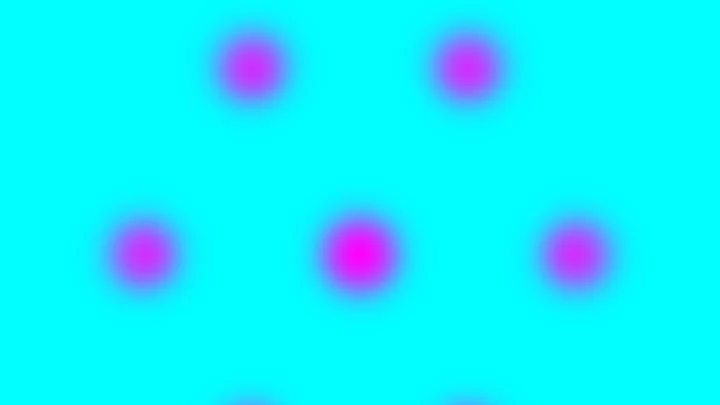
A supersolid is matter that is both crystalline and fluid. It is created from atoms cooled almost to absolute zero. In new work, physicists obtained such a substance as a triangular lattice of droplets. Each droplet oscillates in its own rhythm.
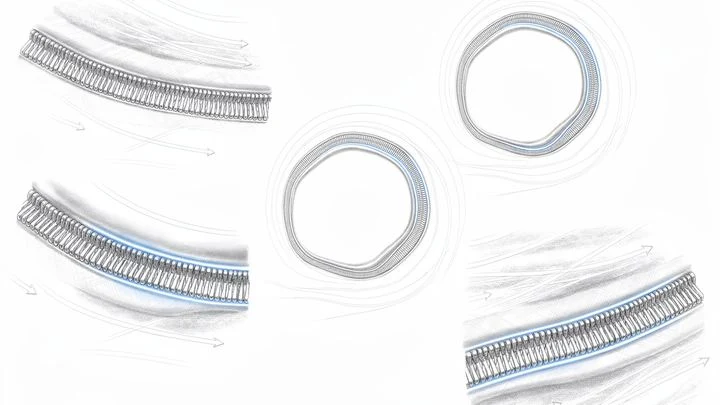
Millions of cilia, thin hairs, work inside the tiny ducts of our bodies. They beat in synchrony, like the oars of a galley, pushing viscous mucus or fluid along. The authors of a new study propose viewing the ciliary carpet as an active porous medium — something like a sponge that squeezes and releases itself, driving water through.
Two grains of salt fall into a glass of water. They dissolve, and sodium and chloride ions spread throughout the volume. The schoolbook truth is simple: like charges repel, opposite charges attract. But recent experiments with tiny spheres in liquids have revealed a picture that breaks this rule.
A drop of thick shampoo falls into water and freezes into a strange rope. A liquid that both flows and springs back is called viscoelastic. In it, tiny particles under ultrasound behave quite differently than in water. Viscoelasticity is a material's ability to both spread like honey and return to shape like rubber.
When you squeeze ketchup out of a bottle, you're battling its stubbornness: it sits still at first, then suddenly shoots out in a blob. That's typical non-Newtonian behavior — resistance to flow changes with how hard you push. But the authors of a new study found a way to almost completely eliminate that resistance.
In a crystal of water and caustic cesium, oxygen and cesium atoms sit in place like beads in a rigid lattice. Hydrogen atoms behave differently: they are like passengers constantly changing seats. In this layered material, each oxygen is linked to three neighbors via hydrogen bridges, forming a honeycomb-like pattern.
River water often swirls into funnels. But in semiconductors, the foundation of microchips, electrons at low temperatures and high purity also turn into a fluid. If you create a circular cavity, vortices appear, just like in a river backwater.
An ordinary phone battery breathes — not with air, but with contact. Inside a solid body, where there are no liquids, lithium presses against the electrolyte (the ion-conducting substance) during charging and pulls away during discharging, like a lung on inhale and exhale. This 'breathing' is not poetry but physics: each cycle creates and destroys the contact points through which current flows.
A ball rolls up a hill, but it doesn't have enough energy, so it rolls back down. That's classical mechanics for you. But in the quantum world, a tiny particle can sometimes pass right through the hill, as if the barrier weren't there. This trick, tunneling, is business as usual for a light atom like hydrogen.
A lithium-ion battery is like a multi-story building where lithium ions live on every floor. When you charge the battery, the ions move from floor to floor, and the whole building warms up a bit. Usually, this heat dissipates evenly, like from underfloor heating. But sometimes one spot gets too hot, and then the whole building can go up in flames.
A piece of magnetite, an ordinary iron stone, behaves strangely. At room temperature, it conducts electricity, but cool it below minus 150 degrees, and its resistance jumps sharply. This jump, discovered back in 1939, physicists could not explain for nearly a century.
A new study offers a solution.
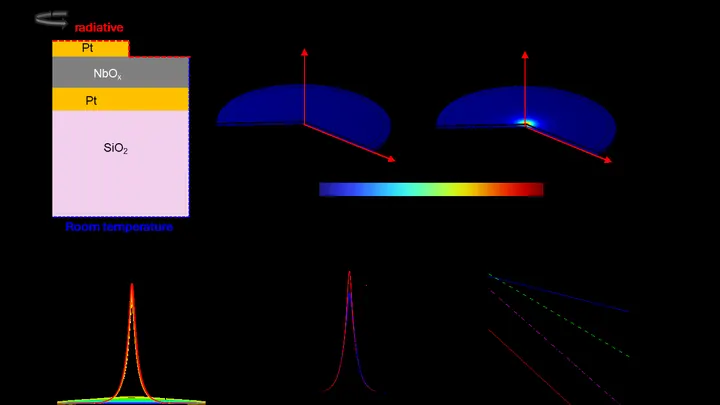
A memristor is a resistor with a memory: after the current is turned off, it retains its resistance. Inside, a thin film of metal oxide is sandwiched between two metal electrodes. When a strong current is first passed through the device, conductive filaments of oxygen vacancies form in the oxide, and the resistance drops sharply.
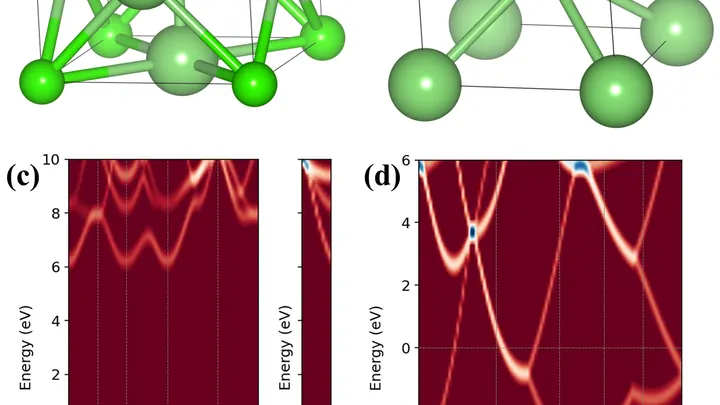
A crystal that promised to conduct electricity without loss at room temperature turned out to be like a house of cards: touch it and it falls apart. Two compounds (one with silver, one with gold) were considered superconductor candidates, but tests showed that neither can withstand even ordinary conditions.
In the silver variant, the lattice simply collapses.
In a thin semiconductor channel, electrons behave not like lone runners but like a crowd at rush hour. They constantly bump into each other, and these collisions determine how easily heat and electric current pass through the material.
A lithium battery is like a sandwich: two slices of bread are the electrodes, and the filling between them is the electrolyte, through which lithium ions shuffle back and forth. In conventional batteries, the filling is liquid, like a sauce, and it can leak or catch fire.
Inside a cell, there are tiny liquid droplets, like oil droplets in water. They form from proteins and RNA and serve all sorts of purposes, from storing molecules to speeding up reactions. But if droplets start merging with each other, you'd end up with one big puddle, which would wreck the cell's organization.
A water molecule, finding itself near a carbon ring, starts to vibrate, and immediately falls under the sway of an invisible conductor. The ring's electron cloud, like a maestro, dampens some vibrations while amplifying others.
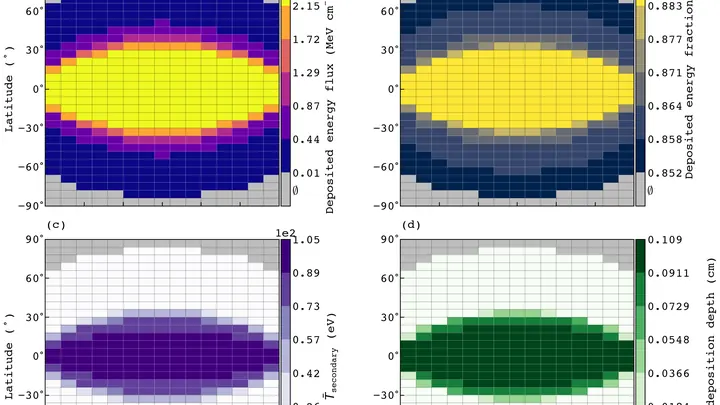
Europa's surface is an icy armor continuously bombarded by charged particles from Jupiter's magnetosphere. Electrons slam into the ice's crystal lattice, lose energy, and kick off chemical reactions. Until now, there was no tool to show how deep such bombardment pierces the ice.
An electron flying through a gas is like a swimmer trying to cross a crowded pool. Each collision with an atom changes its course and speed. In dense argon gas, there are so many collisions that a simple description no longer works.
Physicists measured electron mobility — how easily electrons drift under an electric field.
Plasma is a gas in which electrons are stripped from atoms, behaving like a soup of charged particles. To predict how such a soup flows and heats up, you need to know how particles collide and exchange energy.
Splitting water into hydrogen and oxygen with electricity is an age-old dream of clean fuel. But tiny gas bubbles stand in the way: they cling to the electrodes like foam on the side of a soda glass, interfering with the current's work. Each bubble is a tiny plug, blocking part of the surface where the reaction should occur.
The cell membrane isn't just a wall; it's a turnstile gate. Embedded within it are protein channels that let ions in and out, creating an electric charge, like a battery that powers nerves and muscles.
Beneath Enceladus's icy crust churns an ocean, acting like a perfect heat pump. It pushes heat from the equator to the poles, spending a thousand times less energy than it transports — like a perpetual motion machine built into the moon. The secret lies in salt.
A thin semiconductor layer at low temperatures behaves like a pot of honey: electrons flow not as individual particles but as a thick liquid. If you run an alternating current through such a layer, the resistance responds with a smooth curve.