The enzyme's entropy compass: how information flows toward the active site
Context
Allosteric communication, the way a protein transmits a signal from one region to another, underlies the regulation of enzyme activity. Nearby in the archive are studies linking network topology to dynamics: some analyze entanglement and information flows in complex systems, others apply entropy analysis to climate data, and still others study electron hopping in disordered materials. All of them, like this paper, are looking for universal principles of information transfer in networks. What sets this work apart is that it brings that approach down to the molecular level and tests it on seven real enzymes rather than on model systems.
Methods
The authors used two complementary methods. The first is the dynamical Gaussian network model (dGNM): the protein is reduced to a network of alpha-carbon atoms connected by springs, and entropy transfer from one residue to another is computed from the temporal correlations of fluctuations. The second is information centrality (IC): it relies only on the contact graph (the Kirchhoff matrix) and calculates how well each residue can serve as an information hub, with no temporal dynamics involved. Both methods were applied to seven enzymes: TIM-Barrel, human lysozyme, ribonuclease A1, pepsin, beta-lactamase, human glucokinase, and carbonic anhydrase II.
Results
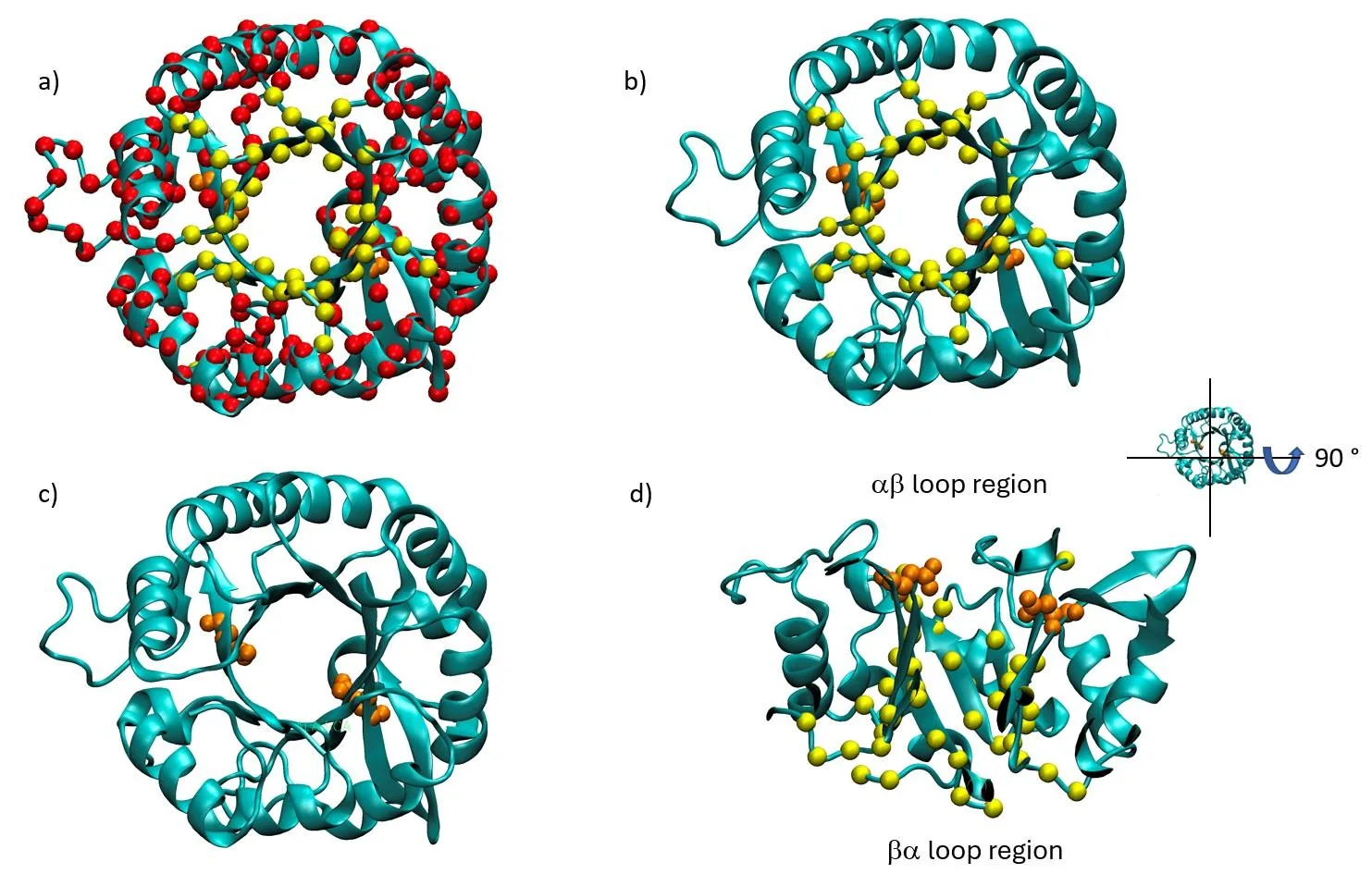
All seven enzymes showed the same gradient: residues at the periphery of the molecule are the best entropy donors, while residues near the catalytic site are the worst. In TIM-Barrel, for instance, 177 of the best donors sit on the outer surface, while 72 of the worst lie in the central region, next to the catalytic residues Asp130 and Asp11. Numerically, this shows up as the total entropy transfer from peripheral nodes to the rest being considerably higher than from nodes near the active center. Comparing the two methods revealed their agreement: information centrality, computed from topology alone, singles out the same residues as dynamical entropy transfer does. This means the direction of information flow is encoded in the structure of the contact network itself, rather than being a mere consequence of dynamics.
Implications
This work differs from neighboring studies in that it applies entropy analysis not to abstract networks or climate data but to concrete biological molecules, and tests the hypothesis on seven different enzymes. Where neighboring papers examine information flows in general terms, this one shows that the topology of the contact graph is enough to predict the direction of allosteric communication. That lowers the computational cost and opens a path to rapid screening of proteins for allosteric properties.
Future development
The topic could develop toward studying how conformational changes during the catalytic cycle affect the entropy flow. It may become possible to link topological measures to specific allosteric events, such as ligand binding. Applying these methods to design new enzymes with tailored regulatory properties also looks promising.
Impact
The results could influence protein engineering and the development of drugs targeting allosteric sites in enzymes.
Next steps
The next step is to check how conformational changes and substrate binding alter the entropy gradient in selected enzymes.
Key open problems
The work connects to an unsolved problem in biochemistry: exactly how the three-dimensional structure of a protein encodes allosteric communication pathways. It shows that the topology of the contact network is enough to determine the direction of flow, but the role of specific dynamical events in the catalytic cycle remains an open question.
TIM-Barrel is one of the most common protein folds in nature: it appears in at least 15 different enzyme families, from bacteria to humans.
Key numbers
- number of enzymes studied: 7
- number of residues in TIM-Barrel: 249
- best entropy donors in TIM-Barrel: 177
- worst entropy donors in TIM-Barrel: 72
- time delay in dGNM: 1.2 ps