Neurotransmitters are chemical messengers that transmit signals between neurons, and from neurons to muscle or gland cells. They are synthesized in the neuron, packaged into vesicles (bubbles), and released into the synaptic cleft in response to an electrical impulse. The molecules diffuse to the postsynaptic membrane and bind to receptors, causing either excitation or inhibition. This process underlies all functions of the nervous system.
History
The concept of chemical transmission arose from Otto Loewi's experiments (1921), which demonstrated humoral transmission in the frog vagus nerve. Later, Henry Dale identified acetylcholine. In the 1950s, the discovery of serotonin, dopamine, and norepinephrine expanded the understanding of synaptic transmission. Current research focuses on the role of neurotransmitters in plasticity, learning, and mental illnesses.
How it works
The process includes: 1) synthesis and loading into vesicles, 2) action potential opening calcium channels, 3) vesicle fusion with the membrane and release of the neurotransmitter, 4) diffusion across the cleft, 5) binding to receptors, 6) postsynaptic response, 7) inactivation. Autoreceptors and reuptake transporters play important roles. Disruptions at any step lead to neurological pathologies.
In practice
Brain function, emotions, movement — everything depends on neurotransmitters; imbalances underlie depression, Parkinson's disease, and other disorders.
Fun fact
Some neurotransmitters, such as oxytocin, act not only in the brain but throughout the body — it stimulates uterine contractions during childbirth and milk ejection, as well as forming the bond between mother and child.
Construction is in full swing: neurons are laying down their processes the way bricklayers stack up walls. But an error has crept into the blueprints. The protein tau, which normally serves as scaffolding for the cellular framework, in its mutant form starts dictating the wrong dimensions.
In a school report card, each grade speaks for itself, but you can only tell how a student is doing overall by looking at the full report. For drugs that act on the brain, such a report card was missing for a long time. Every test on a miniature brain grown in a dish gave its own signal: some genes switched on, others switched off, electrical impulses sometimes sped up and sometimes went quiet.
A plastic film as thin as a hair, and inside it — platinum dots smaller than a millionth of a millimeter. These dots sit at the boundary between two transistor layers and catch electric charge like a sponge catches water. As charge accumulates, the transistor changes its resistance, and remembers that state.
A protein is like a tiny machine that switches on and off on command. The command arrives when another molecule sticks to it, like a key in a lock. The protein then changes shape and passes the signal along. But exactly how the signal travels inside the protein has long been a mystery.
A mail carrier delivers letters along one-way streets. As long as he only drives forward, the route is simple and predictable. But if U-turns are suddenly allowed, he'll start doubling back, crossing his own tracks, and the delivery pattern gets tangled. That's roughly how an infection behaves when people can get sick more than once.
A bell hidden in a thick box can be made to ring without opening the lid. Just send a sound wave through the walls, and the clapper will tremble. That's roughly how transcranial ultrasound works: sound passes through the skull bones and makes neurons deep in the brain 'ring'—generating electrical impulses.
A bell hidden in a thick box can be made to ring without opening the lid. Just send a sound wave through the walls, and the clapper will tremble. That's roughly how transcranial ultrasound works: sound passes through the skull bones and makes neurons deep in the brain 'ring'—generating electrical impulses.
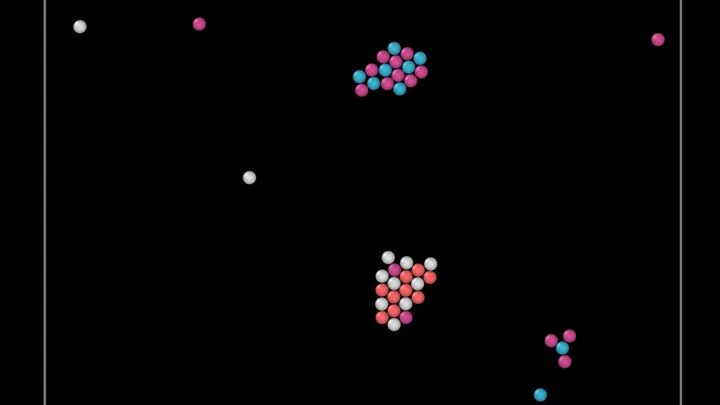
A drop of water on glass trembles and shimmers: it seems to have a life of its own. Similar behavior can now be observed in the world of colloids: tiny particles suspended in a liquid. Researchers simulated particles that emit chemical signals. These signals, like scents in the air, spread around and cause neighbors to either draw closer or move apart.
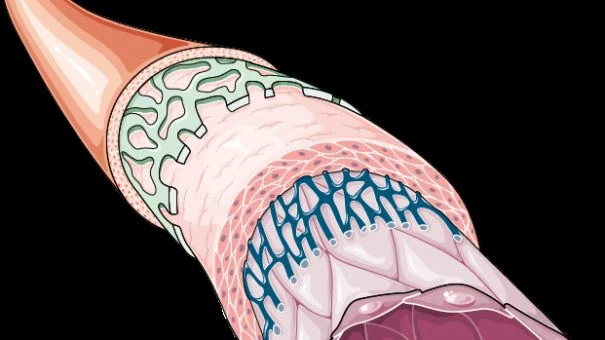
In the long extensions of a neuron, the dendrites, tiny couriers are constantly bustling about. These are messenger RNA molecules carrying instructions for protein assembly. Their journey starts at the cell body and ends at synapses — contacts with other neurons.
In the long extensions of a neuron, the dendrites, tiny couriers are constantly bustling about. These are messenger RNA molecules carrying instructions for protein assembly. Their journey starts at the cell body and ends at synapses — contacts with other neurons.
Inside every cell, logistics is in full swing: tiny protein motors, like couriers, haul cargo along a network of microtubules. One of the main workhorses is kinesin, which steps using the energy of ATP (the cell's main energy currency). For a long time, researchers tried to evaluate it like a car: how much fuel it burns, how fast it gets there.
After a stone is thrown, the circles on water vanish, but the liquid retains microscopic oscillations. The slightest gust, and ripples appear again. Neural networks behave similarly. When electrical signals quiet down, the memory of them remains in the contact points — synapses.
Inside each of us, invisible clocks are ticking. They control the release of cortisol — the hormone that helps us wake up in the morning, cope with anxiety, and keep our immune system on its toes. In adrenal insufficiency, these clocks break down: the body can't produce the right amount of cortisol on its own.
Studying distant exoplanets, scientists look for signs of life — for instance, water and carbon — and signs of technology: radio signals, megastructures. But between these clues there is a yawning gap. If intelligence hasn't created machines or they've vanished, we won't notice it.
A grand symphony orchestra plays, but each group of instruments follows its own score without hearing the others. The violins carry the melody of the heart, the cellos the rhythm of the liver, and the woodwinds the pulse of the brain. It sounds disjointed, even though each part is flawless on its own.
Molecules float in a test tube. Their abundance (say, the concentration of some protein) becomes the input signal. And the output isn't just a cloudy solution but a clear yes-or-no answer.
The authors build a chemical cascade that does exactly that.
Imagine a huge garage with hundreds of parking spots. You're driving a tiny car, a future drug molecule, and you want to find the one free bay where it fits perfectly. But these bays aren't concrete; they're woven from DNA or RNA chains, and no one has posted the parking rules.
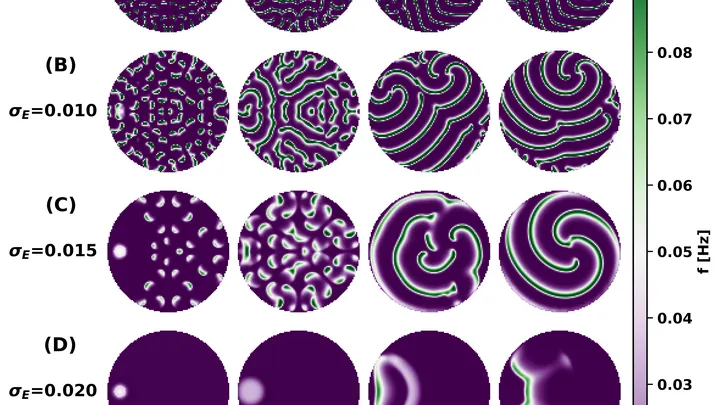
A neuron that has just calmed down is like a pianist lifting their hands from the keys. But inside, silent work continues: tiny pumps push chloride ions outward, returning the instrument to a state of readiness. If the pumps fall behind, chloride builds up, and then an inhibitory signal meant to quiet the cell suddenly starts exciting it.
In a molecule resembling chlorophyll and built from carbon, a metal atom at the center acts as a toggle. Shifting it by fractions of a nanometer can make the molecule glow, quench, or boost its brightness a hundredfold.
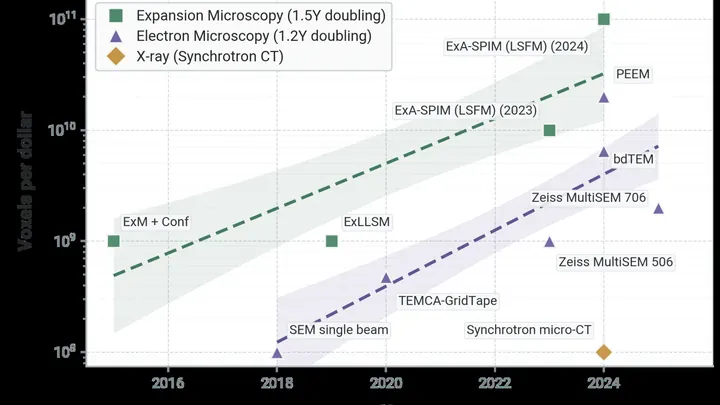
Modern microscopes see the brain in exquisite detail: not just the synapses themselves, the contact points between neurons, but also the molecules they are made of. Such images are becoming more common and cheaper to produce.
A neuron in the brain is like a person handing out business cards at a crowded conference. At first, making acquaintances is easy, but as the address book fills up, each new contact requires more effort: there's little room left. The authors based their model on this 'crowding' rule: the more incoming connections a neuron already has, the harder it is to form another one.
A medicinal chemist is like a detective searching for the right compound among millions of suspects. Modern neural networks speed up the search but behave like a witness who says "it's him" and refuses to elaborate. In pharma, such secrecy is dangerous: a spurious correlation could send a toxic compound to the next stage of trials.
The brain is like a sprawling city: districts-regions communicate via streets-neural pathways. If traffic lights at an intersection fail, traffic grinds to a halt. Similarly, in the brain, when bundles of nerve fibers (white matter) malfunction, distant regions stop working in concert, and thought stalls.
Fluid flows in the narrow gaps between brain cells. It doesn't stay still: each heartbeat pushes it forward, and breathing adds its own waves. This was seen in images ten years ago, but only now have researchers calculated how this pulsing accelerates molecules.
If you drop ink into a stream, it drifts with the current. But if the stream speeds up and slows down, the ink spreads wider.
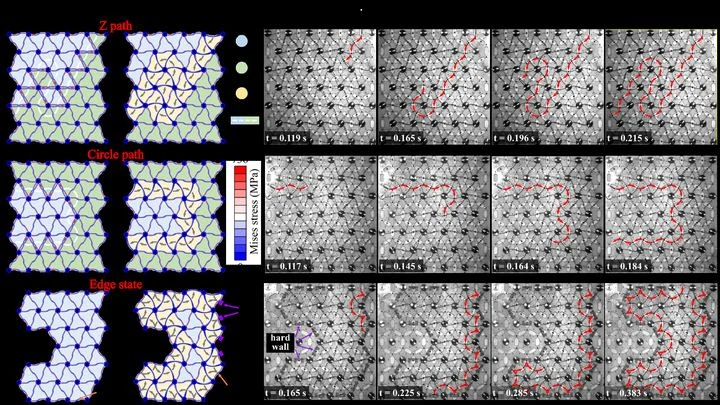
The popping lid of a jam jar is the hero of this story. Press it, and with a loud click it flips from a convex to a concave shape. Exactly the same happens with a hinged beam inside each cell of a new mechanical lattice.
Scientists assembled these snapping beams into a hexagonal grid, like honeycomb, but made of elastic plates. When one beam is sharply compressed, it snaps and pushes its neighbor.
Nitinol is a metal with a memory: compressed into a tiny tube, it springs back into shape inside a vessel and keeps it open. But simply inserting a stent isn't enough: it must not clog with clots. To prevent that, a drug is applied, which should be released slowly, like water from a sponge, not all at once.
In the air of factory floors and laboratories, invisible solvent molecules drift. One of them, acetonitrile, has a faint smell, but at high concentrations it can harm health. Typical sensors for it are bulky and expensive, but here we have a thin crystalline film that responds on its own to the presence of vapor.
Ordinary light is a stream of independent particles: photons fly through each other without noticing their neighbors. But in superconducting circuits cooled to near absolute zero, the situation changes. There, photons travel along narrow metal tracks, and if tiny elements called Josephson junctions are embedded in these tracks, light begins to 'feel' itself.
A bacterium in a drop of water doesn't just swim: it probes the space around it, decides where to turn, and finds its way out of a tangled maze. Artificial microscopic swimmers haven't been able to do that until now: they had to be led by the hand, with signals sent from outside.